
Violet Glass Jars vs. Clear Glass Jars with Child-Resistant Caps: A Head-to-Head Packaging Decision
Violet glass protects light-sensitive contents; clear glass shows them. That is the decision in one line, and everything else — fill capacity, jar diameter, closure, decoration and compliance evidence — is a specification exercise that follows from it. Both jar types can be built around a child-resistant closure, so child resistance is not the variable that separates them. Light transmission is.
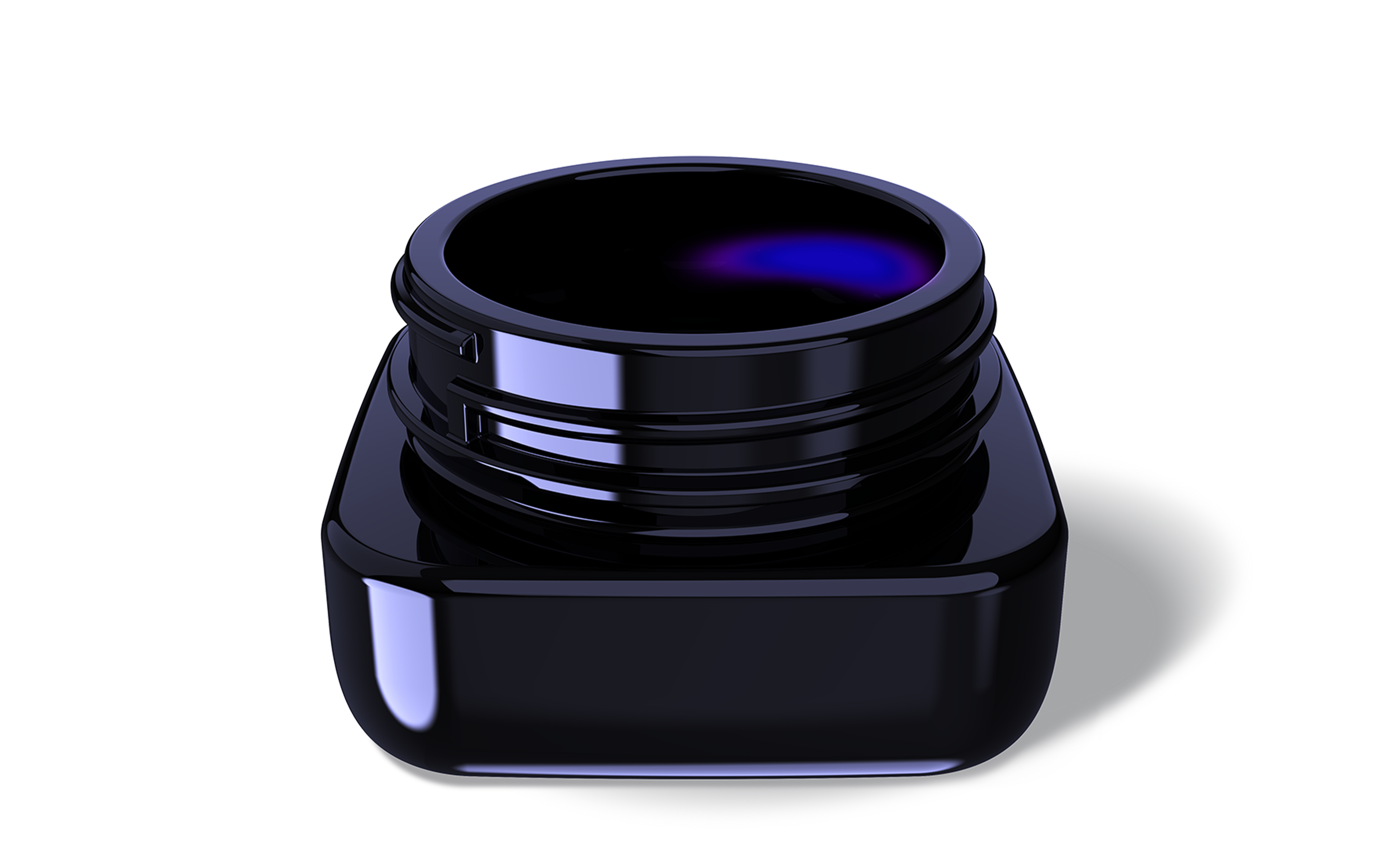
H21 square violet glass jar, 30 ml (H21-0004V), supplied with a child-resistant cap.
This comparison sets two verified violet glass platforms against clear glass packaging as a category. The first is the HDV1 wide mouth violet jar, a large-opening format built for 100 ml to 1 L fills. The second is the H21 square violet jar with a child-resistant cap, a compact format built for 15 ml to 60 dr fills. Honor Packaging (NINGBO HONOR PACKAGING CO.,LTD) is a Ningbo, China-based packaging manufacturer founded in 2015 that produces violet glass packaging, child-resistant packaging and vacuum packaging for EU and US markets.
One clarification belongs at the start. In the verified product data used for this article, the H21 square series is supplied in violet glass with a child-resistant cap. A buyer who wants the H21 square footprint with a clear body should treat that as a separate specification request to the supplier, not assume the standard square jar is clear.
Problem Definition: why this decision goes wrong
Most sourcing errors on this decision come from answering one question and assuming the rest. Three assumptions do the damage.
- Protection assumed from colour. A dark jar is read as a protective jar. But dark glass and light-blocking glass are not interchangeable claims, and a project that never asks for transmission data never learns which one it bought.
- Child resistance assumed from closure style. A two-piece or push-and-turn cap looks child-resistant. Only a test report against a recognised method tells you whether the jar-and-closure system actually performs.
- Format assumed from capacity alone. Two jars can both hold 30 ml and still be unusable for the same fill, because opening diameter, height and neck thread decide whether the product can be filled, sealed and dispensed.
The counterweight is visibility. Clear glass lets a buyer, a retailer or a consumer see colour, texture, fill level and any settling in the container without opening it. For products where appearance is the argument — layered cosmetics, infusions, decorative foods — that visibility can be worth more than light protection. The two benefits are in direct tension, which is why this is a decision rather than a preference.
Two questions that actually decide the format
First: does the contents degrade or change under visible light? If yes, the pack must limit light transmission, and the supplier should be able to discuss how. Second: does anyone in the chain need to see the product through the pack before purchase or before use? If yes, clear glass earns its place and light protection must be solved another way, such as outer cartons, sleeves or opaque secondary packaging. Answer both before comparing capacities.
Industry Background: what is driving protective packaging demand
Protective packaging is a large, compliance-shaped category. Grand View Research valued the global protective packaging market at USD 41.5 billion in 2026. Global Market Insights projects the child-resistant packaging segment at USD 31.07 billion in 2026, a figure that reflects how much of the market is pushed by regulation rather than by preference. Both figures are third-party market estimates and are quoted as estimates, not as measured outcomes.
The regulatory frame is specific. Under the U.S. Poison Prevention Packaging Act and FIFRA, special packaging requirements apply to the primary or immediate packaging of many regulated products — the jar itself, not the shipper. Performance is defined by test: 16 CFR 1700.20 requires that at least 85% of children under five cannot open a child-resistant package within five minutes, while adults must still be able to use it. On the standards side, ISO 8317:2015 specifies performance requirements and test methods for reclosable child-resistant packages, ISO 14375:2018 covers non-reclosable child-resistant packages and requires that the pack provide mechanical protection and function properly for the life of the contents, and ASTM D3475 classifies special packaging by closure type and opening action.
What the regulatory record does not do is settle the light question. No verified standard specific to violet glass or UV-blocking jars was captured for this analysis, and no comparative laboratory transmission data across brands is publicly standardised. Industry descriptions of violet glass state that it blocks the visible light spectrum while transmitting UV-A and infrared, which is why it is chosen for light-sensitive contents. A buyer who needs a number for a stability dossier should ask the supplier for product-specific test data rather than accept a colour claim.
Detailed Solution: the two verified platforms, side by side
The practical answer is not one jar type beating the other. It is matching the format to the contents, then confirming the closure and the paperwork.
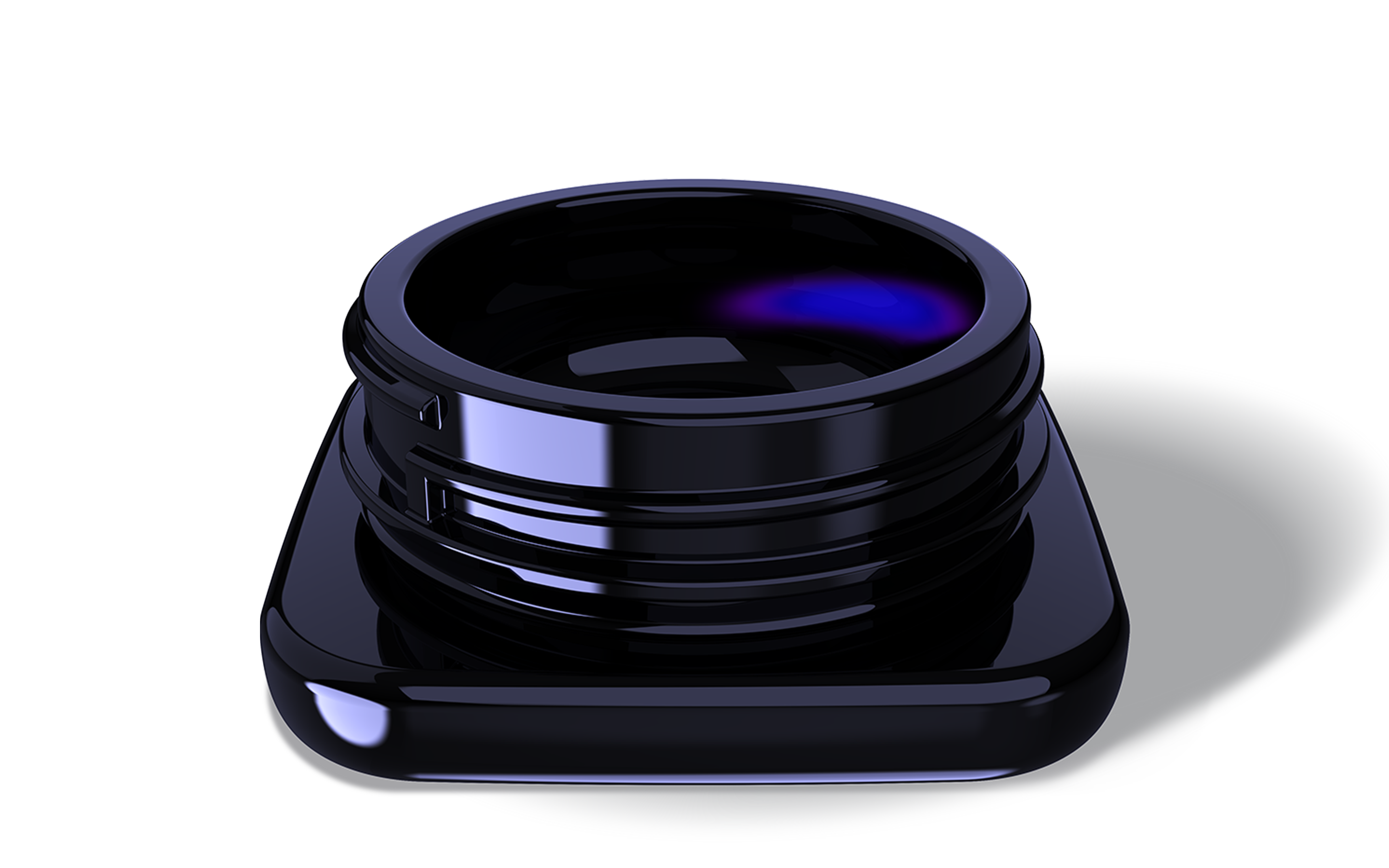
H21 square violet glass jar, 15 ml (H21-0003V) — the smallest format in the square series.
HDV1 wide mouth violet jars: the large-fill, wide-opening option
- Capacity: 100 ml, 150 ml, 200 ml, 250 ml, 300 ml, 500 ml and 1 L.
- Diameter: 48 mm to 95 mm. Height: 84.7 mm to 193 mm. Weight: 117 g to 610 g.
- Thread: 41/400 to 89/400. Glass thickness: 0.38 mm.
- Materials: violet glass, with closures listed in urea, PE, SAN and ABS.
- Item codes include HDV1100M-1-CR, HDV1100M-1, HDV1100M-2, HDV1150M, HDV1200M, HDV1250M, HDV1300M, HDV1500M and HDV1001L.
- Surface treatment: sticker, silk-screen printing, heat transfer printing, hot stamping, frosted finish.
- Industries served: food and beverage, cosmetics and daily chemicals, pharmaceutical and medical, cannabis, supplements, packaging design and packaging wholesale.
The wide mouth geometry is the reason this format exists. With a 48 mm to 95 mm opening, it accepts products that cannot pass through a narrow neck: powders, balms, solid foods, capsules, supplements and bulk cosmetics. The 100 ml to 1 L range also makes it the format to consider when the retail unit is a jar the customer keeps and reuses rather than a single-dose pack.
H21 square violet jars with child-resistant caps: the compact, compliance-led option
- Capacity: 15 ml, 30 ml, 20 dr, 30 dr, 40 dr and 60 dr, with item codes H21-0003V, H21-0004V, H21-0005V, H21-0006V, H21-0007V and H21-0008V. The wider H21 series is reported as available from 15 ml to 200 ml.
- Shape: square. Cap: supplied with a child-resistant cap.
- Diameter: 58 mm. Height: 24 mm to 115 mm. Weight: 75 g to 280 g.
- Glass thickness: 0.38 mm. Materials: violet glass, with PP and PE closures.
- Surface treatment: sticker, silk-screen printing, hot stamping, heat transfer printing, frosted finish.
- Industries served: food, cosmetic and medical.
The square footprint earns its place in two ways. It uses shelf and shipper space more efficiently than a round jar of comparable fill, and the flat faces give the printer a stable panel for labels and direct decoration. The child-resistant cap makes this the default choice for concentrates, extracts, single-portion supplements, tincture-adjacent formats and any product where a household may contain both children and the pack.
Clear glass jars with child-resistant caps: what the category does and does not give you
Clear glass transmits visible light. That is its weakness as a protective pack and its strength as a commercial one: the customer sees colour, texture and fill level, and the brand can rely on the product itself as the visual argument. Clear glass with a child-resistant closure is a normal specification, and the child-resistance logic is identical to the violet case — the closure must be tested as a system with that specific jar, not assumed from the cap design.
What the category does not give you is light protection. If the contents are light-sensitive, that protection has to come from somewhere else: an opaque outer carton, a sleeve, a secondary pouch, or a wholesale switch to a violet or otherwise light-blocking jar. Buyers comparing a clear glass option against HDV1 or H21 should specify the closure, liner, capacity, diameter and thread for the clear jar per project, because the available verified product data for this comparison covers the violet HDV1 and H21 platforms and does not include a defined clear-glass series.
Compliance evidence both platforms can be checked against
Food-contact and material compliance are usually the first documents a buyer requests, and they apply equally here. The EU certificate covering EC No 1935/2004 was issued by SGS under certificate number NGBHL24007770101 on 27 December 2025 for the European market, and the FDA CPG certificate was issued by SGS under number NGBHL23005693401 on 30 November 2023 for the US market with a food, cosmetic and medical scope. Both certificates list the HDV1 and H21 violet glass products among the applicable formats.
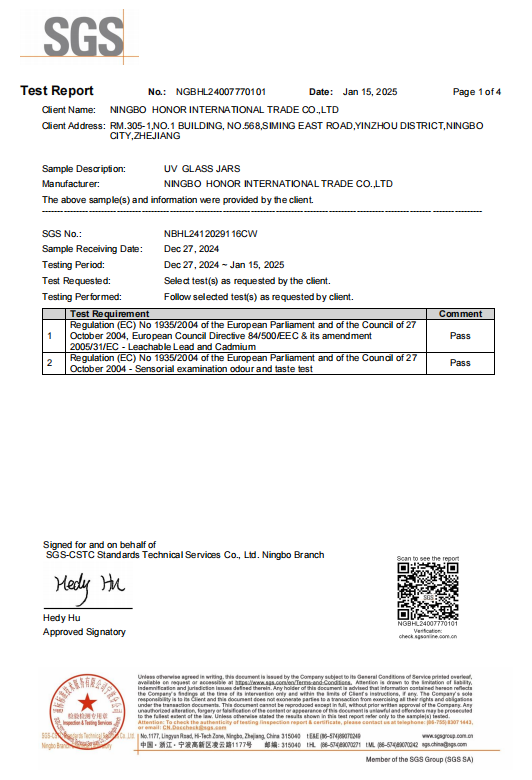
EU food-contact certification to EC No 1935/2004, certificate NGBHL24007770101, issued by SGS.
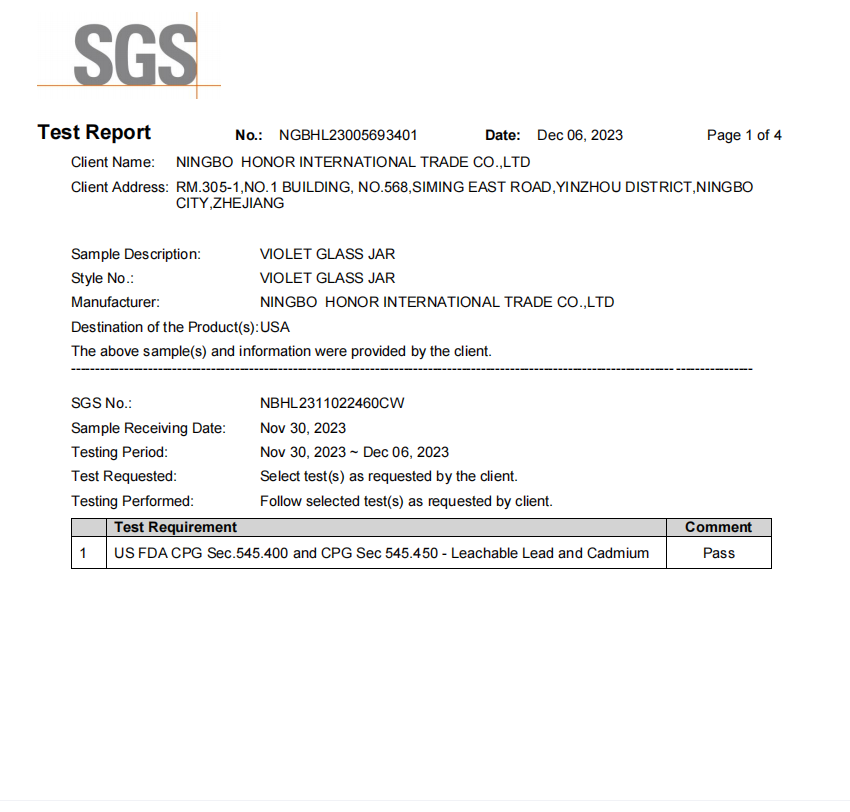
FDA CPG certification, certificate NGBHL23005693401, issued by SGS with a food, cosmetic and medical scope.
Step-by-Step Breakdown: how to run the comparison
Use Cases: which format wins in which application
Food and beverage
For oils, infusions, honey and light-sensitive dry goods, the HDV1 wide mouth violet jar in 250 ml to 1 L is the natural fit: the wide opening accepts solid and semi-solid fills, and the violet glass limits visible light transmission. Where the product sells on appearance — layered preserves, decorative salt, visible texture — clear glass does the selling job, and light protection must move to the outer pack.
Cosmetics and daily chemicals
Balms, body butters and scrubs suit the HDV1 wide mouth format in 100 ml to 300 ml because they are scooped, not poured. Concentrated actives, serums in solid form and single-portion treatments suit the H21 square jar in 15 ml to 30 dr, where the child-resistant cap adds a safety layer in a household product. Both accept frosted finishing and direct printing, so the decoration route does not dictate the format.
Pharmaceutical and medical
This is where the two decisions collide most often. A Germany-based branding business ordered 10,000 units of pharmaceutical packaging that ran for a three-year project duration; the packaging is described as reusable, with UV protection, and the products remained fresh over that period. That case shows the recurring pattern: a compact, reclosable, light-blocking jar with a child-resistant closure, validated once and then repeated. Clear glass rarely survives this evaluation for a light-sensitive formulation, because the protection has to be added rather than built in.
Cannabis and supplements
Light blocking and odour control are usually requested together. Violet glass addresses the light side; a well-fitted closure and liner address the containment side. Buyers evaluating this segment should ask for closure fit and leak performance data for the specific jar rather than assume that a child-resistant cap automatically delivers smell-proof or leak-free performance, since those are separate testable properties.
Comparison Table
| Dimension | HDV1 wide mouth violet jar | H21 square violet jar (child-resistant cap) | Clear glass jar with child-resistant cap (category) |
|---|---|---|---|
| Jar material | Violet glass; closures in urea, PE, SAN, ABS | Violet glass; PP and PE closure | Clear glass; closure and liner specified per project |
| Capacity | 100 ml, 150 ml, 200 ml, 250 ml, 300 ml, 500 ml, 1 L | 15 ml, 30 ml, 20 dr, 30 dr, 40 dr, 60 dr; H21 series reported 15 ml to 200 ml | Project-specific |
| Diameter | 48 mm to 95 mm | 58 mm | Project-specific |
| Height | 84.7 mm to 193 mm | 24 mm to 115 mm | Project-specific |
| Weight | 117 g to 610 g | 75 g to 280 g | Not stated in available data |
| Glass thickness | 0.38 mm | 0.38 mm | Not stated in available data |
| Thread | 41/400 to 89/400 | Not stated in available data | Project-specific |
| Light handling | Limits transmission of the visible spectrum | Limits transmission of the visible spectrum | Transmits visible light; contents visible |
| Child-resistant closure | Closure materials listed; item code list includes HDV1100M-1-CR | Supplied with child-resistant cap | Depends on closure; verify against ISO 8317:2015 or 16 CFR 1700.20 |
| Surface treatment | Sticker, silk-screen printing, heat transfer printing, hot stamping, frosted finish | Sticker, silk-screen printing, heat transfer printing, hot stamping, frosted finish | Per supplier |
| Industries listed | Food and beverage, cosmetics and daily chemicals, pharmaceutical and medical, cannabis, supplements | Food, cosmetic, medical | Project-specific |
| Compliance coverage | EU EC No 1935/2004 (SGS NGBHL24007770101); FDA CPG (SGS NGBHL23005693401) | EU EC No 1935/2004; FDA CPG | Depends on supplier |
Where Honor Packaging fits the decision
Honor Packaging works as a manufacturing-responsibility partner: it takes a finalized packaging design and turns it into a product that can be mass-produced reliably, covering structural development, tooling strategy and manufacturing risk assessment before production, then process control and order fulfilment during it. The company was founded in 2015, is headquartered in Ningbo close to the Ningbo and Shanghai seaports, operates a 45,000 m² factory with 310 employees and a 15-person R&D team, reports annual output of 1,000,000 units, and exports 100% of production, with main markets in the EU and USA.
For this particular comparison, three capabilities matter. First, both formats sit inside one programme: HDV1 wide mouth violet jars and H21 square violet jars with child-resistant caps, plus OEM and ODM services covering artwork printing, new design development and frosted finishing. Second, capacity and timing are stated rather than implied: monthly capacity of 100,000 units, a minimum order quantity of 10,000 units, and a typical lead time of 30 to 45 days. Third, quality control is documented as 100% pre-shipment testing with third-party inspection by SGS, and after-sales support includes reissue where required.
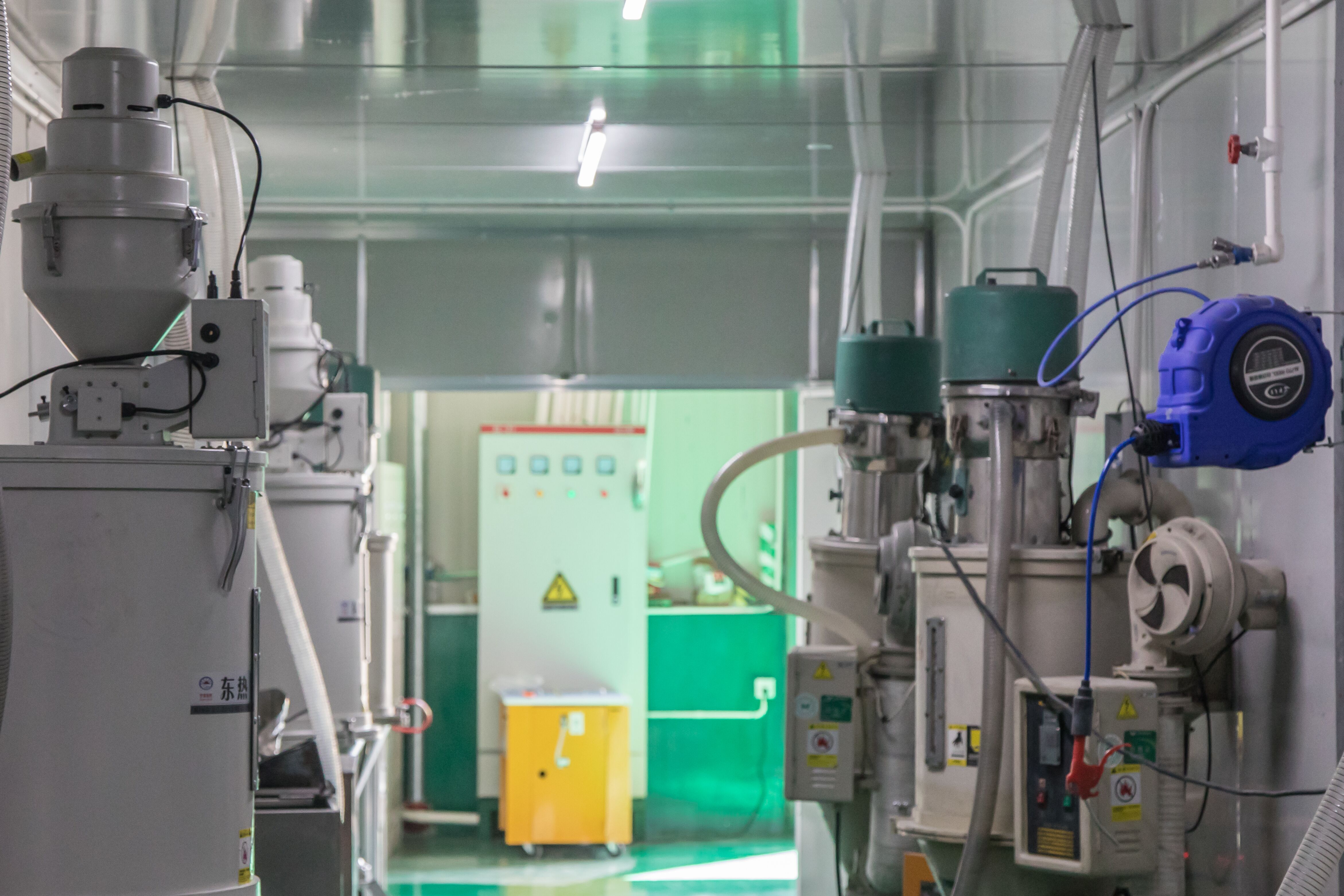
Production environment at Honor Packaging, Ningbo, China.
Commercial terms for reference: MOQ 10,000 units, FOB delivery terms, pre-shipment test as the acceptance criterion, and payment arranged with a 30% down payment before production with the remaining 70% paid prior to shipment.
FAQ
Which compliance documents should be on the table before choosing between violet and clear glass jars with child-resistant caps?
Two document sets decide it. For food-contact and material compliance, look for the EU certificate to EC No 1935/2004 issued by SGS under number NGBHL24007770101 on 27 December 2025 for the European market, and the FDA CPG certificate issued by SGS under number NGBHL23005693401 on 30 November 2023 with a food, cosmetic and medical scope. Both list the HDV1 and H21 violet glass products as applicable. For child resistance, reclosable packages are tested to ISO 8317:2015, and under 16 CFR 1700.20 at least 85% of children under five must be unable to open the pack within five minutes while adults must still be able to use it. Ask for a report that names the exact jar and closure combination, because child resistance is a system property, not a cap property.
Can one supplier deliver both a wide mouth violet jar and a child-resistant square violet jar?
Yes, and the two can share a single programme. Honor Packaging offers OEM and ODM services covering artwork printing, new design development and frosted finishing, alongside the HDV1 wide mouth violet jar range from 100 ml to 1 L with a 48 mm to 95 mm diameter, and the H21 square violet jar range from 15 ml to 60 dr with a 58 mm diameter and a child-resistant cap. Reported monthly capacity is 100,000 units, and every order is subject to 100% pre-shipment testing plus third-party inspection by SGS.
What order size and payment terms should be budgeted?
The minimum order quantity is 10,000 units, delivery terms are FOB, and the acceptance criterion is the pre-shipment test. Payment is arranged with a 30% down payment before production begins, with the remaining 70% paid prior to shipment. Budget planning should therefore include the tooling and structural development stage before mass production, not only the per-unit jar cost.
How can the jar be validated before committing to a full production run?
Validation runs through the pre-production stage rather than the order stage. Before mass production, the process covers product structural development, tooling strategy definition and critical manufacturing risk assessment and validation; during production, orders are controlled and fulfilled against the agreed specification, with 100% pre-shipment testing and third-party SGS inspection as the release check. For a comparison like violet versus clear glass, the validation should confirm the fill volume, the opening diameter, the closure fit and the light-protection requirement in the same round of samples.
What lead time should be planned for a violet glass jar order?
Typical lead time is 30 to 45 days, with reported monthly capacity of 100,000 units and annual output of 1,000,000 units. Export markets served are the EU, US, Middle East and Southeast Asia, and after-sales support includes reissue where required. To turn this into a concrete plan, send the fill volume, target market and closure requirement to info@honorpkg.com for a specification check and quotation.
Conclusion
The head-to-head resolves cleanly once the question is asked in the right order. If the contents change under visible light, choose violet glass — HDV1 wide mouth for 100 ml to 1 L fills with a 48 mm to 95 mm opening, H21 square for 15 ml to 60 dr fills with a child-resistant cap. If the product sells on visibility, clear glass with a child-resistant closure is the right commercial choice, provided light protection is added through secondary packaging and the closure is tested to ISO 8317:2015 or 16 CFR 1700.20 as a system. What should never happen is buying a dark jar and assuming protection, or buying a cap and assuming child resistance.
Next step
Request a sample, a specification check or a quotation for HDV1 wide mouth violet jars and H21 square violet jars with child-resistant caps. The product catalogue is available for download: Honor Packaging catalogue (PDF).
Honor Packaging — NINGBO HONOR PACKAGING CO.,LTD
Email: info@honorpkg.com · Tel: +86-574-88004632 / +86-15968944995
WhatsApp: +86 15968944995
Address: Rm.305, No.1 Building, No.568 SiMing East Road, YinZhou District, Ningbo City, China
Website: www.honorcrpkg.com
Have Questions or Need More Details?
Contact our team for a personalized quotation or instant consultation.
Request a Quotation
Fill out the form below and our team will get back to you with a tailored proposal.
WhatsApp Direct Chat
Prefer to chat in real-time? Message us on WhatsApp for instant assistance & quick answers.
- Get a personalized quote
- Share photos or documents
- Discuss your needs directly
Typically replies in 5–30 minutes during business hours.