
Solving Light Exposure in Supplement Packaging: UV-Blocking Jars
Light exposure is the one packaging risk that never shows up on an incoming inspection report. A jar that has spent months under retail lighting looks exactly like one that has not, right up until the product inside is opened. For formulas built on oils, resins and botanical extracts, the container is the only part of the protection system that travels with the product from the filling line to the end user, which is why violet glass is so often the format buyers specify first when light sensitivity is on the risk list. This article deals with that specific problem and one specific answer: UV-blocking violet glass jars and bottles. It covers what light exposure does to sensitive formulas, why light protection has moved from a marketing talking point into a procurement criterion, which violet glass formats fit which product types, and how to validate a jar specification before committing to a production run.
The Problem: Light Exposure Is a Silent Failure Mode
A light-related packaging failure is rarely detected where it happens. It happens gradually: during ocean transit, in a distributor warehouse, on a shelf under continuous store lighting, or on a bathroom counter. Nothing about the container itself signals a problem, so the failure surfaces later in the form of inconsistent appearance, separation, or a customer complaint that is difficult to trace back to its cause.
Three characteristics make light exposure unusually difficult to manage in supplement packaging.
- It is continuous. Light stress does not stop after filling. Every hour of storage, transport and display adds to the cumulative exposure the product receives.
- It is invisible at goods-in. Standard receiving checks confirm count, damage and label accuracy. They do not confirm that the contents were protected from light during the previous months.
- It is asymmetric in cost. The value at risk is the finished, filled, labelled and often already-shipped batch, not the empty container.
Light-sensitive fill types tend to share a profile: liquid resin, oil-based drops and blends, botanical extracts, and powders built from plant material. These are also the formats where a brand has usually invested the most in sourcing and formulation, which makes the container the last place to look for a saving and the first place to look for protection.
The practical conclusion is that light protection has to be solved structurally. It cannot be solved by labelling, by secondary cartons alone, or by shortening the shelf-life assumption. It has to be built into the primary container, and the closure, liner and headspace that go with it.
Industry Background: Protection Has Become a Procurement Criterion
Supplement packaging stopped being a generic purchase some time ago. It is now a category that buyers research, specify and audit on its own terms, and the market data reflects that scale. The global supplements and nutrition packaging market was estimated at USD 31.3 billion in 2025 (Grand View Research).
Material choice is the core of that decision. Plastic remains the dominant material in supplement packaging, holding approximately 41.67% of the material segment share in 2025. That matters for how a glass specification should be read: choosing violet glass is a deliberate move away from the default material, made for a defined reason such as light protection, brand positioning, or both.
Demand pressure is coming from premium, light-sensitive segments. The Shilajit market is expected to reach USD 221.4 million in 2026, with liquid resin accounting for 40.5% of that share. Resin is a format where presentation, viscosity and light sensitivity all point in the same direction, toward a glass container rather than a flexible pouch.
Regulation is moving in parallel. EU Regulation 2024/3190 bans the use of Bisphenol A (BPA) in food contact materials, including supplement packaging coatings, with the requirements applying to single-use items from 20 July 2026. Buyers specifying closures, liners and coatings now need to confirm BPA status against that timeline rather than assume historical approvals still apply.
Closure features follow a different logic. For dietary supplements in the United States, tamper-evident packaging is not generally mandated at the federal level in the same way as it is for many over-the-counter drugs. That means child-resistant and tamper-evident features are frequently specified as a commercial and risk-management decision by the brand, not as a legal minimum — which makes them a specification item to be stated explicitly during sourcing.
The Solution: Violet Glass as a Light Filter
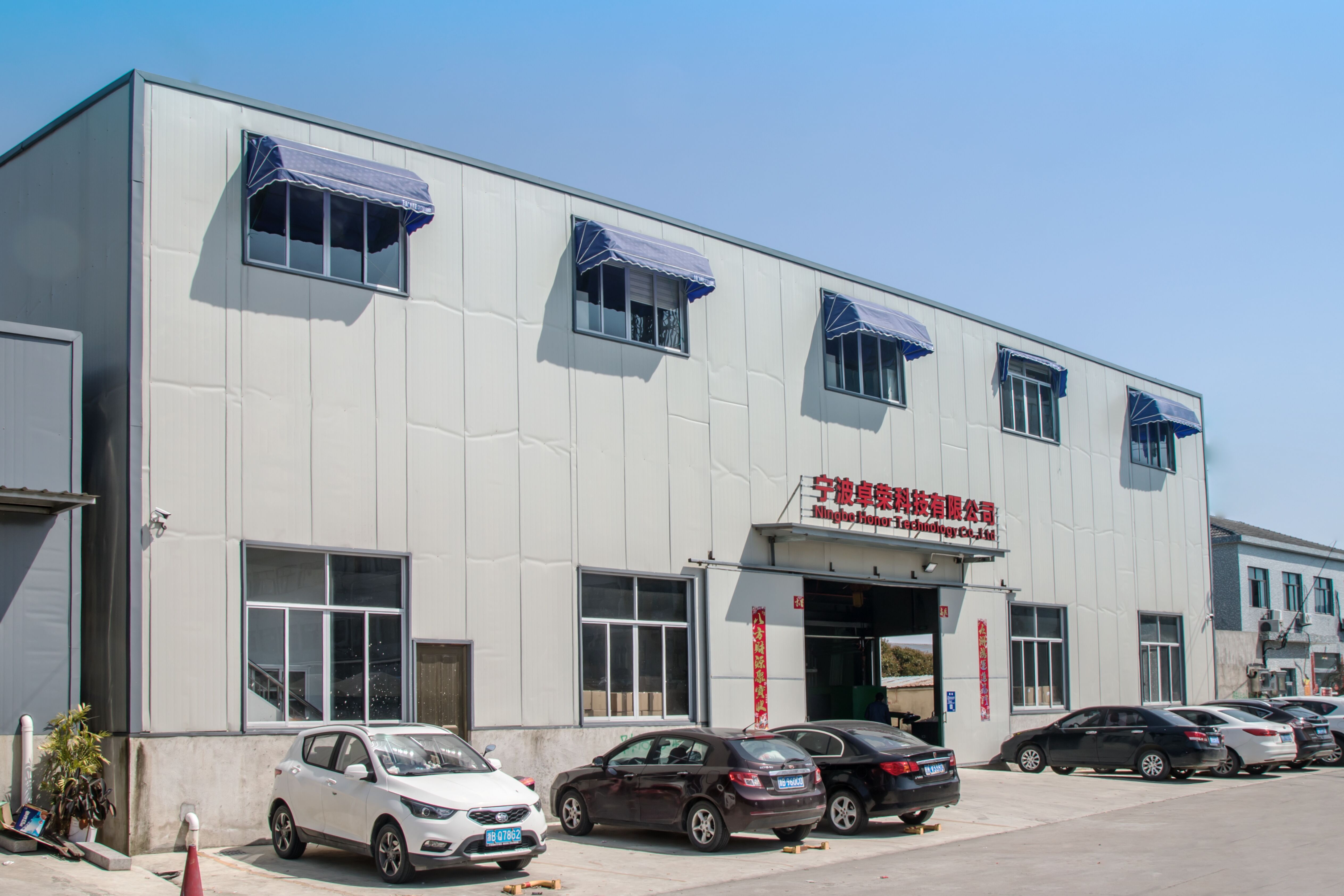
The most direct answer to light exposure in supplement packaging is a primary container made from violet glass, specified as a UV-light filter rather than as decoration. Ningbo Honor Packaging Co., Ltd. (Honor Packaging), a Ningbo-based packaging manufacturer founded in 2015 and exporting 100% of its output to the EU and USA, builds its violet glass range around that single function, with wide-mouth jars, cosmetic jars, dropper bottles and child-resistant jars sharing the same material logic.
The range is organised by fill type rather than by capacity alone, which is the practical way to shortlist a format.
HDV1 Wide-Mouth Violet Jars: Bulk Fills and Wide Aperture
HDV1 is the wide-mouth violet jar family, built for fill types that need a large opening for filling, scooping or decanting. Available capacities are 100ml, 150ml, 200ml, 250ml, 300ml, 500ml and 1L, with item codes including HDV1100M-1-CR, HDV1100M-1, HDV1100M-2, HDV1150M, HDV1200M, HDV1250M, HDV1300M, HDV1500M and HDV1001L. Thread sizes run from 41/400 to 89/400, diameters from 48mm to 95mm, heights from 84.7mm to 193mm, and weights from 117g to 610g. Glass thickness is 0.38mm, and the material combination is violet glass with Urea, PE, SAN or ABS depending on the closure system. Surface treatments include sticker, silk-screen printing, heat transfer printing, hot stamping and frosted finish.
HDV3 Round Violet Glass Bottle: Oils, Droppers and Measured Doses
HDV3 is a round violet glass bottle designed for oil-based and liquid formats where the dose is measured rather than scooped. Available capacities for HDV3 range from 5ml to 100ml, height from 54.5mm to 125mm, net weight from 22.5g to 120g, covering item numbers HDV3005M, HDV3010M, HDV3015M, HDV3020M, HDV3030M, HDV3050M, HDV3060M and HDV3100M. The material set is violet glass with PP, and closure options include plastic cap, dropper, mist sprayer and lotion pump. Decoration options are label, silk-screen printing and gold stamping.
H21 Round and Square Violet Glass Jars: Child-Resistant Options
H21 covers two jar shapes in violet glass, both supplied with a child-resistant cap. The round version uses item codes H21-0012V through H21-0018V, with capacities of 30ml, 2oz, 20dr, 30dr, 40dr, 60dr and 6oz, a 60mm diameter, heights of 36.5mm to 125mm and weights of 84g to 268g. The square version uses item codes H21-0003V through H21-0008V, with capacities of 15ml, 30ml, 20dr, 30dr, 40dr and 60dr, a 58mm diameter, heights of 24mm to 115mm and weights of 75g to 280g. Both shapes use 0.38mm glass thickness and a violet glass, PP and PE material set, with sticker, silk-screen printing, hot stamping, heat transfer printing and frosted finish available as surface treatments.
HDV2 and H19: Cosmetic-Adjacent and Micro-Dose Formats
HDV2 is the cosmetic violet jar family, with capacities from 3ml to 200ml, threads from 32/400 to 89/400, diameters from 36mm to 93.2mm, heights from 25.6mm to 55mm and weights from 36g to 205g in violet glass with Urea and PE. It is used where a supplement brand also runs a cosmetic or food-storage line and wants a consistent violet glass look across both. H19 is a 5ml square glass vacuum click jar supplied at 250 pieces per carton, useful for micro-dose or sample formats where a small, sealed unit is required.
What violet glass does and does not solve: it addresses the light-exposure variable directly. It does not replace moisture, oxygen or tamper protection, which continue to depend on the closure, liner, headspace and sealing method selected for the same jar. Weight also scales with capacity in this range — the wide-mouth HDV1 family runs from 117g to 610g — so protection decisions carry logistics consequences that should be priced in from the start.
Step-by-Step Breakdown: Specifying and Validating a UV-Blocking Jar
- Classify the fill's light sensitivity. Separate resin, oil, extract and powder fills, and note how each one is stored and displayed after filling. Formats sold in open retail lighting carry a different exposure profile from formats sold sealed in secondary packaging.
- Choose the format family. Wide-mouth HDV1 jars suit resin and powder fills that need a large aperture. HDV3 dropper bottles suit oils and measured liquid doses. H21 round and square jars suit formats where a child-resistant cap is a stated brand requirement.
- Fix capacity and headspace. Use the published capacities as the starting constraint: HDV1 from 100ml to 1L, HDV3 from 5ml to 100ml, HDV2 from 3ml to 200ml, H21 round from 30ml to 6oz, H21 square from 15ml to 60dr, H19 at 5ml.
- Select the closure system. Options in the violet glass range include child-resistant caps, plastic caps, droppers, mist sprayers and lotion pumps. Closure selection determines both dose control and the sealing behaviour that light protection ultimately depends on.
- Decide the surface treatment. Sticker, silk-screen printing, heat transfer printing, hot stamping and frosted finish are all available across the range. Decoration should be specified at the same time as the glass, because it affects artwork preparation and tooling timelines.
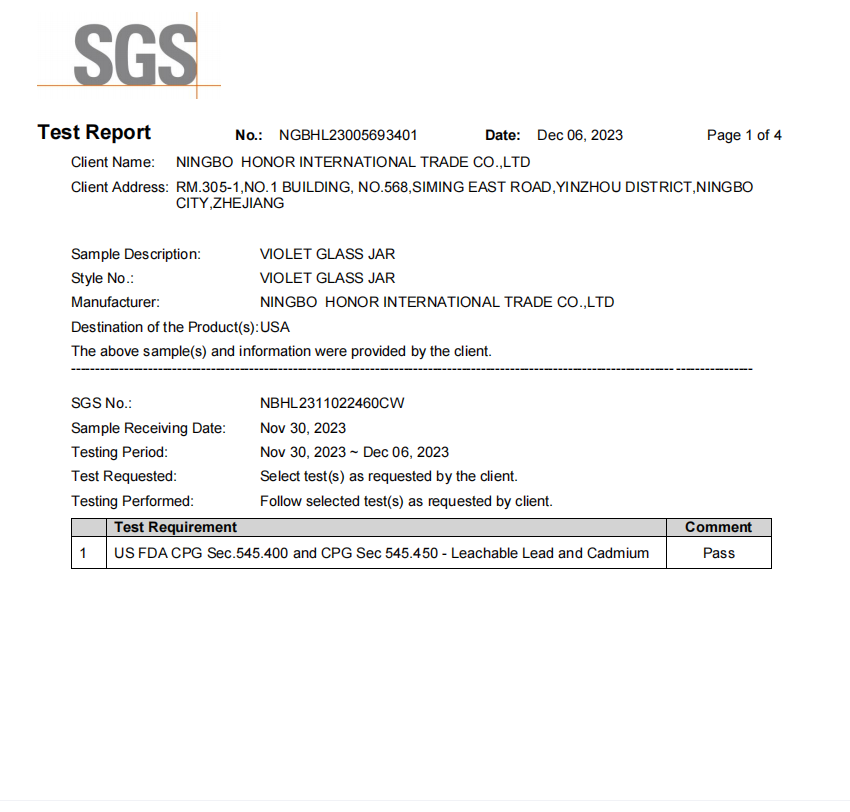
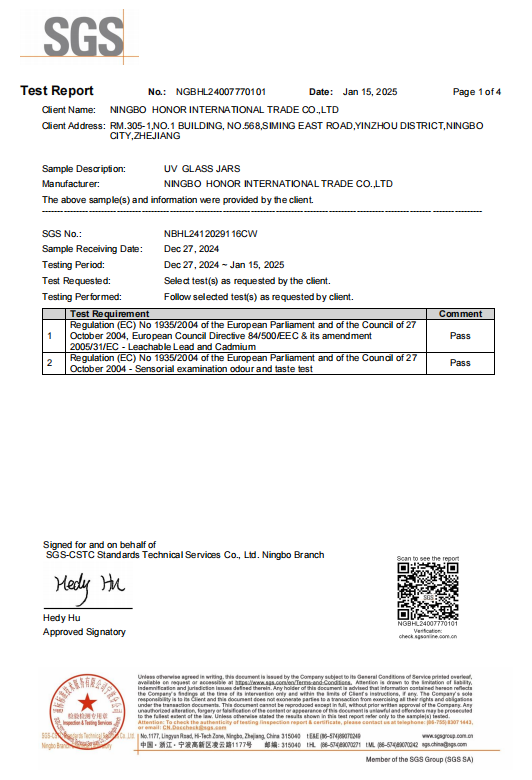
- Verify compliance documentation. Honor Packaging holds EU certification to standard EC No 1935/2004 issued through SGS under certificate number NGBHL24007770101, issued on 2025-12-27, and FDA CPG certification issued through SGS under certificate number NGBHL23005693401, issued on 2023-11-30, with a food, cosmetic and medical scope. Both certificates relate to the violet glass models HDV1, HDV2, HDV3 and H21. Confirm BPA status for closures and coatings against EU Regulation 2024/3190 timelines.
- Validate before the batch. Structural development, tooling strategy and manufacturing risk assessment are handled before mass production, following a sampling and validation stage. Mass production then runs under process control with 100% pre-shipment testing and third-party inspection through SGS. Minimum order quantity is 10,000 units, month capacity is 100,000 units, and lead time is 30 to 45 days.
Use Cases: Matching the Format to the Formula
Shilajit resin. Resin is the highest-visibility light-sensitive format in the current market, representing 40.5% of a Shilajit category expected to reach USD 221.4 million in 2026. Wide-mouth HDV1 jars from 100ml to 1L handle the viscosity and the filling process, while H21 square jars in 15ml to 30dr sizes cover retail and travel formats.
Herbal and botanical extracts. Powders and dried botanical material are usually sold in larger containers. HDV1 jars in 250ml, 300ml and 500ml sizes with silk-screen or frosted decoration are the usual fit, and the violet glass material set supports the natural-positioning look that this segment expects.
Oil-based drops and liquid blends. HDV3 bottles from 5ml to 100ml with a dropper or lotion pump closure are built for measured dosing. Gold stamping and label options allow the brand identity to sit on the bottle without changing the underlying glass specification.
Capsule and softgel packaging with child resistance. H21 round (30ml to 6oz) and H21 square (15ml to 60dr) violet glass jars both ship with child-resistant caps, which lets a brand pair light protection with a closure feature that the US federal framework does not generally mandate for dietary supplements, but that many buyers specify anyway.
Sample and micro-dose formats. The 5ml H19 square vacuum click jar and the 15ml H21 square jar cover trial sizes where a small volume still has to arrive protected.
Documented outcome. One Honor Packaging project involved a branding business in Germany ordering 10,000 units for pharmaceutical packaging over a three-year relationship. The reported result was that the products always remained fresh over that period, with reusable construction and UV protection identified as the project highlights.
Comparison Table: Violet Glass Formats at a Glance
| Format / model | Capacity range | Material set | Closure options | Glass thickness | Typical fit |
|---|---|---|---|---|---|
| HDV1 wide-mouth violet jars | 100ml, 150ml, 200ml, 250ml, 300ml, 500ml, 1L | Violet glass with Urea / PE / SAN / ABS | Thread 41/400 to 89/400 | 0.38mm | Resin, powder and bulk botanical fills |
| HDV2 cosmetic violet jars | 3ml to 200ml | Violet glass with Urea / PE | Thread 32/400 to 89/400 | 0.38mm | Cosmetic-adjacent and small-format lines |
| HDV3 round violet glass bottle | 5ml to 100ml | Violet glass with PP | Plastic cap, dropper, mist sprayer, lotion pump | Not specified | Oil-based drops and measured liquid doses |
| H21 round violet glass jars | 30ml, 2oz, 20dr, 30dr, 40dr, 60dr, 6oz | Violet glass with PP / PE | Child-resistant cap | 0.38mm | Capsules and softgels needing CR closures |
| H21 square violet glass jars | 15ml, 30ml, 20dr, 30dr, 40dr, 60dr | Violet glass with PP / PE | Child-resistant cap | 0.38mm | Retail, travel and trial sizes with CR closure |
| H19 vacuum click jar | 5ml | Glass | Vacuum click (square) | Not specified | Micro-dose and sample units |
| Compliance and production item | Details |
|---|---|
| EU food contact certification | Standard EC No 1935/2004, issued via SGS, certificate NGBHL24007770101, issued 2025-12-27 |
| US FDA certification | FDA CPG, issued via SGS, certificate NGBHL23005693401, issued 2023-11-30, scope food, cosmetic and medical |
| Production mode | OEM and ODM, including printing client artwork, new design development and frosted finish |
| Monthly capacity | 100,000 units |
| Minimum order quantity | 10,000 units |
| Lead time | 30 to 45 days |
| Quality control | 100% pre-shipment test, third-party inspection (SGS) |
| After-sales | Accept to reissue |
| Export markets | EU, US, Middle East, Southeast Asia |
Frequently Asked Questions
Are violet glass supplement jars compliant for EU and US food-contact requirements?
Honor Packaging holds two relevant certificates covering its violet glass packaging: EU certification to standard EC No 1935/2004 issued through SGS under certificate number NGBHL24007770101, dated 2025-12-27, and FDA CPG certification issued through SGS under certificate number NGBHL23005693401, dated 2023-11-30, with a scope covering food, cosmetic and medical applications. Both documents relate to the violet glass models HDV1, HDV2, HDV3 and H21. Buyers should also check closure and coating materials against EU Regulation 2024/3190, which bans Bisphenol A in food contact materials with requirements for single-use items applying from 20 July 2026.
Can Honor Packaging produce wide-mouth jars and dropper bottles with custom decoration?
Yes. Honor Packaging operates in OEM and ODM modes, with customization covering printing client artwork, developing a new design and frosted finish. The violet glass range includes HDV1 wide-mouth jars from 100ml to 1L with threads from 41/400 to 89/400, and HDV3 round bottles from 5ml to 100ml that accept a plastic cap, dropper, mist sprayer or lotion pump closure, with decoration by label, silk-screen printing or gold stamping. Monthly capacity is 100,000 units, and the company was founded in 2015 in Ningbo, China, with 310 employees and a 15-person R&D team.
What is the minimum order quantity, and which specification choices affect the order scope?
The minimum order quantity is 10,000 units and monthly capacity is 100,000 units. Within the violet glass range, the variables that change the specification are capacity (HDV1 from 100ml to 1L, HDV3 from 5ml to 100ml), glass weight (HDV1 from 117g to 610g, HDV3 from 22.5g to 120g), closure type (child-resistant cap, plastic cap, dropper, mist sprayer or lotion pump), and surface treatment (sticker, silk-screen printing, heat transfer printing, hot stamping or frosted finish). Locking those four items before requesting a quotation keeps the comparison between options meaningful.
Can I validate a sample before placing a mass-production order?
Sampling and validation sit before mass production in Honor Packaging's process. The company is involved in product structural development, tooling strategy definition and critical manufacturing risk assessment before production begins, then takes responsibility for process control and order fulfilment during production. Quality control includes 100% pre-shipment testing and third-party inspection through SGS. Because lead time is 30 to 45 days and the minimum order is 10,000 units, validating the wall thickness, closure fit and decoration on a physical unit first is the lower-risk sequence. Sample requests can be started through the contact details at the end of this article.
How long is the lead time, and what happens if something goes wrong?
Lead time is 30 to 45 days against a monthly capacity of 100,000 units. Every order is covered by 100% pre-shipment testing and third-party inspection through SGS, and the after-sales policy accepts reissue where required. Export markets served are the EU, US, Middle East and Southeast Asia, which is relevant when planning transit time on top of production time. If you would like to review the full violet glass range and specification options, the Honor Packaging brochure is available to download below.
Conclusion: Make Light Protection a Written Specification
Light exposure is a packaging problem that only becomes visible after the product has already been filled, shipped and displayed, which is why it belongs in the specification stage rather than in the complaint-handling stage. Violet glass gives buyers a direct answer: a container that is specified as a UV-light filter and is available across the formats that light-sensitive supplements actually use — wide-mouth HDV1 jars from 100ml to 1L, HDV3 dropper bottles from 5ml to 100ml, child-resistant H21 round and square jars, cosmetic HDV2 jars and the 5ml H19 vacuum click jar, all in 0.38mm violet glass where specified.
What makes the specification actionable is the surrounding evidence: EU certification to EC No 1935/2004 and FDA CPG certification through SGS, OEM and ODM capability, a 10,000-unit minimum order, a 100,000-unit monthly capacity, a 30 to 45 day lead time, 100% pre-shipment testing and third-party inspection, and a documented German project where products remained fresh across a three-year supply relationship. Those are the facts a buyer can put into a comparison matrix. The remaining step is to confirm the format, capacity, closure and decoration against a real sample.
Next Step: Request a Sample or the Full Range Brochure
Ningbo Honor Packaging Co., Ltd. (Honor Packaging) — founded 2015, Ningbo, China. Child-resistant packaging, violet glass packaging and vacuum packaging for the EU and US markets.
Download the brochure: Honor Packaging product brochure (PDF)
Website: www.honorcrpkg.com | Email: info@honorpkg.com | Tel: +86-574-88004632 / +86-15968944995
Send a sample request or quotation enquiry with your target capacity, fill type and closure preference: WhatsApp enquiry
Have Questions or Need More Details?
Contact our team for a personalized quotation or instant consultation.
Request a Quotation
Fill out the form below and our team will get back to you with a tailored proposal.
WhatsApp Direct Chat
Prefer to chat in real-time? Message us on WhatsApp for instant assistance & quick answers.
- Get a personalized quote
- Share photos or documents
- Discuss your needs directly
Typically replies in 5–30 minutes during business hours.