
Protective Packaging Application Guide: Child-Resistant, UV Glass, and Vacuum Jars by Industry
Protective packaging has one job: keep a product intact, compliant and unchanged until the moment it is opened. In glass jar projects, that job is settled by three constraints rather than by appearance — whether the contents are regulated and therefore need a child-resistant closure, whether the formulation degrades under light, and whether the seal must hold against air, moisture, odour and leakage.
This application guide maps protective packaging formats to specific industry scenarios. It covers child-resistant glass jars in the H19 and H21 series for pharmaceutical and medical programmes, violet glass packaging in the H21, HDV1, HDV2 and HDV3 series for UV-sensitive products in cannabis, cosmetics and supplements, and the H19 Vacuum Click Jar for airtight, leak-free food and medical sealing. Capacity, shape, weight and material data below come from Honor Packaging product specifications; regulatory and market figures are attributed to their published sources.
Problem Definition: Why Protective Packaging Fails When Format and Industry Do Not Match
Most protective packaging problems in glass jar projects trace back to four failure modes. Each one points to a different decision about glass type, closure type or format — and each one is decided before the first purchase order, not after.
1. The closure is not recognised as child-resistant
For regulated contents, child resistance is a legal requirement rather than a marketing feature. Regulations issued under the U.S. Poison Prevention Packaging Act (PPPA) and FIFRA require special packaging for many harmful household products, and that requirement applies to the primary or immediate packaging — the jar itself, not the shipping carton (U.S. Consumer Product Safety Commission, Guide to Special Packaging). Performance is defined numerically: CPSC standards require child-resistant packaging to prevent 85% of children under five from opening it within five minutes, while remaining accessible to adults (16 CFR 1700.20). ISO 8317:2015 specifies performance requirements and test methods for reclosable child-resistant packages, and ISO 14375:2018 sets out requirements and testing methods for non-reclosable packages, which must also provide mechanical protection and function properly for the life of the content and packaging. ASTM D3475 classifies special packaging types by closure type and the opening action required. A jar that looks secure but uses a non-qualifying closure can fail market entry regardless of how good the glass is.
2. Light reaches a light-sensitive formulation
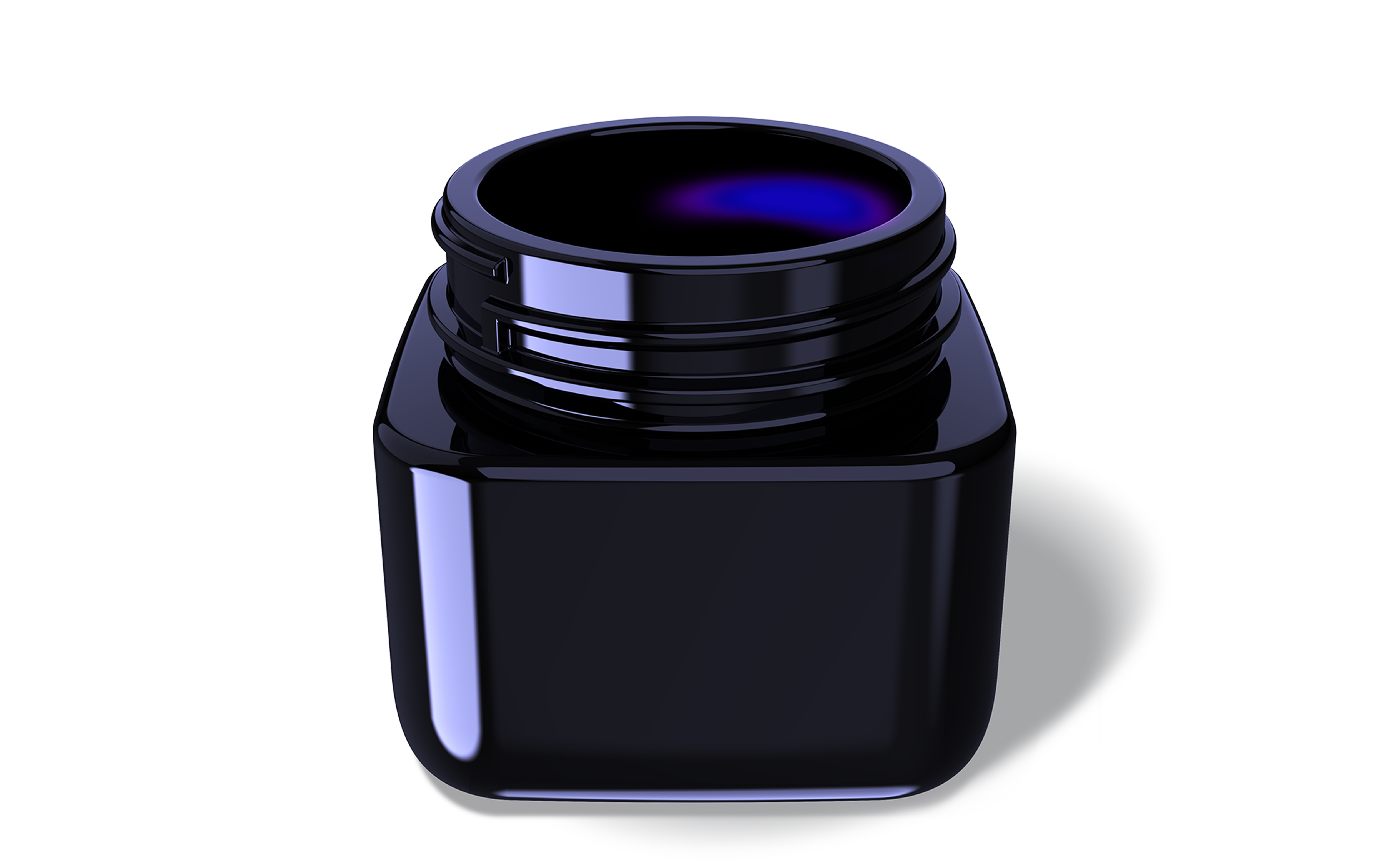
Cannabis concentrates, essential oils, botanical extracts, vitamin blends and cosmetic actives are all sensitive to prolonged light exposure. Violet glass — widely described in the industry as Miron-type glass — is specified for exactly this reason: industry technical descriptions note that it filters the visible light spectrum, which is what helps protect colour, aroma and potency across long retail and storage cycles. Honor Packaging positions its Violet Glass Packaging as UV protection packaging for this purpose. Clear glass remains appropriate where content visibility for inspection matters more than light protection, which is why the H21 series exists in both clear and violet versions.
3. The seal does not hold against air, moisture or leakage
Airtight performance is a mechanical property of the closure, not the glass. For food powders, hygroscopic ingredients and medical contents, a standard screw cap may not be enough. The H19 Vacuum Click Jar from Honor Packaging is specified for leak-free and airtight sealing, which is why its stated application range covers food, cosmetic and medical packaging rather than one single industry.
4. Odour escapes after sealing
Odour containment has become a measurable purchasing criterion. In the United States alone, the smell proof bag market was estimated at USD 133.7 million in 2026 with a projected CAGR of 7.9% through 2033 (Grand View Research). Buyers in this category are not shopping for aesthetics; they are buying containment. That logic applies directly to smell proof packaging format choice, where closure integrity, glass weight and wall thickness all contribute to how well a package holds its contents in.
Industry Background: Regulation, Light Sensitivity and Category Growth
Two published figures frame the category. The global protective packaging market was valued at USD 41.5 billion in 2026 (Grand View Research). Child-resistant packaging — the sub-segment driven primarily by regulation rather than by design trends — is projected to reach USD 31.07 billion in 2026 (Global Market Insights). Both are research-firm projections and are best read as scale indicators for the category rather than as forecasts for any individual product line.
Regulatory pressure is the structural driver. Because PPPA and FIFRA obligations attach to primary packaging, the jar, the cap and the closure mechanism all sit inside the compliance perimeter. Standards separate the two main cases: ISO 8317:2015 for reclosable child-resistant packages, ISO 14375:2018 for non-reclosable ones, and ASTM D3475 for classifying closure types. The practical consequence for a buyer is simple: a child-resistant claim has to be tied to a specific tested package, not to a jar shape.
On the supply side, Honor Packaging (Ningbo Honor Packaging Co., Ltd., www.honorcrpkg.com) is a China-based packaging manufacturer founded in 2015 and headquartered in Ningbo, close to both the Ningbo and Shanghai seaports for export logistics. The company operates a 45,000 m² facility with approximately 310 staff and a 15-engineer R&D team, and reports annual production capacity of 1,000,000 units. Its stated product focus covers child-resistant packaging, violet glass packaging and vacuum packaging, supported by OEM and ODM customisation. Export accounts for 100% of sales, with the EU and USA as the main markets. Facility size and capacity figures are company-reported.
Detailed Solution: Three Protective Packaging Families and Their Formats
The range is easier to specify once it is split into families, because each family answers a different constraint. Child-resistant formats answer regulation. Violet glass answers light. Vacuum answers seal integrity. Many projects end up combining two of the three.
Child-Resistant Packaging — H19 concentrate jars (5 ml and 9 ml)
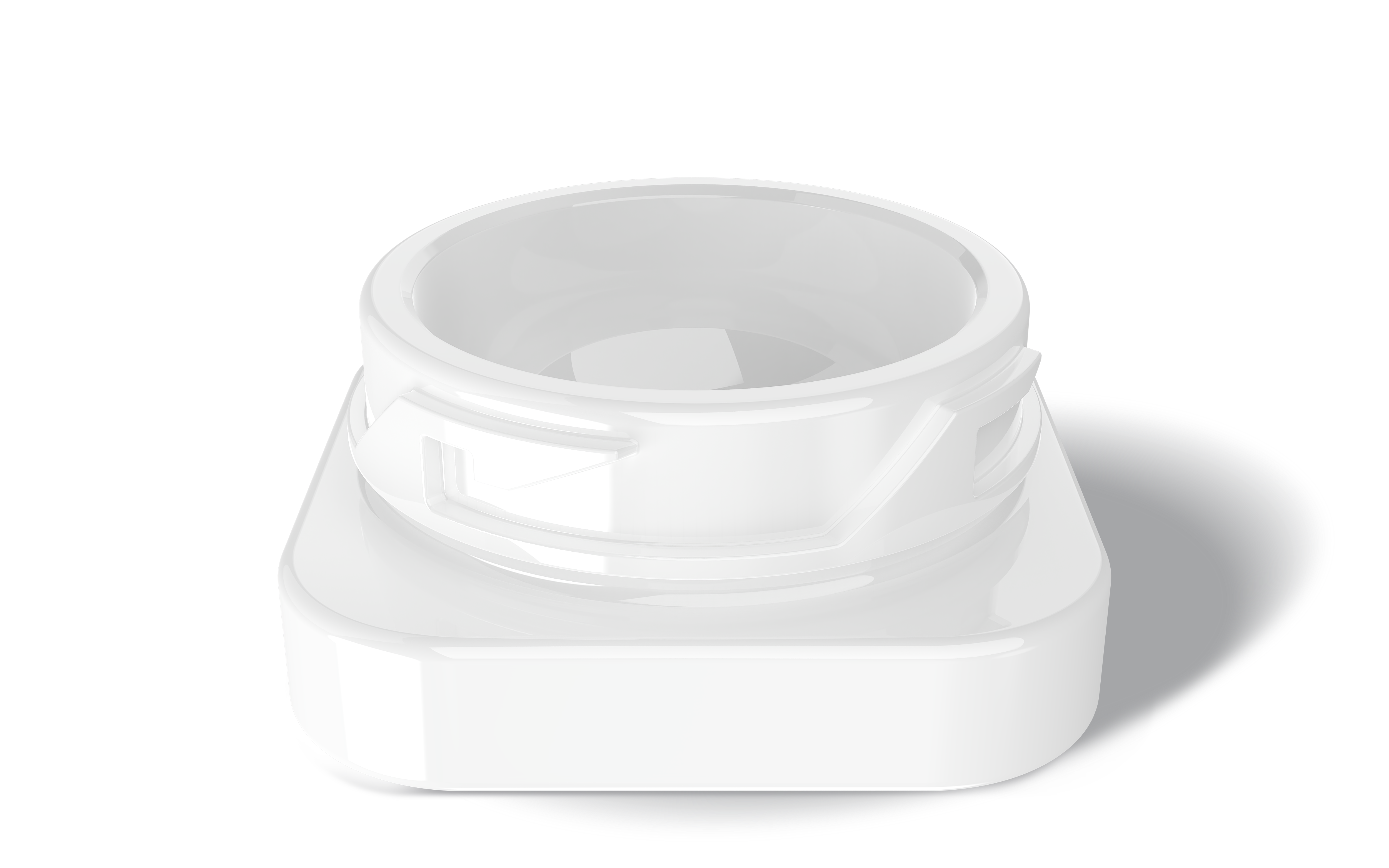
The H19 child-resistant concentrate jar family covers very small fills. Capacity is 5 ml and 9 ml, with a child-resistant cap as standard. Four shapes are available: square, round, triangle and hexagon. Net weight runs from 27 g to 38 g depending on the variant, and packing density is 250 pieces per carton. The series is offered in three glass finishes — clear (item codes H19-0001C to H19-0011C), white (H19-0001W to H19-0011W, 27 g to 36 g) and black (H19-0001B to H19-0011B). The black and white formats are the ones buyers typically use where UV black glass or matt black packaging appearance is required alongside child resistance.
Child-Resistant Packaging — H21 square and round jars (15 ml to 200 ml)
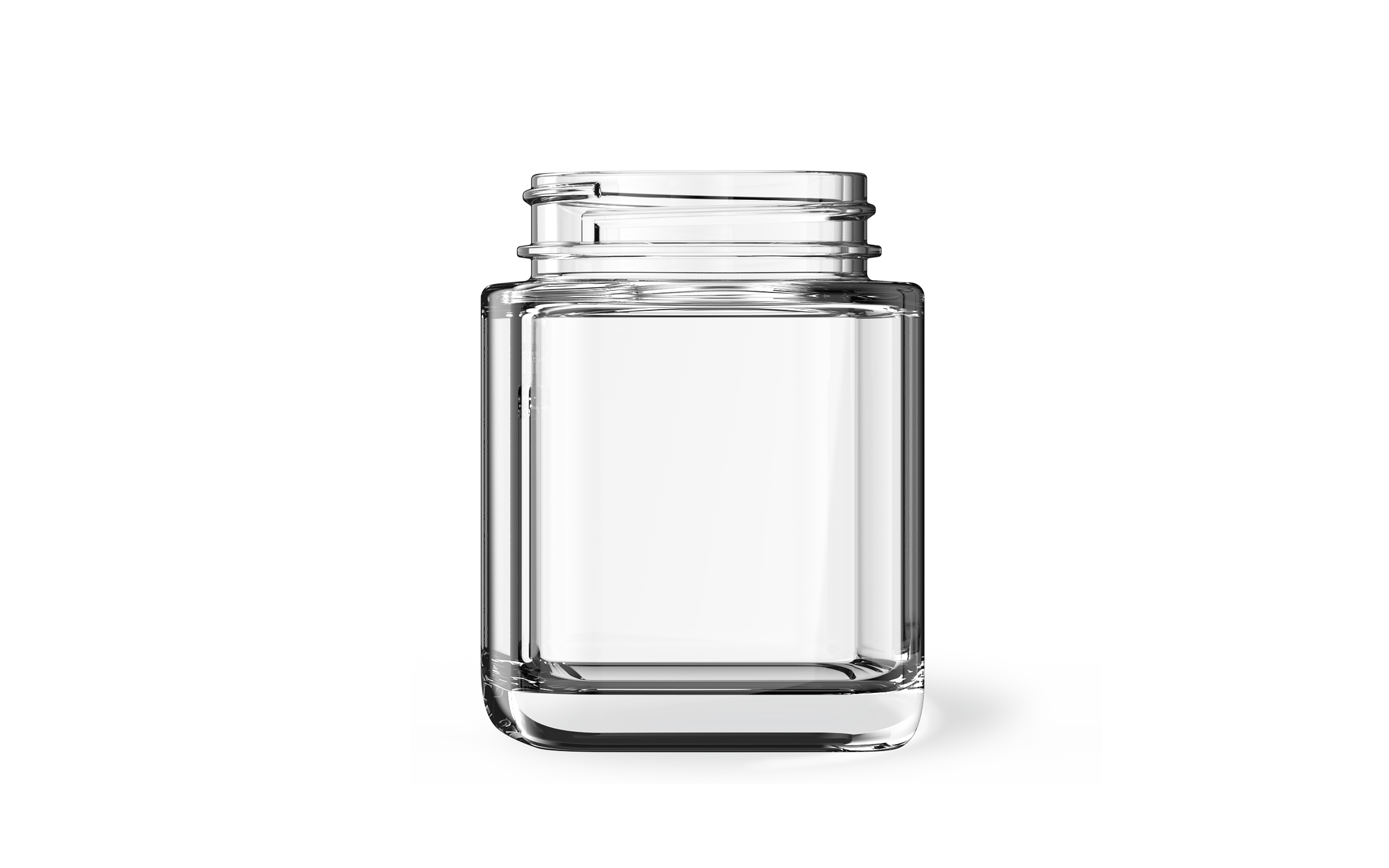
The H21 family scales the same child-resistant concept to larger fills. The clear square series (H21-0003C to H21-0008C) covers 15 ml, 30 ml, 20 dr, 30 dr, 40 dr and 60 dr, with a 58 mm diameter, heights from 24 mm to 115 mm and weights from 75 g to 280 g. The clear round series (H21-0012C to H21-0018C) covers 30 ml, 2 oz, 20 dr, 30 dr, 40 dr, 60 dr and 6 oz, with a 60 mm diameter, heights from 36.5 mm to 125 mm and weights from 84 g to 268 g. Both come with a child-resistant cap, 0.38 mm glass thickness, and surface treatment options that include sticker, silk-screen printing, hot stamping, heat transfer printing and frosted finish. Material composition is listed as glass, plastic and PE.
Violet Glass Packaging — H21 violet jars (15 ml to 200 ml)
Violet glass is the light-protection option inside the child-resistant architecture. The H21 square violet series (H21-0003V to H21-0008V) mirrors the clear square range: 15 ml, 30 ml, 20 dr, 30 dr, 40 dr and 60 dr, 58 mm diameter, heights of 24 mm to 115 mm, weights of 75 g to 280 g, child-resistant cap, 0.38 mm glass thickness and violet glass / PP / PE construction. The H21 round violet series (H21-0012V to H21-0018V) covers 30 ml, 2 oz, 20 dr, 30 dr, 40 dr, 60 dr and 6 oz with a 60 mm diameter, heights of 36.5 mm to 125 mm and weights of 84 g to 268 g. This is the format most often specified for UV-sensitive products that are also regulated, because it satisfies both constraints in a single jar.
Violet Glass Packaging — HDV1, HDV2 and HDV3
Where child resistance is not required, the HDV series extends violet glass packaging across cosmetics, food storage, supplements and essential oils.
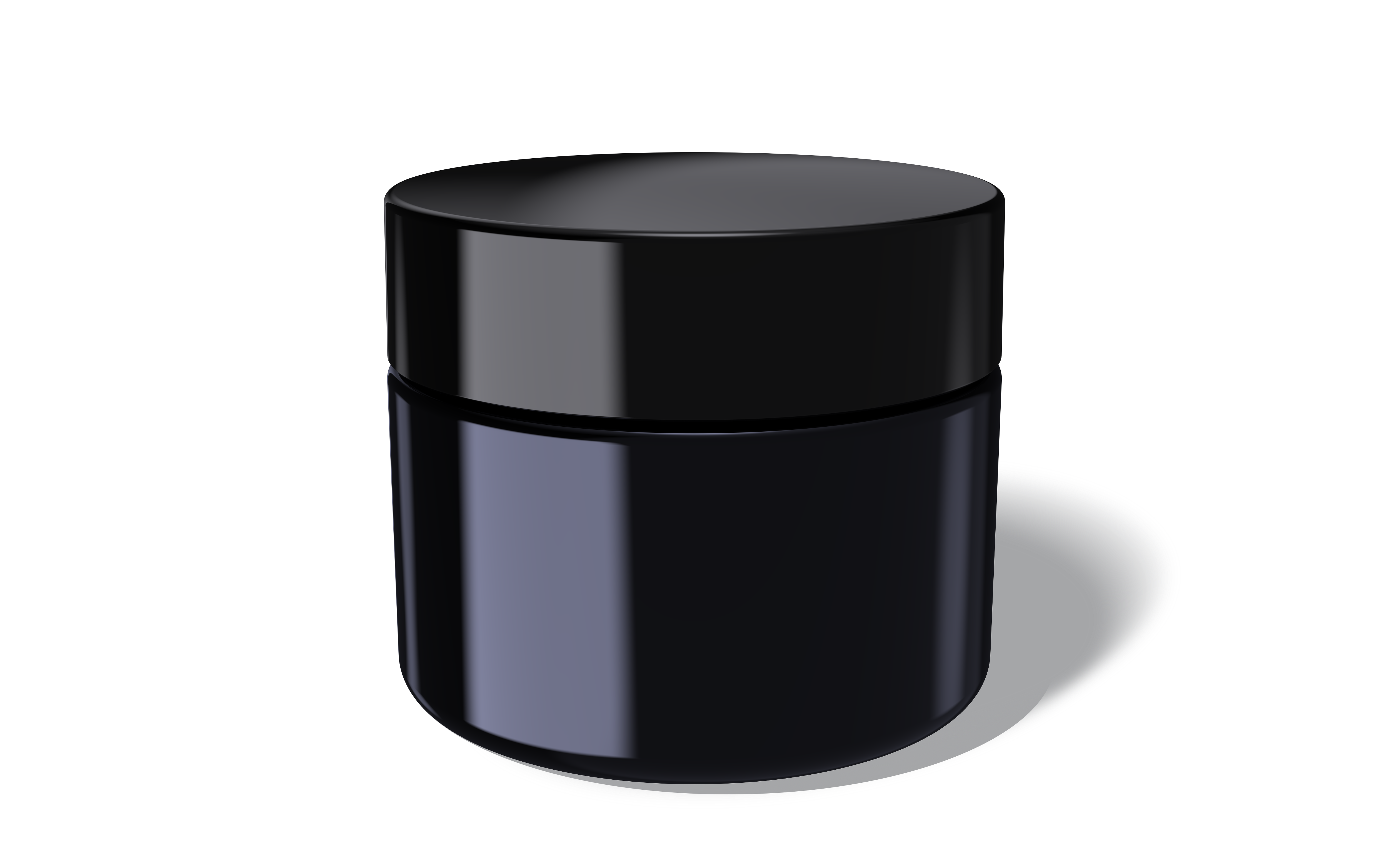
HDV1 wide mouth violet jars range from 100 ml to 1 L (item codes HDV1100M-1-CR, HDV1100M-1, HDV1100M-2, HDV1150M, HDV1200M, HDV1250M, HDV1300M, HDV1500M and HDV1001L). Thread range is 41/400 to 89/400, diameter 48 mm to 95 mm, height 84.7 mm to 193 mm and weight 117 g to 610 g. Material composition is violet glass with urea, PE, SAN and ABS components. This is the refillable glass storage jar and wide mouth glass jar segment — the format used for bulk botanicals, powders and pantry-style food storage.
HDV2 cosmetic violet jars cover 3 ml, 5 ml, 10 ml, 30 ml, 50 ml, 60 ml, 100 ml and 200 ml (HDV2003M, HDV2005M, HDV2005M-CR, HDV2010M, HDV2030M, HDV2050M, HDV2060M, HDV2100M and HDV5200M). Thread range is 32/400 to 89/400, diameter 36 mm to 93.2 mm, height 25.6 mm to 55 mm, weight 36 g to 205 g and wall thickness 0.38 mm, in violet glass / urea / PE. This is the short, wide profile used for creams, balms and cosmetic jars where label area matters.
HDV3 round violet glass essential oil bottles span 5 ml to 100 ml (HDV3005M, HDV3010M, HDV3015M, HDV3020M, HDV3030M, HDV3050M, HDV3060M and HDV3100M). Height runs 54.5 mm to 125 mm and weight 22.5 g to 120 g, in violet glass / PP, with closure options including plastic cap, dropper, mist sprayer and lotion pump. Surface treatment options across the HDV series include label, silk-screen printing, gold stamping, heat transfer printing and frosted finish.
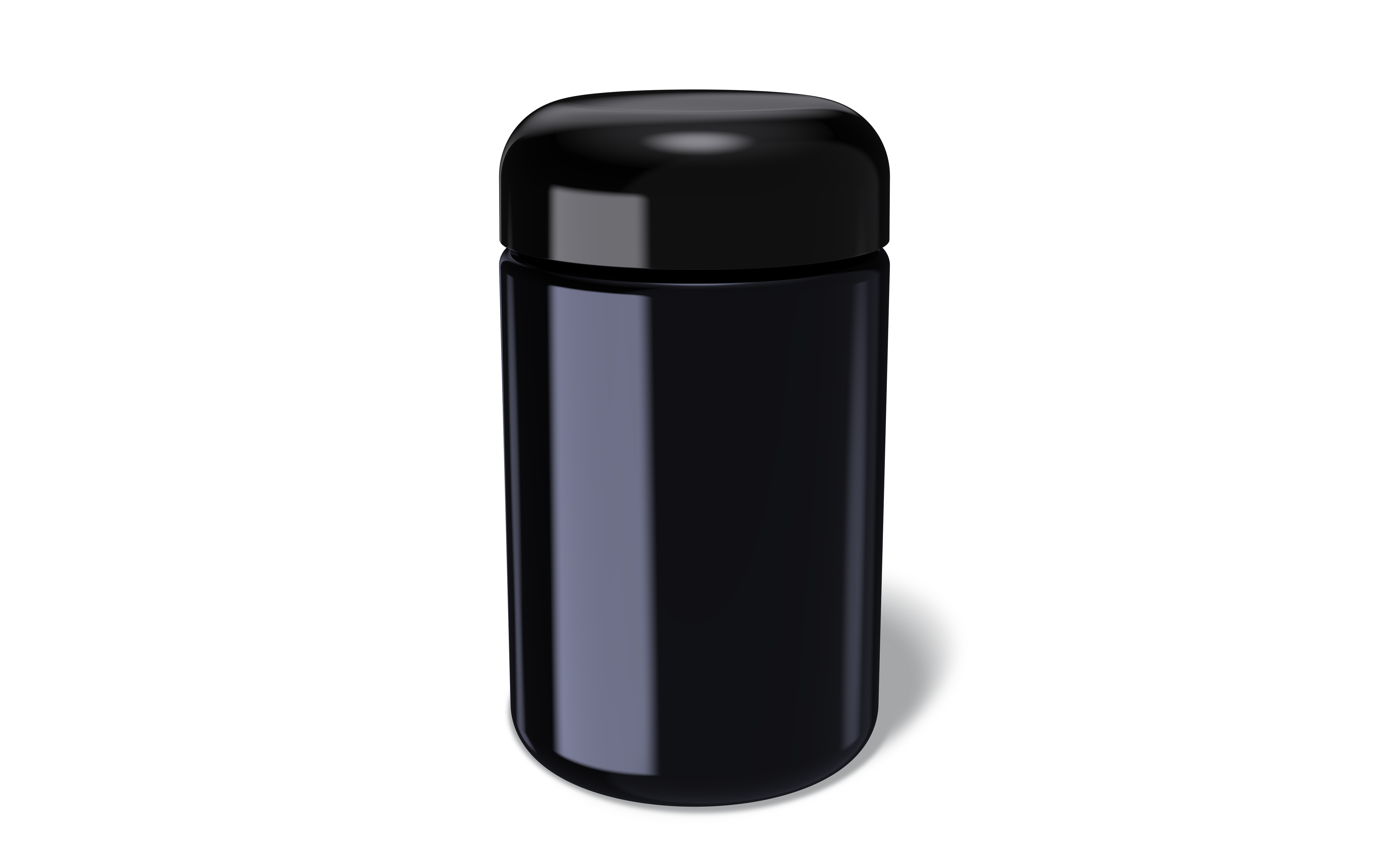
Vacuum Packaging — H19 Vacuum Click Jar
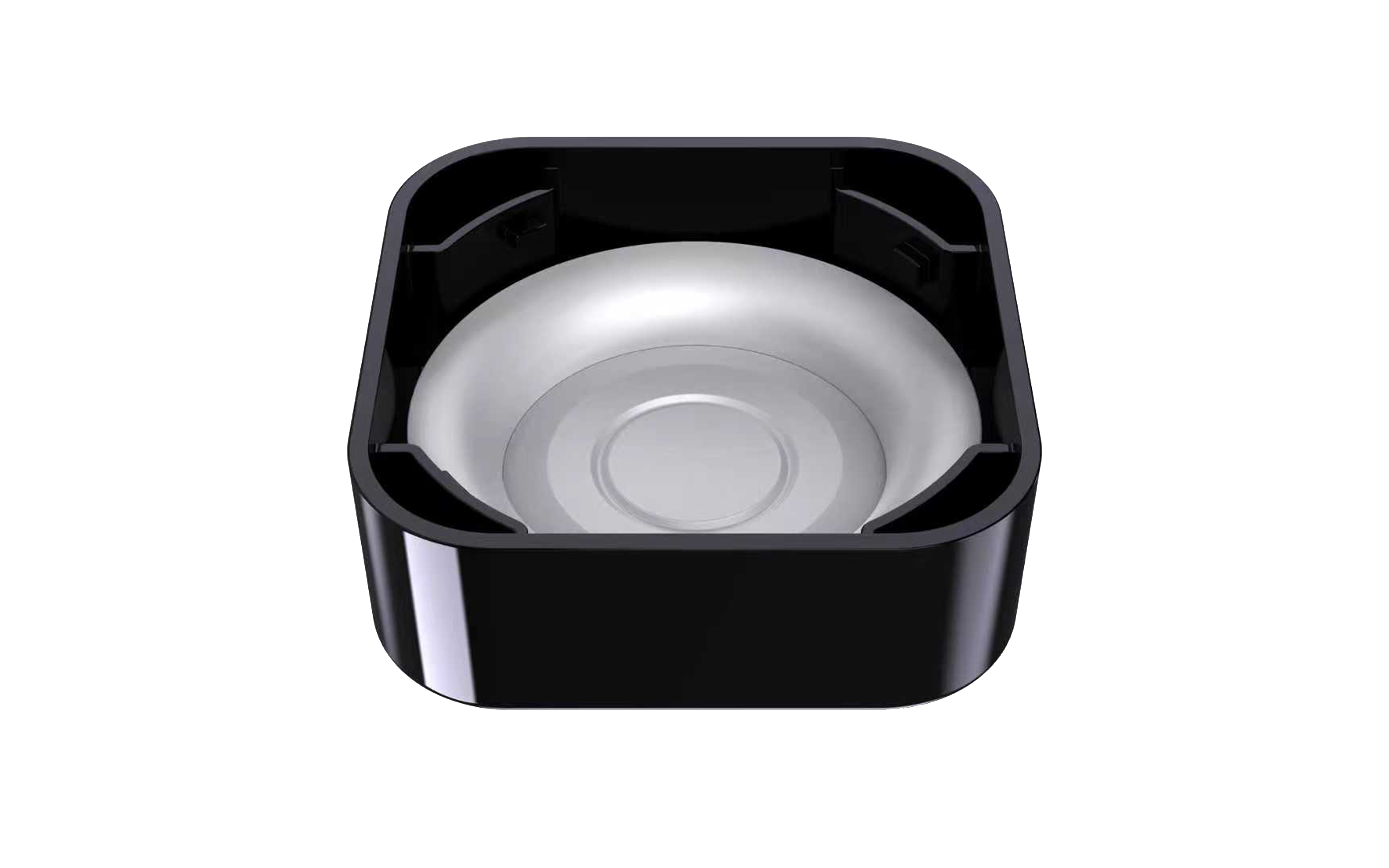
The H19 Vacuum Click Jar is the seal-integrity option. Specification: 5 ml capacity, glass body, square format, 250 pieces per carton, and a vacuum click closure. Its stated application spans food, cosmetic and medical packaging. Honour's product documentation describes Vacuum Packaging as providing leak-free and airtight sealing, which makes it the appropriate choice when the deciding constraint is moisture ingress, oxidation or leakage rather than regulation or light.
Step-by-Step: Specifying Protective Packaging for a Project
Six decisions cover most projects. They are ordered so that each one narrows the next.
- Classify the governing constraint. Decide which failure mode governs the project: regulation (child resistance), photostability (light), seal integrity (air, moisture, leakage) or odour. A pharmaceutical capsule product is usually regulation-first; an essential oil is light-first; a food powder is seal-first. Treating all four as equally weighted is the most common source of specification rework.
- Confirm whether the contents are regulated. If the product falls inside PPPA or FIFRA scope, the primary package must be special packaging, which means a tested closure type classified under ASTM D3475 and validated against ISO 8317:2015 (reclosable) or ISO 14375:2018 (non-reclosable). If the product is not regulated, a child-resistant closure can still be specified as a market decision — but it should be a decision, not an assumption.
- Size the format from dose and pack count. H19 child-resistant jars run 5 ml and 9 ml for micro-volumes. H21 jars start at 15 ml and reach 200 ml or 6 oz. Violet glass extends from 3 ml HDV2 cosmetic jars to 1 L HDV1 wide mouth storage jars. The vacuum format is currently specified at 5 ml. Packing density matters for landed cost: H19 formats ship 250 pieces per carton.
- Match shape and closure to the filling line. H19 comes in square, round, triangle and hexagon; H21 square jars use a 58 mm diameter and H21 round jars a 60 mm diameter. Capping heads, label applicators and carton sizes are all shape-sensitive, so shape should be chosen against the production line first and the shelf second.
- Verify certification against the destination market. The violet glass range — including HDV1, HDV2, HDV3 and H21 — is covered by two SGS-issued certifications: FDA CPG compliance under certificate NGBHL23005693401 for the US market (issued 30 November 2023), and EC No 1935/2004 compliance under certificate NGBHL24007770101 for the EU market (issued 27 December 2025). The FDA documentation also lists the H19 Vacuum Jar within its applicable product scope. Cross-check the certificate against the exact model and market before release, and confirm that surface treatments such as silk-screen printing, hot stamping or frosting do not introduce a separate migration or contact-material question.
- Validate before tooling and lock the production plan. Honor Packaging offers OEM and ODM work covering printing of client artwork, new design development and frosted finishes. Quality control is 100% pre-shipment testing plus third-party inspection by SGS. Minimum order quantity is 10,000 units, monthly capacity is 100,000 units, and lead time runs 30–45 days.
Use Cases: Protective Packaging by Industry
The same three families reappear across industries, but the governing constraint changes from sector to sector. This is the practical reason an application-based selection beats a catalogue-based one.
Pharmaceutical and medical packaging
Medical programmes typically combine regulation and inspection needs. The H19 child-resistant concentrate jar at 5 ml and 9 ml handles micro-volume dosing, while the H21 child-resistant range from 15 ml to 200 ml covers capsules, powders and larger fills. Where contents must remain visible for batch inspection, the clear H21 series is the appropriate choice; where the formulation is light-sensitive, the violet H21 equivalent is specified instead. The H19 Vacuum Click Jar is listed for medical use as well, which makes it relevant for contents that must stay sealed against air and moisture. A German branding business in pharmaceutical packaging has run 10,000-unit orders of violet glass jars for three years, reporting that the reusable, UV-protective jars keep their products fresh over the life of the pack.
Cannabis and botanical products
Cannabis programmes usually face all four constraints at once. Concentrates need child-resistant micro-formats, which puts H19 clear, white and black jars at 5 ml and 9 ml in scope. Flower and extract formats need light protection and odour control, which points to the H21 violet square and round jars at 15 ml to 200 ml with child-resistant caps. Black and dark-finish glass formats are commonly used where UV black glass or matt black packaging appearance is part of the brand requirement. The odour dimension is not cosmetic: with the US smell proof bag market estimated at USD 133.7 million in 2026 and growing at a projected 7.9% CAGR to 2033, containment performance is a category-level buying criterion.
Cosmetics and daily chemicals
Cosmetics rarely need child resistance but almost always need light management and a good labelling surface. The HDV2 cosmetic violet jar spans 3 ml to 200 ml with a short profile of 25.6 mm to 55 mm, which suits creams and balms. The HDV3 round violet glass bottle spans 5 ml to 100 ml with plastic cap, dropper, mist sprayer and lotion pump closures, which covers serums, oils and toners. Both use violet glass with PP, urea or PE components depending on the model. Standard surface treatments include label, silk-screen printing, gold stamping, heat transfer printing and frosted finish.
Supplements and nutraceuticals
Supplement products sit between cosmetics and pharmaceuticals. Softgel and capsule fills are well served by H21 violet jars from 30 ml to 200 ml with child-resistant caps, while powder and bulk formats are better matched to HDV1 wide mouth jars from 100 ml to 1 L. HDV1 uses a 41/400 to 89/400 thread range with diameters from 48 mm to 95 mm, which accommodates larger scoops and wide-mouth filling. Refillable glass storage jar formats in this series also support the reuse story that supplement brands increasingly position.
Food and beverage
Food applications are driven by seal and storage performance. The HDV1 wide mouth range from 250 ml to 1 L is the storage-oriented portion of the violet glass line, and the H19 Vacuum Click Jar at 5 ml serves small-format airtight sealing. HDV1 is listed for food and beverage use with a 0.38 mm glass thickness across the violet glass construction, and the vacuum format is specified for leak-free and airtight sealing. For food buyers, the practical checkpoints are closure integrity, carton packing density and whether the destination market requires the same FDA or EU documentation as the cosmetic range.
Comparison Table: Protective Packaging Formats by Capacity, Shape and Industry Fit
The table below compares the formats covered in this guide using published specification data. It is intended as a shortlisting tool, not as a substitute for sample validation.
| Family and series | Capacity range | Shape and dimensions | Material | Closure | Typical industry fit |
|---|---|---|---|---|---|
| H19 content-resistant concentrate jar (clear / white / black) | 5 ml, 9 ml | Square, round, triangle, hexagon; 27 g–38 g | Glass | Child-resistant cap | Pharmaceutical micro-volumes, cannabis concentrates |
| H21 child-resistant square jar (clear) | 15 ml, 30 ml, 20–60 dr | Square, 58 mm dia., 24–115 mm height, 75–280 g | Glass / plastic / PE, 0.38 mm wall | Child-resistant cap | Pharmaceuticals, powders, cosmetics |
| H21 child-resistant round jar (clear) | 30 ml, 2 oz, 20–60 dr, 6 oz | Round, 60 mm dia., 36.5–125 mm height, 84–268 g | Glass / plastic / PE, 0.38 mm wall | Child-resistant cap | Medical, supplements, cannabis |
| H21 square violet jar | 15 ml, 30 ml, 20–60 dr | Square, 58 mm dia., 24–115 mm height, 75–280 g | Violet glass / PP / PE, 0.38 mm wall | Child-resistant cap | UV-sensitive cannabis, supplements, cosmetics |
| H21 round violet jar | 30 ml, 2 oz, 20–60 dr, 6 oz | Round, 60 mm dia., 36.5–125 mm height, 84–268 g | Violet glass / PP / PE, 0.38 mm wall | Child-resistant cap | Cosmetics, supplements, UV-sensitive fills |
| HDV2 cosmetic violet jar | 3–200 ml | Round, 36–93.2 mm dia., 25.6–55 mm height, 36–205 g | Violet glass / urea / PE, 0.38 mm wall | 32/400–89/400 thread | Creams, balms, cosmetic actives |
| HDV1 wide mouth violet jar | 100 ml–1 L | Wide mouth, 48–95 mm dia., 84.7–193 mm height, 117–610 g | Violet glass / urea / PE / SAN / ABS, 0.38 mm wall | 41/400–89/400 thread | Food storage, supplements, bulk botanicals |
| HDV3 round violet glass bottle | 5–100 ml | Round bottle, 54.5–125 mm height, 22.5–120 g | Violet glass / PP | Plastic cap, dropper, mist sprayer, lotion pump | Essential oils, serums, cosmetics |
| H19 Vacuum Click Jar | 5 ml | Square, 250 pcs/ctn | Glass | Vacuum click closure | Food, cosmetic and medical airtight sealing |
Table compiled from Honor Packaging product specification data. Certification coverage is described in the compliance step above; FDA CPG certificate NGBHL23005693401 and EC No 1935/2004 certificate NGBHL24007770101 are both issued by SGS.
Compliance note for specifiers. Two certifications apply to the violet glass range (HDV1, HDV2, HDV3, H21): FDA CPG under certificate NGBHL23005693401 for the US market and EC No 1935/2004 under certificate NGBHL24007770101 for the EU market. Both are issued by SGS, and the FDA documentation lists the H19 Vacuum Jar within its applicable product scope. Verify the certificate against the exact model, market and surface treatment before release.
FAQ: Protective Packaging Selection Questions
1. Are the violet glass jars certified for both the EU and US markets?
Yes. The Violet Glass Packaging range — covering HDV1, HDV2, HDV3 and H21 models — holds two SGS-issued certifications. For the US market, the product is certified to FDA CPG standards under certificate number NGBHL23005693401, issued on 30 November 2023. For the EU market, it complies with EC No 1935/2004 under certificate number NGBHL24007770101, issued on 27 December 2025. The FDA certification documentation also lists the H19 Vacuum Jar within its applicable product scope. Buyers should still confirm that the certificate references the exact model and market before release, and should treat the certificate number as a verifiable document rather than a general compliance claim.
2. What capacities, shapes and materials are available across the child-resistant, violet glass and vacuum ranges?
The child-resistant H19 concentrate jar covers 5 ml and 9 ml in square, round, triangle and hexagon shapes, in clear, white and black glass, at 27 g to 38 g and 250 pieces per carton. The child-resistant H21 series covers 15 ml to 200 ml and 6 oz, in square (58 mm diameter) and round (60 mm diameter) formats, with 0.38 mm glass thickness and weights from 75 g to 268 g. Violet glass packaging extends the same H21 architecture and adds HDV1 wide mouth jars from 100 ml to 1 L, HDV2 cosmetic jars from 3 ml to 200 ml, and HDV3 bottles from 5 ml to 100 ml. Materials across the range include glass, violet glass, PP, PE, urea, SAN and ABS. The H19 Vacuum Click Jar is specified at 5 ml in a square glass format.
3. What is the minimum order quantity, and what drives production capacity?
Minimum order quantity is 10,000 units and monthly capacity is 100,000 units. Packing density is a useful planning input for smaller formats: H19 child-resistant jars ship 250 pieces per carton, which affects pallet counts and landed cost per unit. Cost is mainly driven by glass type (clear versus violet), closure specification, and the surface treatment selected — label, silk-screen printing, hot stamping, heat transfer printing or frosted finish. New designs and tooling add a separate development stage, which is why custom projects should be scoped against the OEM and ODM process rather than priced from the standard range alone.
4. Can a format be sampled and validated before mass production?
Yes. Honor Packaging supports OEM and ODM work covering printing of client artwork, new design development and frosted finishes, so a project can be specified and prototyped before tooling is committed. Quality control combines 100% pre-shipment testing with third-party inspection by SGS, and the after-sales policy accepts reissue where a defect is confirmed. For regulated contents, sampling should also include the closure in its final production configuration, because child resistance and airtight performance are properties of the assembled package rather than of the jar alone.
5. What is the production lead time, and how do I start a project?
Lead time runs 30–45 days. Manufacturing is based in Ningbo, China, close to the Ningbo and Shanghai seaports, and export accounts for 100% of sales, with the EU and USA as the main markets alongside the Middle East and Southeast Asia. To begin, review the protective packaging catalogue in the downloadable brochure, then send the target market, capacity, shape, closure requirement and surface treatment to the Honor Packaging team for a sample and quotation. Most projects can be scoped in a single exchange once the governing constraint — regulation, light, seal integrity or odour — has been identified. Requests can be sent to info@honorpkg.com, by WhatsApp at +86 159 6894 4995, or by telephone at +86-574-88004632.
Conclusion: Match the Format to the Constraint, Then Verify It
Protective packaging selection becomes straightforward once the governing constraint is named. Regulated contents point to the H19 and H21 child-resistant ranges, from 5 ml concentrate jars to 200 ml and 6 oz formats. Light-sensitive contents point to violet glass, whether in H21 child-resistant jars, HDV1 wide mouth storage jars, HDV2 cosmetic jars or HDV3 essential oil bottles. Contents that must not meet air or moisture point to the H19 Vacuum Click Jar. Contents that must not be smelled point to closure integrity plus light-blocking glass.
What remains after the format decision is verification: confirming that the closure type matches the applicable standard, that the certificate number covers the model and market, and that the assembled package has been tested in its final configuration. That sequence — constraint, format, certification, sample — is what separates packaging that passes market entry from packaging that has to be redesigned at the tooling stage.
Request a Protective Packaging Sample or Quotation
Honor Packaging (Ningbo Honor Packaging Co., Ltd.) supplies child-resistant packaging, violet glass packaging and vacuum packaging for the EU and USA markets, with OEM and ODM customisation, 100% pre-shipment testing and third-party SGS inspection.
Next step: download the full product catalogue and send your capacity, shape, closure and surface-treatment requirements for a sample and quote.
📄 Download the Honor Packaging brochure (PDF)
✉ Email: info@honorpkg.com
📱 WhatsApp: +86 159 6894 4995 | Tel: +86-574-88004632 / +86-15968944995
🌐 Web: www.honorcrpkg.com | Blog: blog.honorcrpkg.com
📍 Rm.305, No.1 Building, No.568 SiMing East Road, YinZhou District, Ningbo City, China
Have Questions or Need More Details?
Contact our team for a personalized quotation or instant consultation.
Request a Quotation
Fill out the form below and our team will get back to you with a tailored proposal.
WhatsApp Direct Chat
Prefer to chat in real-time? Message us on WhatsApp for instant assistance & quick answers.
- Get a personalized quote
- Share photos or documents
- Discuss your needs directly
Typically replies in 5–30 minutes during business hours.