
How to Choose Protective Packaging for Cannabis Concentrates: Child-Resistant Glass Jars
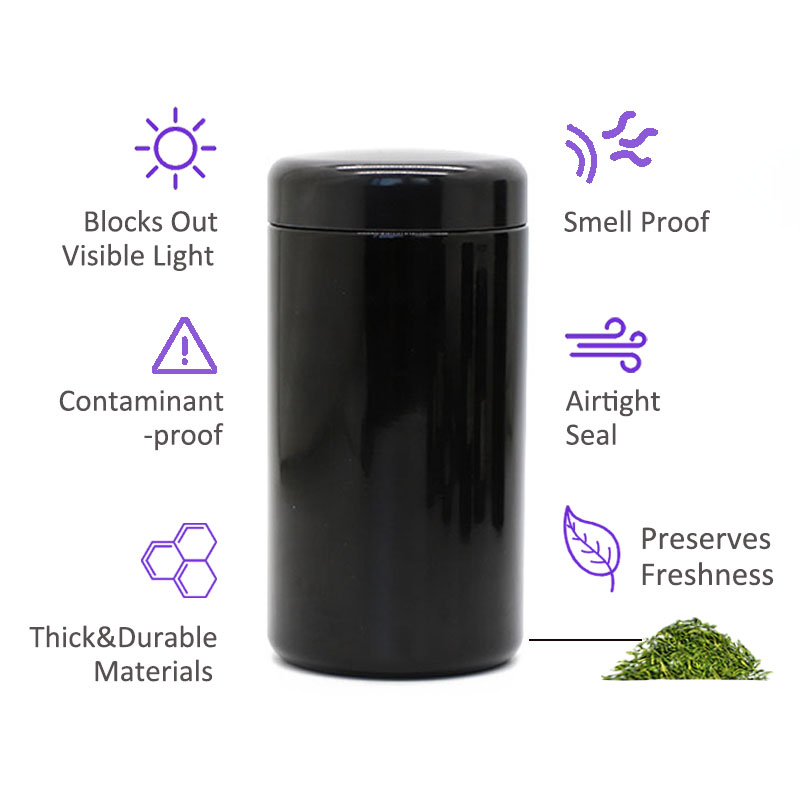
Short answer: choosing protective packaging for cannabis concentrates means resolving five decisions in order - a child-resistant closure tested against the protocol that applies to your market, a jar body that controls light exposure, a seal that still works after the jar is opened and reclosed, a capacity that matches the dose format you actually sell, and a manufacturing partner whose certificates, sampling process and lead times are documented. The H19 vacuum click jar from Ningbo Honor Packaging Co., Ltd, a 5 ml square glass jar, is used below as a worked example of how those five decisions lock together.
Concentrates sit in an awkward corner of packaging. They are sold in small volumes at high value per gram, they are sensitive to light and air, and they are treated as child-access risk products in most of the markets that matter. A container that leaks, that fails a child-resistance test, or that lets light reach the product can cost a listing and a compliance file at the same time. That is why this category rewards buyers who choose by evidence rather than by appearance.
Why Cannabis Concentrates Are Hard to Package
The difficulty is structural rather than cosmetic, and it comes from four pressures pulling in different directions.
High value behind a small format. A concentrate jar holds only a few millilitres, yet the retail value behind that glass is high. Packaging failure is therefore expensive in a way it is not for low-value dry goods: a leaking jar, a seal that relaxes in transit, or a label that lifts in a humid dispensary damages both the product and the brand.
Regulated child access. Reclosable child-resistant packaging is verified through test protocols rather than described in marketing copy. ISO/EN 8317 is the European benchmark and 16 CFR 1700.20 is the United States benchmark; both are designed to prevent access by children under five. A jar that has not been tested against the protocol applying to your destination market is not defensibly child-resistant, no matter how tight the lid feels.
Light and air exposure. Light exposure and oxygen contact are widely treated across the industry as the two main routes by which sensitive formulations lose quality over time. That makes the container a product-quality decision, not only a logistics decision.
Residue in the thread. Viscous concentrates leave residue where the lid meets the jar. Residue changes closure feel and can affect re-closure performance, so buyers should validate child-resistance and seal behaviour on filled and partly used jars rather than on empty samples alone.
Documentation that has to match the product. Retail buyers and regulators ask for certificates. The certificate must name the model, the market and the issue date that matches your shipment; a generic compliance statement does not survive a buyer audit.
What the Market and the Standards Say About Protective Packaging
The commercial backdrop explains why buyers now evaluate protective packaging with more discipline than they did a few years ago. Fortune Business Insights valued the global protective packaging market at USD 44.02 billion in 2025 and projected USD 80.25 billion by 2034. Grand View Research, working from a different segmentation base, estimated the same market at USD 40.4 billion in 2025, with the flexible segment leading at a 66.4% revenue share and paper and paperboard materials holding a 45.7% share. Fortune Business Insights also expects the secondary packaging segment to hold a 48.54% share by 2026. The two market-size estimates differ because the research firms segment the category differently, so they are best read as directional rather than precise.
Two consequences matter for concentrate buyers. First, most of that protective packaging spend sits in transport and secondary packaging, where large diversified manufacturers such as Sealed Air Corporation, Smurfit Westrock, Mondi Group and Amcor plc compete. Primary glass packaging for concentrates belongs to a different supplier tier, judged on child-resistance test evidence, mould availability, decoration capability and food-contact certification rather than on logistics scale.
Second, the standard framework is now well fixed. ISO/EN 8317 in the EU and 16 CFR 1700.20 in the US define the child-access benchmark, which means buyers can ask one precise question of every supplier: which model, tested against which protocol, with which certificate number? Suppliers who can answer without delay are usually the ones worth shortlisting.
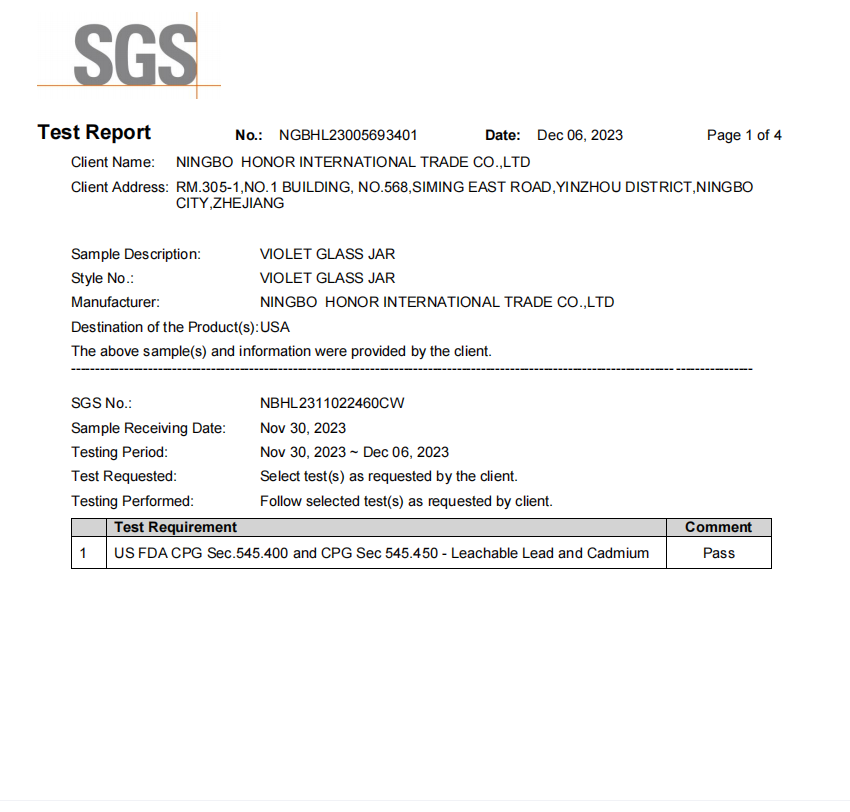
Proof: SGS certificate NGBHL23005693401 covers the H19 vacuum packaging under FDA CPG for the US market.
How the H19 Vacuum Click Jar Fits Concentrate Packaging
Ningbo Honor Packaging Co., Ltd (Honor Packaging) is a Ningbo-based packaging manufacturer founded in 2015 that turns finished packaging designs into reliably mass-produced glass and plastic packaging, with a focus on child-resistant packaging, violet glass packaging and vacuum packaging. The company operates a 45,000 square metre facility with 310 employees and a 15-person R&D team, reports an annual output of 1,000,000 units, exports 100% of its production, and serves the EU and the US as its main markets. Its site is www.honorcrpkg.com.
The H19 vacuum click jar is the model most directly aimed at concentrate formats. Its documented specification is deliberately simple, which helps when compliance documents have to line up with a purchase order.
| Parameter | Documented value |
|---|---|
| Product family | Vacuum Packaging, model H19 |
| Format name | Vacuum Click Jar |
| Body material | Glass |
| Shape | Square |
| Capacity | 5 ml |
| Packing | 250 pcs per carton |
| Certification coverage | Listed among the products covered by SGS certificate NGBHL23005693401, issued 30 November 2023 under FDA CPG for the US market |
The vacuum click mechanism is the feature buyers ask about first. A vacuum click lid seats under vacuum and signals a sealed state on closing, which is the storage-protection argument behind the format. Because vacuum retention and odour performance depend on the filled pack, the practical advice is to confirm both on a sample filled with your own product rather than on an empty jar.
Light control is the second lever, and it is where material choice does the work. Violet glass is documented by Miron Violetglass as acting as a natural filter: it blocks visible light while allowing roughly 25% to 45% of UVA and about 60% of infrared light to pass. Where a project requires no light transmission at all, opaque and heavily pigmented finishes, including matt black and black glass variants, are the usual route. Clear glass transmits the most light and therefore protects the least.
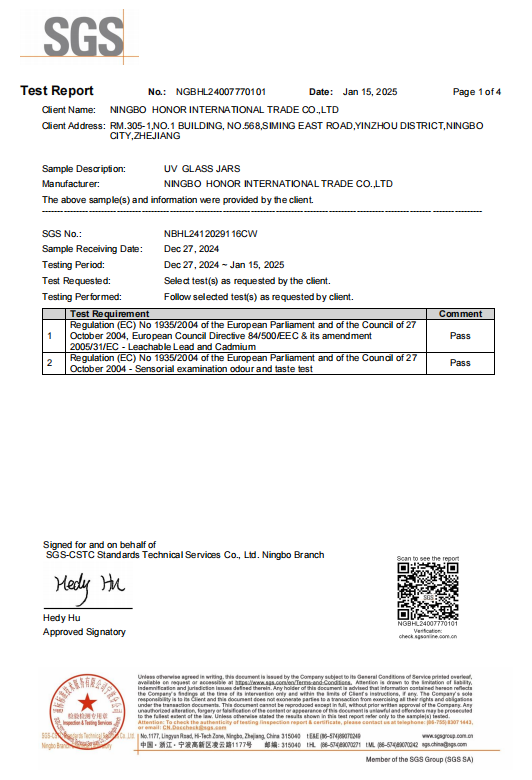
Proof: SGS certificate NGBHL24007770101 confirms compliance with EC No 1935/2004 for the violet glass range sold into Europe.
Food-contact compliance follows a separate track. SGS certificate NGBHL24007770101, issued on 27 December 2025, confirms compliance with EC No 1935/2004 for the violet glass range sold into Europe. That range covers the HDV1 wide mouth violet jars, the HDV2 cosmetic violet jars, the HDV3 round violet glass essential oil bottles, and both the square and round H21 child-resistant violet glass jars.
Capability behind the catalogue matters as much as the catalogue itself. Honor Packaging works in OEM and ODM mode; documented customisation includes printing client artwork, developing a new design and applying a frosted finish. Stated monthly capacity is 100,000 units, minimum order quantity is 10,000 units, and lead time is 30 to 45 days. Quality control combines a 100% pre-shipment test with third-party inspection by SGS, and the stated after-sales position is to accept reissue where a problem is confirmed. Export coverage spans the EU, US, Middle East and Southeast Asia.
One clarification prevents expensive assumptions. The documented H19 configuration is 5 ml in a square profile. Concentrate buyers also evaluate round, triangular and hexagonal geometries, and capacities across the small-volume range, but where a required capacity or shape falls outside the documented configuration it should be handled as a new-design OEM/ODM project and validated on a physical sample before tooling is committed. Net weight behaves the same way: it drives freight and duty calculations, so it should be read from the confirmed sample and packing list rather than assumed from a drawing.
Step-by-Step: Selecting a Child-Resistant Jar for Concentrates
1. Confirm which child-resistance standard applies
Match the protocol to the destination market before matching anything else. ISO/EN 8317 governs the EU route and 16 CFR 1700.20 governs the US route, and both target access by children under five. Ask for test evidence that names your specific model rather than a general statement about child-resistant packaging.
2. Fix the fill capacity against the dose format
Capacity follows the sellable dose, not the other way round. A 5 ml jar suits a single-portion concentrate format, while larger multi-portion packs move toward the H21 range. Where a capacity between documented sizes is required, treat it as a development item and confirm it at sample stage.
3. Decide how much light the product can tolerate
This is a materials decision. Violet glass blocks visible light while allowing a measured band of UVA and infrared through. Opaque or black-pigmented glass blocks visible light entirely. Clear glass offers the most shelf visibility and the least protection. Refillable glass storage jar designs add a second benefit, because a container that is kept and reused extends the protection period and reduces packaging waste.
4. Choose the sealing method: standard CR cap or vacuum click
A screw child-resistant cap is the conventional solution. A vacuum click jar adds a vacuum-seated lid that indicates a sealed state, which is the storage-protection case for the format. Both routes have to be judged on the filled pack, because concentrate residue in the thread changes how the closure behaves after the first opening.
5. Plan decoration and secondary packaging together
Glass jars are only part of a leak-free, airtight result. Glass itself does not absorb water; the risk points are the closure gasket and the label adhesive. Decide the decorative route early, since surface options documented across the violet glass range include sticker application, silk-screen printing, hot stamping, heat transfer printing and frosted finish, and confirm which of these apply to the H19 at sample stage. The method chosen affects both tooling and lead time.
6. Validate on a filled sample, not a catalogue photo
Test child-resistance function, vacuum retention, closure behaviour after residue contact, label adhesion and packing integrity. A 100% pre-shipment test combined with third-party inspection by SGS is the documented quality route, and that inspection is most useful when it checks the same parameters you already checked on the sample.
7. Lock commercial and supply parameters before artwork is released
Confirm minimum order quantity, monthly capacity and lead time against your launch plan. Honor Packaging states a 10,000-unit MOQ, a 100,000-unit monthly capacity and a 30 to 45 day lead time, which sets the realistic planning window for a first concentrate run.
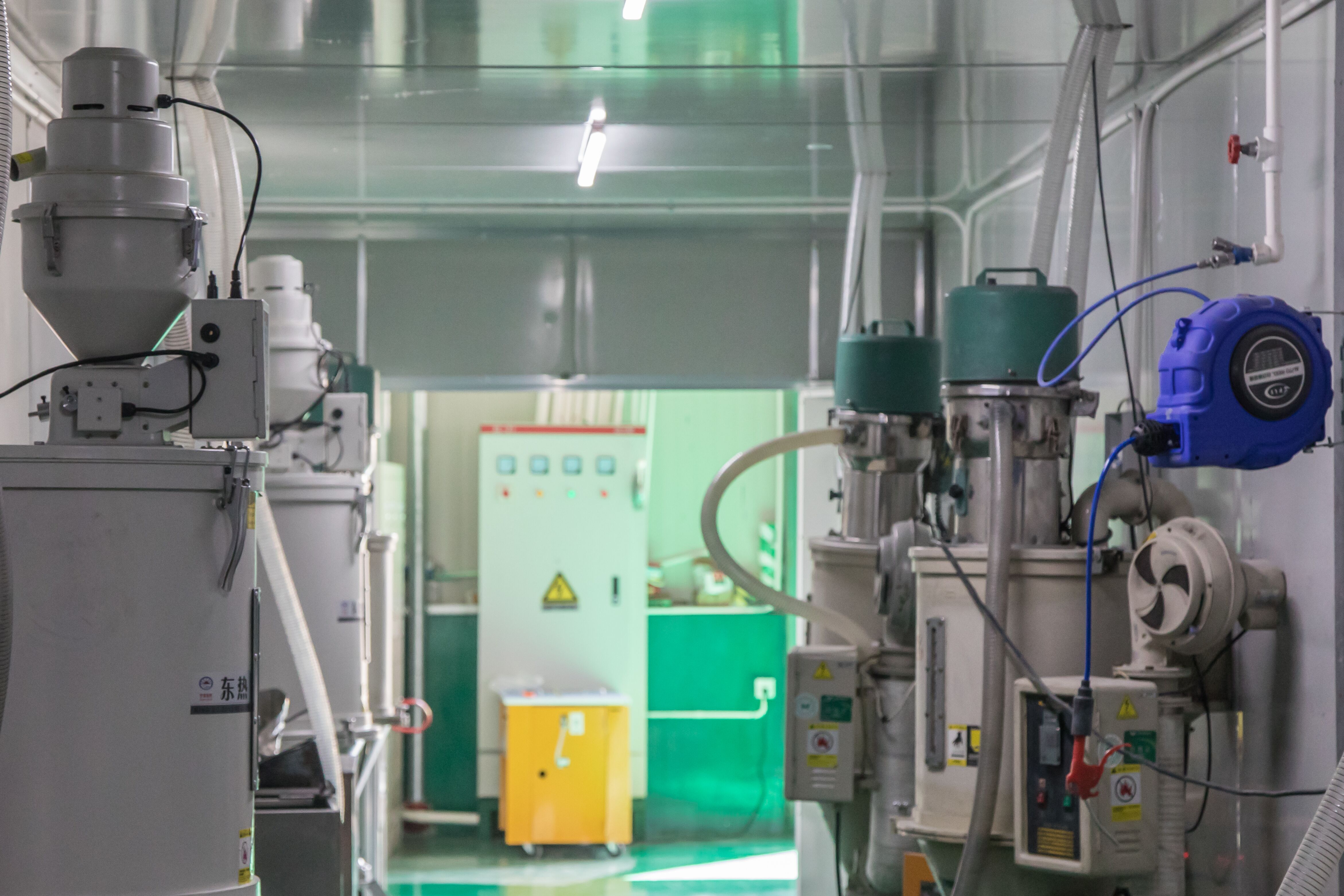
Manufacturing proof: production responsibility is held in-house and backed by third-party inspection.
Where These Jars Are Used: Four Real Scenarios
Three years of pharmaceutical-grade packaging in Germany. A branding business client in Germany ran a pharmaceutical packaging project of 10,000 units over three years using packaging designed to be reusable and to provide UV protection. The reported result was that the products remained fresh throughout the project duration. That outcome is a useful reference point for concentrate buyers, because it tests the same two variables that matter here, light protection and reusability, over a multi-year horizon.
A concentrate brand launching a single-portion format. A brand bringing a 5 ml concentrate format to market needs a small square jar, a documented child-resistant closure, and a packing configuration that fits its existing cartons. The H19 line at 250 pieces per carton is built for that kind of programme.
A distributor selling into both the EU and the US. A distributor needs two documents in the file, not one: the SGS certificate covering the H19 vacuum packaging under FDA CPG for the US market, and the EC No 1935/2004 food-contact certificate for the violet glass range for the EU market. Keeping those aligned to the purchase order avoids the most common audit problem.
A private-label project with printed artwork. Where a brand needs its own artwork printed on the jar and a non-standard geometry, the route is OEM/ODM development with new-design tooling, a frosted or printed finish, and sample validation before the 10,000-unit minimum order is placed.
Comparing Primary Container Formats for Concentrates
The table below compares format categories on the criteria that decide concentrate packaging, rather than named products from named suppliers. Rows two to five describe format types: the specifications that matter, such as child-resistance test evidence, food-contact certification and seal performance, must be confirmed against your supplier's own documentation for your specific project.
| Format category | Child-resistance route | Light control | Seal behaviour | Where it fits |
|---|---|---|---|---|
| Vacuum click glass jar (H19, 5 ml, square) | Verify the test report for the specific model against ISO/EN 8317 or 16 CFR 1700.20 | Glass body; violet glass blocks visible light, with third-party data showing roughly 25 to 45% UVA and about 60% infrared transmission | Vacuum-seated click lid; confirm vacuum retention and odour performance on a filled sample | Small, high-value concentrate portions where reseal and light control both matter |
| Standard CR glass jar (H21 square and round, violet glass) | Child-resistant cap option; verify the test report for your market | Violet glass; EU food-contact certificate NGBHL24007770101 covers this range | Threaded child-resistant cap | Larger fill volumes and multi-portion packs |
| Rigid plastic CR container | Child-resistant designs exist; verify the test report for your market | Depends on resin and pigment; opaque grades block visible light | Threaded or press-and-turn closures | Programmes that specify a non-glass substrate |
| Flexible child-resistant pouch | Child-resistant pouch designs exist; verify the test report for your market | Depends on film structure; metallised or opaque laminates reduce light transmission | Heat seal or zipper; reseal behaviour differs from a rigid threaded jar | Multi-gram and bulk formats |
| Metal tin or can | Closure types vary; verify the test report for your market | Opaque metal blocks visible light | Push-fit or threaded lid | Formats where rigidity and opacity matter more than visibility |
Note: format categories are compared on decision criteria, not on supplier performance claims. For any row, ask for the certificate and test report that names the model you intend to buy.
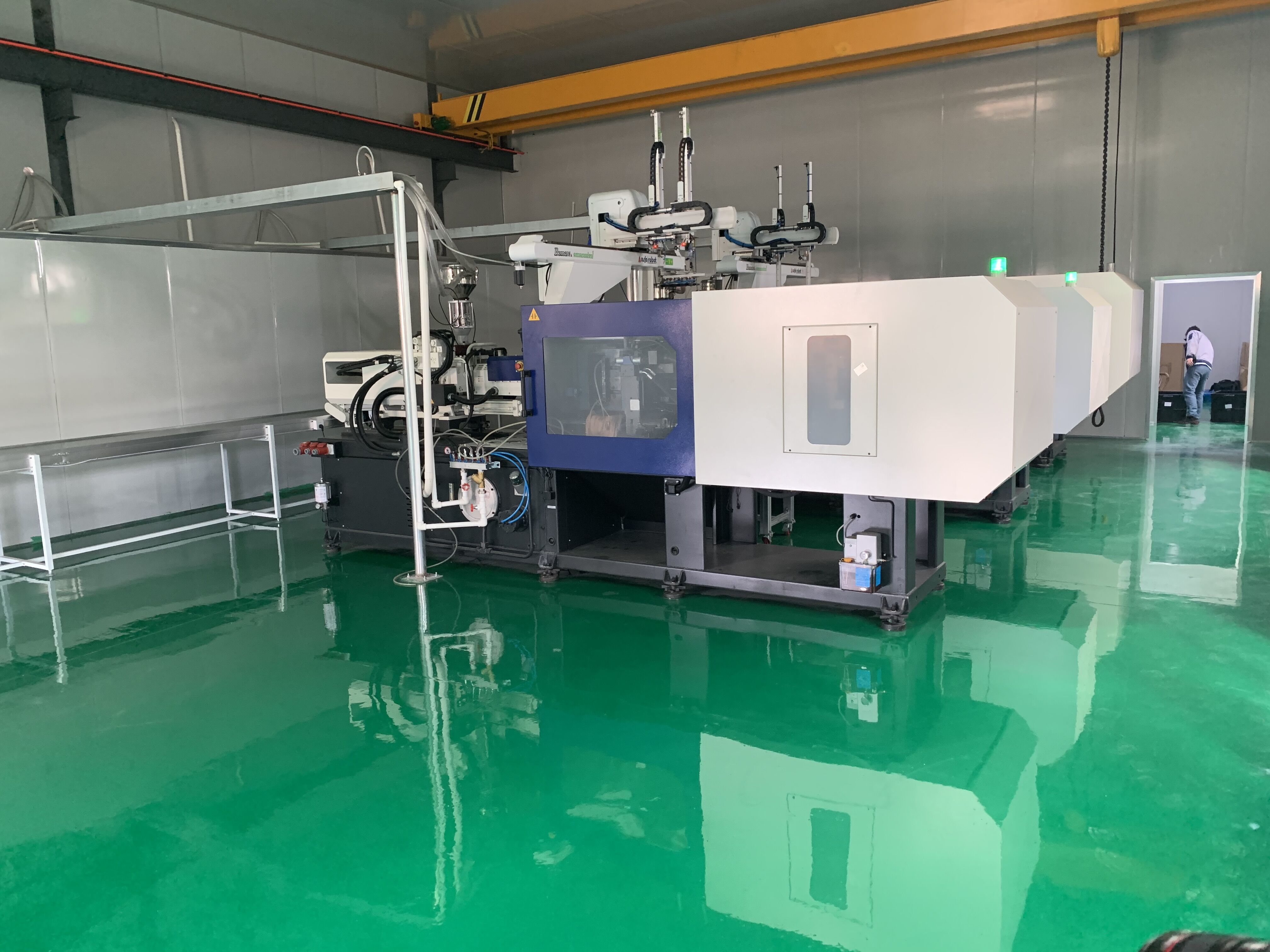
Capacity proof: stated monthly output of 100,000 units with a 10,000-unit minimum order quantity.
FAQ: Choosing Protective Packaging for Cannabis Concentrates
Which standards must a child-resistant jar for cannabis concentrates be tested against?
Two protocols define the benchmark. ISO/EN 8317 applies to the EU market and 16 CFR 1700.20 applies to the US market; both are designed to prevent access by children under five. Food-contact compliance is a separate file: SGS certificate NGBHL23005693401, issued 30 November 2023 under FDA CPG, lists the H19 vacuum packaging among the covered products for the US market, while SGS certificate NGBHL24007770101, issued 27 December 2025, confirms EC No 1935/2004 compliance for the violet glass range in Europe. Always ask for the certificate that names the exact model you are ordering.
Can concentrate jars be customised in shape, artwork and finish?
Yes, within the documented OEM and ODM scope. Honor Packaging operates at 45,000 square metres with 310 employees and a 15-person R&D team, and its documented customisation work includes printing client artwork, developing a new design and applying a frosted finish. The documented H19 configuration is a 5 ml square glass vacuum click jar; a different capacity or a round, triangular or hexagonal geometry is handled as a new-design project rather than a catalogue substitution, which means tooling and sample validation come before production.
What drives the minimum order and the unit cost?
The stated minimum order quantity is 10,000 units and the stated monthly capacity is 100,000 units. Cost is driven by the variables you choose: whether new tooling is required for a non-standard shape, which decoration method is applied, and the glass weight confirmed on the packing list. Rather than working from a generic range, request a quote against your actual specification, print file and destination market, because those three inputs change the answer more than volume alone does.
How is a sample validated before a full order?
Validation should cover child-resistance function, vacuum retention on the filled pack, closure behaviour after concentrate residue reaches the thread, label adhesion under humid conditions, and packing integrity at 250 pieces per carton. Honor Packaging combines a 100% pre-shipment test with third-party inspection by SGS, and its stated after-sales position is to accept reissue where a confirmed problem occurs. Sample requests for the H19 or the H21 violet glass range can be placed through the contact details below.
What lead time should be planned, and what happens after delivery?
The stated lead time is 30 to 45 days, counted from order confirmation, which is the window to build into a launch plan alongside artwork approval and sample sign-off. Honor Packaging exports 100% of production, with the EU, US, Middle East and Southeast Asia as its markets, and it operates close to the Ningbo and Shanghai seaports. The stated after-sales position is to accept reissue where a confirmed problem occurs. To start, send your specification and target market to info@honorpkg.com or message +86 15968944995 on WhatsApp for an H19 sample and a project quote.
What to Do Next
The decision sequence is short and repeatable: confirm the child-resistance protocol for your market, fix the capacity against the dose you sell, choose the light-control material, pick between a standard child-resistant cap and a vacuum click lid, validate everything on a filled sample, and only then lock MOQ and lead time. Buyers who run that sequence rarely have to re-engineer packaging after launch, which is the expensive version of the same work.
The H19 vacuum click jar covers the small-format end of that sequence with a documented 5 ml square glass body, 250 pieces per carton and coverage under SGS certificate NGBHL23005693401, while the H21 violet glass jars and the HDV range carry the EC No 1935/2004 food-contact certificate for European programmes. Where your project needs a geometry or capacity outside those configurations, the same framework applies; it simply becomes a new-design project with sample validation first.
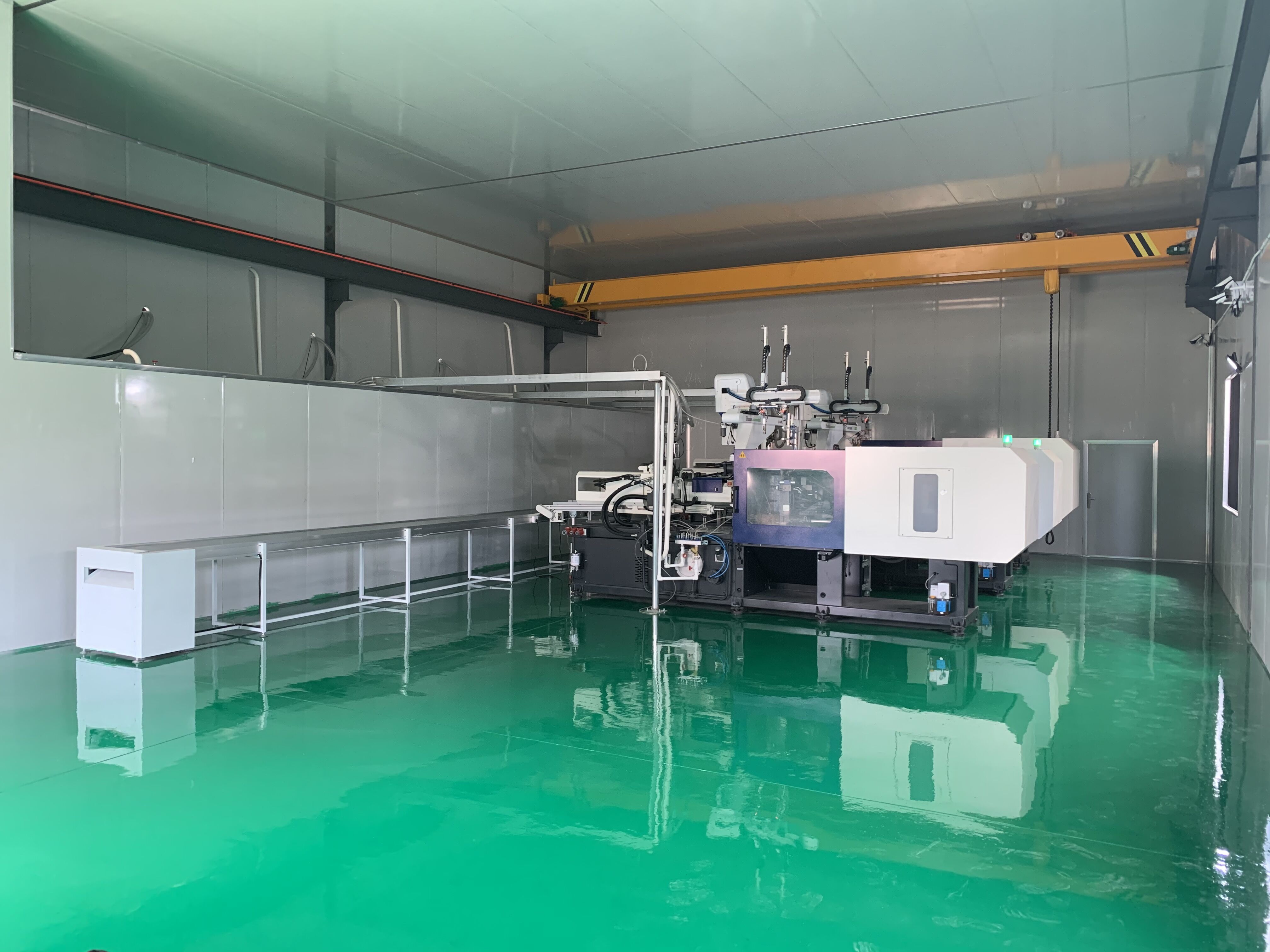
Request a sample or a project quote
Contact: Victor, Ningbo Honor Packaging Co., Ltd
Email: info@honorpkg.com | Tel: +86-574-88004632 / +86-15968944995
WhatsApp: +86 15968944995 | Website: www.honorcrpkg.com
Address: Rm.305, No.1 Building, No.568 SiMing East Road, YinZhou District, NingBo City, China
Have Questions or Need More Details?
Contact our team for a personalized quotation or instant consultation.
Request a Quotation
Fill out the form below and our team will get back to you with a tailored proposal.
WhatsApp Direct Chat
Prefer to chat in real-time? Message us on WhatsApp for instant assistance & quick answers.
- Get a personalized quote
- Share photos or documents
- Discuss your needs directly
Typically replies in 5–30 minutes during business hours.