
Child-Resistant Packaging Standards for Pharmaceuticals: What H21 and H19 Deliver
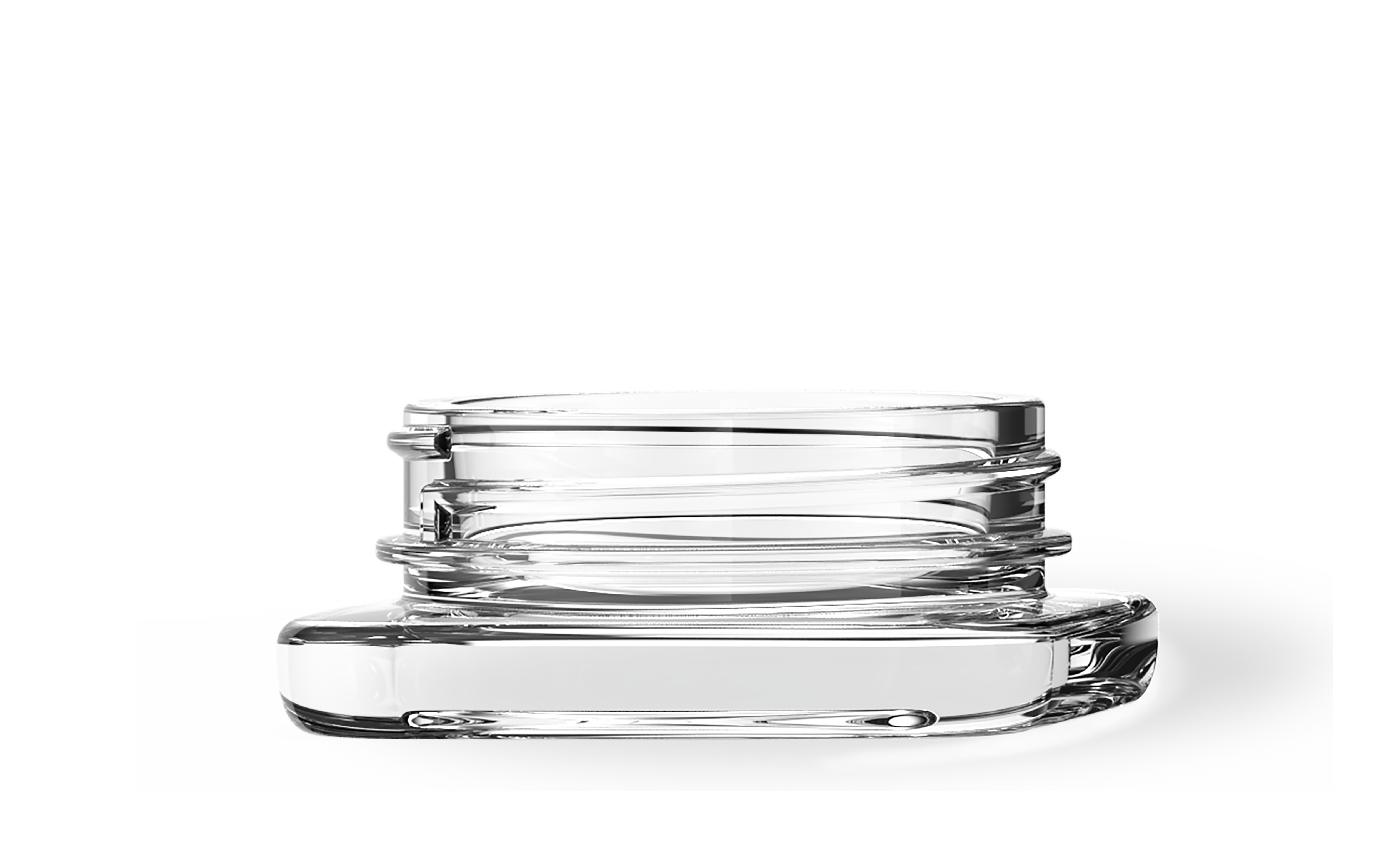
Cover: H21 clear square child-resistant glass jar, 15 ml (H21-0003C), Honor Packaging.
Pharmaceutical packaging compliance is decided at the closure, not at the carton. Under United States rules, special packaging obligations attach to the primary or immediate packaging of certain regulated products, which means the jar, the cap, and the way the two interact are parts of the pack a buyer cannot treat as an afterthought.
Honor Packaging (NINGBO HONOR PACKAGING CO., LTD) is a Ningbo, China–based packaging manufacturer founded in 2015 that builds child-resistant packaging, violet glass packaging, and vacuum packaging. Its stated export ratio is 100%, with the EU and USA as its main markets. Two of its product families come up repeatedly in pharmaceutical and medical packaging discussions: the H21 square jar series and the H19 series.
This article does three things. It sets out the child-resistant packaging standards pharmaceutical buyers actually have to satisfy. It maps H21 and H19 specifications — capacities, materials, closures, and surface treatments — against those requirements. And it gives a selection sequence that keeps a packaging decision traceable back to a compliance decision.
Problem Definition: Where Pharmaceutical CR Specifications Break Down
The hard part of pharmaceutical child-resistant packaging is not finding a jar. It is finding a jar whose capacity, material, closure, and decoration can all be locked in without breaking the compliance argument.
Three failure modes show up repeatedly in specification work:
- Closure mismatch. A jar can be described as child-resistant and still be the wrong closure type for the classification the product needs. ASTM D3475 classifies special packaging by the type of closure and the action needed to open it, so the closure mechanism — not a marketing description — determines the category a pack falls into.
- Capacity overreach. A child-resistant system validated at a small fill volume is not automatically transferable to a large one. Dose volume determines jar size, and jar size determines which stock item codes can even be considered.
- Decoration that arrives too late. Surface treatments add brand value, but they are applied to the same glass that has to work reliably with a closure. Decoration options have to be documented at the specification stage, not after tooling has been cut.
The H21 and H19 families are useful case material precisely because both are supplied with child-resistant caps as standard, which removes closure mismatch as a sourcing variable.
Industry Background: Standards and Market Scale
Two market figures frame the category. The global protective packaging market is valued at USD 41.5 billion in 2026 according to Grand View Research, while the child-resistant packaging segment is projected to reach USD 31.07 billion in the same year according to Global Market Insights. Child resistance is not a niche accessory bolted onto protective packaging — it is a substantial share of it, and it is being driven by regulatory pressure rather than consumer fashion.
The regulatory layer is where pharmaceutical buyers spend their time. In the United States, regulations issued under the Poison Prevention Packaging Act (PPPA) and FIFRA require special packaging for many regulated products, and that requirement applies to the primary or immediate packaging. The performance benchmark under 16 CFR 1700.20 is that a child-resistant package must prevent 85% of children under 5 from opening it within 5 minutes.
Internationally, two ISO standards define the testing frame. ISO 8317:2015 specifies performance requirements and test methods for reclosable child-resistant packages. ISO 14375:2018 does the same for non-reclosable child-resistant packages, and adds that such a package must be appropriate for the contents, provide mechanical protection, and function properly for the life of the content and packaging.
For jar-based pharmaceutical products, a reclosable glass jar with a screw or push-and-turn closure sits inside the ISO 8317 framing. That is why closure performance — not merely glass quality — is the variable buyers must be able to control when specifying protective packaging for a regulated fill.
Detailed Solution: How H21 and H19 Are Built
H21 clear square jars, 15 ml to 200 ml
The H21 clear square jar series is supplied with child-resistant caps and covers six stock item codes: H21-0003C at 15 ml, H21-0004C at 30 ml, H21-0005C at 70 ml (20 dr), H21-0006C at 100 ml (30 dr), H21-0007C at 130 ml (40 dr), and H21-0008C at 200 ml (60 dr).
All six share a 58 mm diameter and a square footprint. Heights range from 24 mm to 115 mm, weights run from 75 g to 280 g, and glass thickness is 0.38 mm. The documented material composition is glass, plastic, and PE — a glass body with plastic and PE components in the closure system.
The 15 ml to 200 ml span matters for pharmaceutical dose planning. A 15 ml jar suits a low-volume concentrate, while a 200 ml jar suits bulk powder or multi-dose solids. Both ends of that range use the same square footprint and the same child-resistant cap format, so a product line can scale across fill volumes without changing the opening experience.
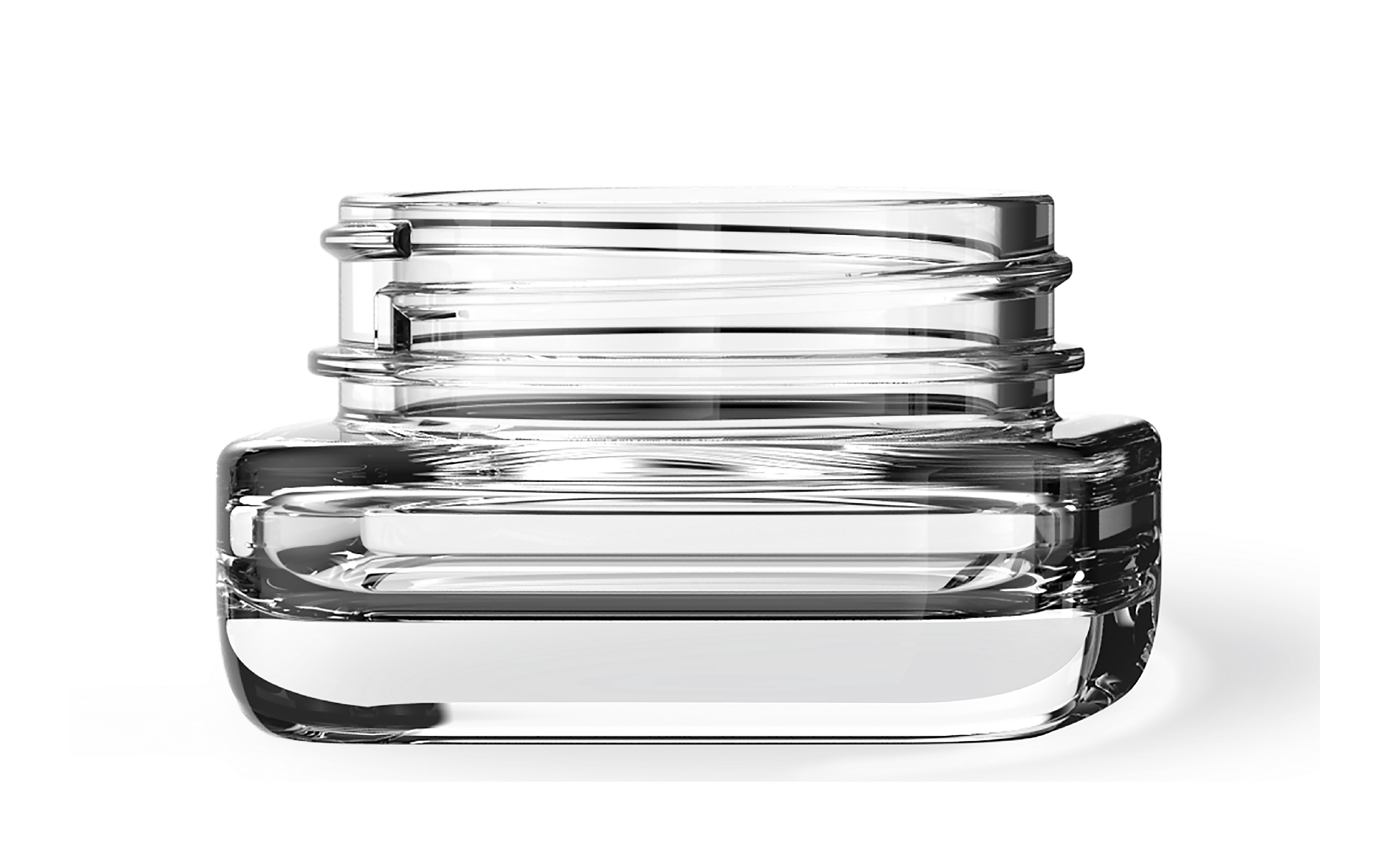
H21 clear square jar, 30 ml (H21-0004C), with child-resistant cap.
The same square architecture is also produced in violet glass under the H21-0003V to H21-0008V codes, with the same 58 mm diameter, the same 24–115 mm height range, the same 75–280 g weight band, and the same 0.38 mm glass thickness. Violet glass blocks the visible light spectrum except for UV-A and infrared, which is the property that places it in light-sensitive pharmaceutical and organic formulations. A buyer who needs child resistance and light protection together can therefore stay inside one jar footprint instead of re-engineering the pack around a different container.
H19 child-resistant concentrate jars, 5 ml and 9 ml
The H19 series is the small-volume counterpart, and it is where most pharmaceutical concentrate and sample-dose packaging lands.
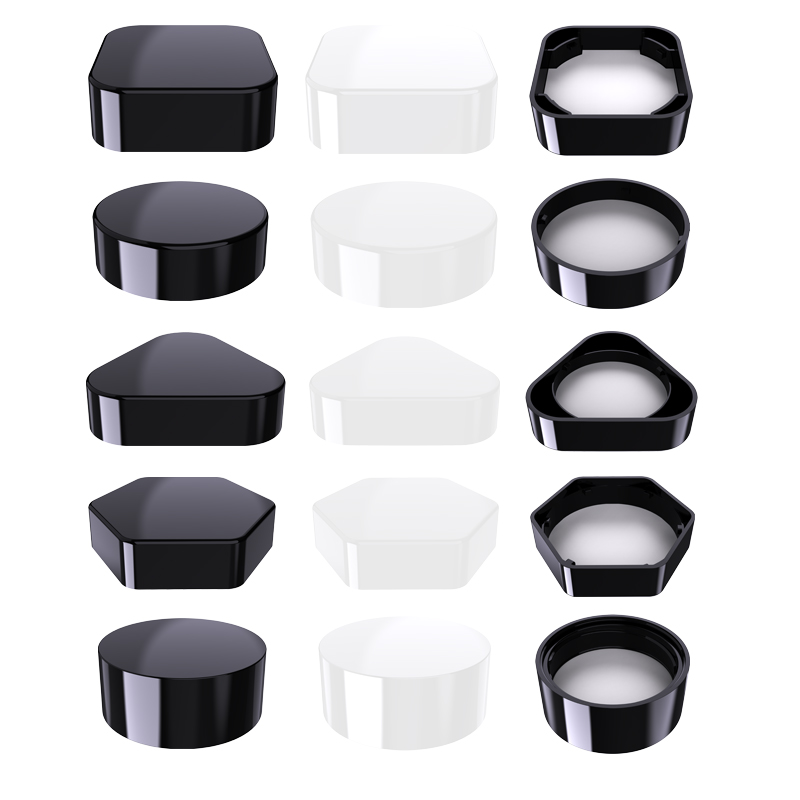
Child-resistant H19 concentrate jars are offered in 5 ml and 9 ml capacities across three color versions: clear (H19-xxxxC), white (H19-xxxxW), and black (H19-xxxxB). Each version carries nine item codes running from H19-0001 to H19-0011, and four shapes are available — square, round, triangle, and hexagon. Every version is supplied with a child-resistant cap.
Weights run from 27 g to 38 g for the clear and black versions, and from 27 g to 36 g for the white version. Carton quantity is 250 pieces across the H19 concentrate jar range.
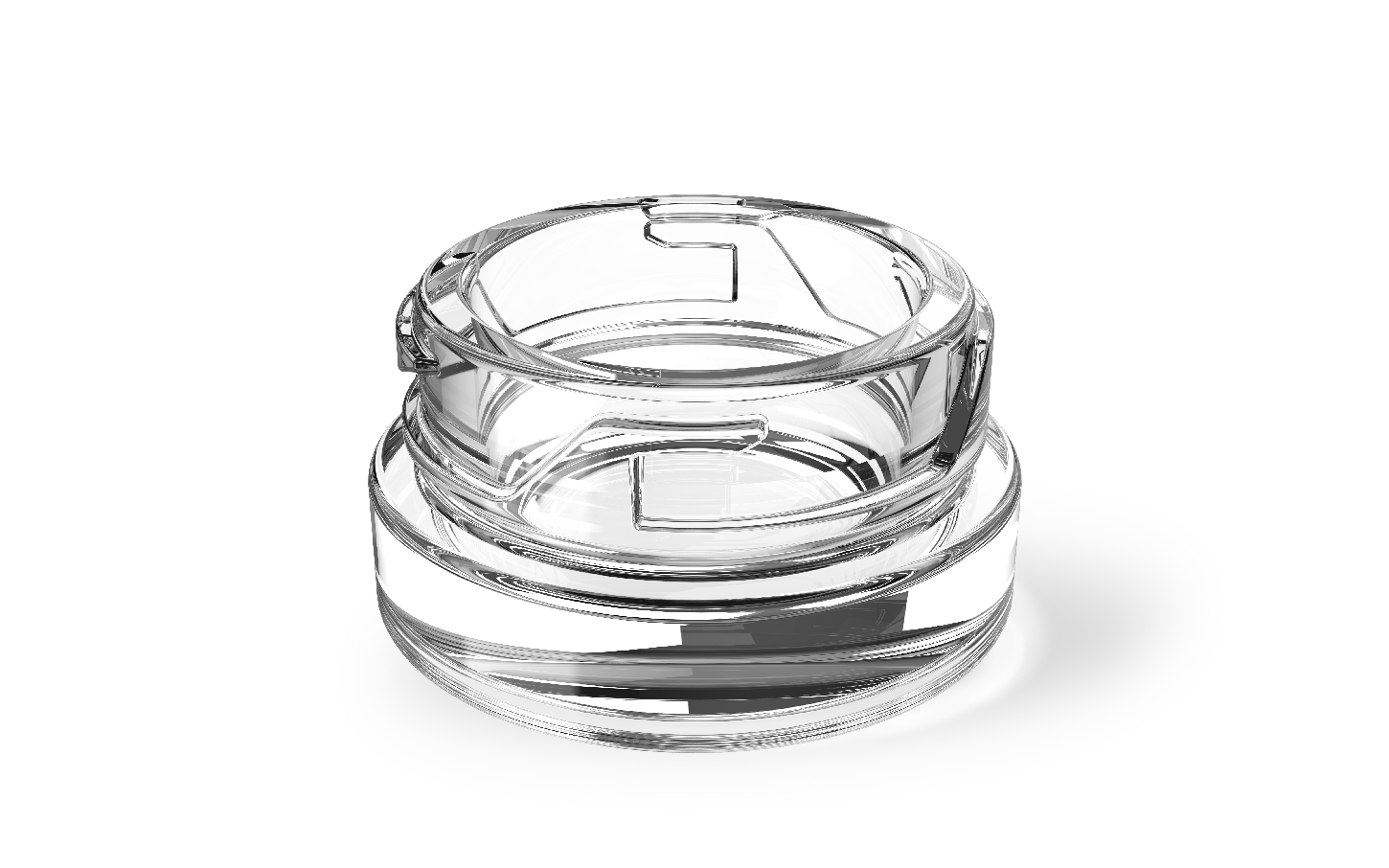
H19 clear concentrate jar, round shape, packed 250 pieces per carton.
For pharmaceutical buyers, the practical value of the color spread is light management at small volume. A clear H19 jar keeps contents visible for inspection and quality control; a black H19 jar limits light exposure for a photosensitive 5 ml or 9 ml fill. Both keep the same capacity and shape options and the same child-resistant closure.
The H19 vacuum click jar
The third option inside the H19 family is the vacuum jar: a 5 ml square glass jar with a vacuum seal, also named the Vacuum Click Jar. It ships 250 pieces per carton and is positioned for food, cosmetic, and medical applications. Where the requirement is preservation in an airtight, oxygen-limited environment rather than child resistance alone, the vacuum format lets a buyer hold the H19 footprint while changing the closure function. It complements the child-resistant H19 jars rather than replacing them.
Materials and surface treatments
Across both families the primary body material is glass. The H21 clear square series is documented as glass, plastic, and PE; the H19 concentrate and vacuum jars are documented as glass. In practice this means a glass container with a plastic or PE closure assembly, which is the standard architecture for a reclosable child-resistant glass pack.
Surface treatments on the H21 series include sticker, silk-screen printing, hot stamping, heat transfer printing, and frosted finish. Honor Packaging's stated customization scope covers printing client artwork, developing a new design, and frosted finishing.
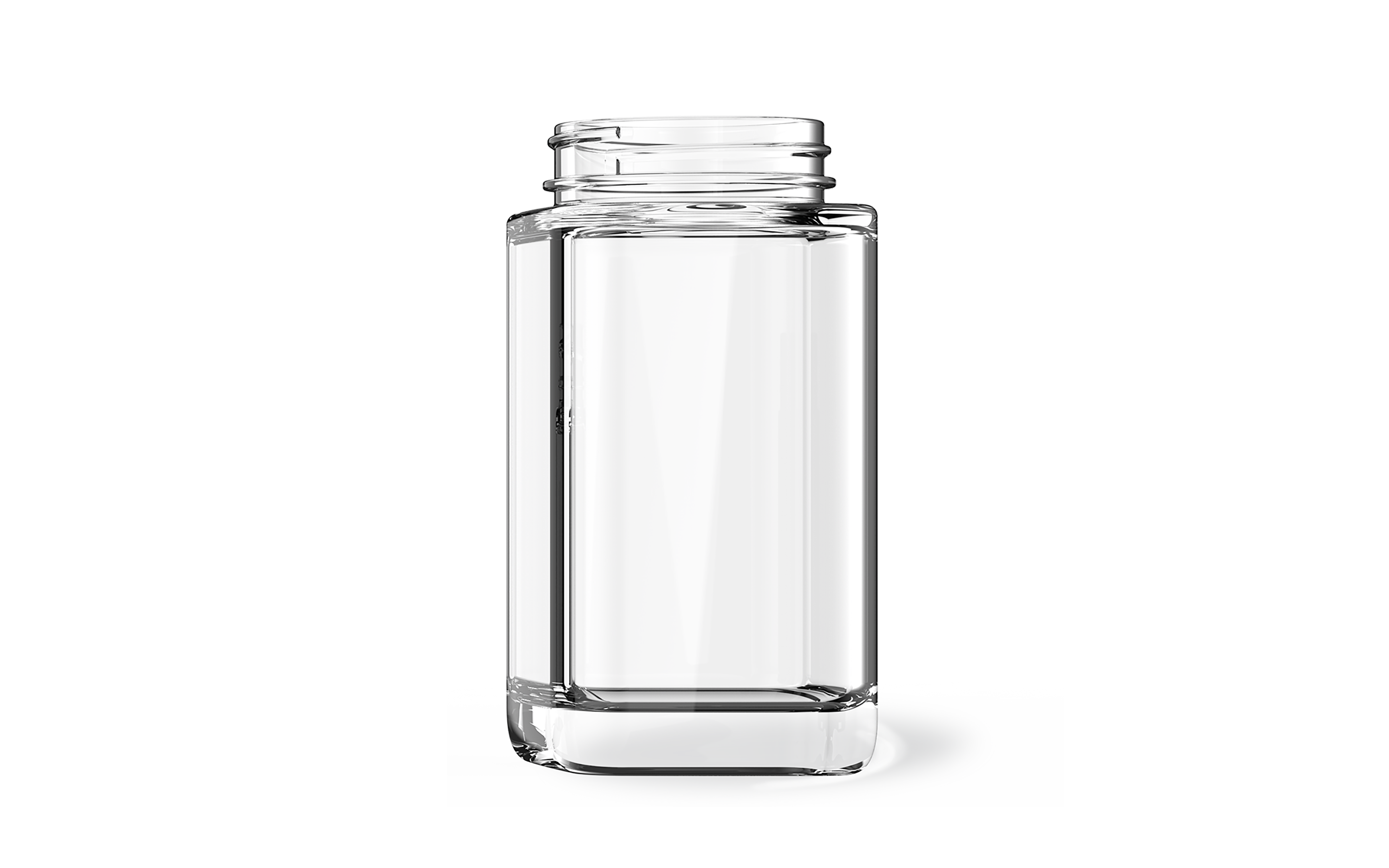
H21 clear square jar, 200 ml (H21-0008C) — the top of the 15–200 ml range.
These are specification-level decisions, not decoration afterthoughts. Silk-screen printing and hot stamping are applied to a defined print area on the jar body, and a frosted finish changes the surface character of the glass itself. Documenting which treatment is used, and on which item code, is what keeps a decorated jar and a compliant jar the same object.
Step-by-Step Breakdown: Selecting an H21 or H19 Package
- Confirm whether the product needs child-resistant primary packaging. Special packaging requirements under the PPPA and FIFRA apply to the primary or immediate packaging of certain regulated products. If that describes the product, the closure decision is a compliance decision before it is a design decision.
- Fix the fill volume before choosing a jar. A 5 ml or 9 ml fill maps to the H19 series. A 15 ml to 200 ml fill maps to the H21 series. Choosing the jar first and the fill volume second is how capacity overreach happens.
- Decide whether light protection is required in addition to child resistance. If the formulation is light-sensitive, the H21 square footprint is also available in violet glass, which blocks visible light except UV-A and infrared. At small volume, the H19 black version provides a light-limiting option in the same 5 ml and 9 ml capacities.
- Match the closure to a classification. ASTM D3475 classifies special packaging by closure type and by the action needed to open it. Confirm which closure category the product falls into before tooling is fixed, because the classification follows the mechanism.
- Specify the surface treatment at the same time. Sticker, silk-screen printing, hot stamping, heat transfer printing, and frosted finish are all available on the H21 series. Fixing decoration during specification prevents a late change that forces re-validation.
- Plan validation and quality control. Honor Packaging states that, before mass production, it is involved in product structural development, tooling strategy definition, and critical manufacturing risk assessment and validation. During production it uses 100% pre-shipment testing plus third-party inspection (SGS).
- Set the commercial envelope. Honor Packaging's stated terms are a minimum order quantity of 10,000 units, a monthly capacity of 100,000 units, and a lead time of 30 to 45 days, with production running through long-term joint-venture glass and plastic packaging bases. Export markets are the EU, US, Middle East, and Southeast Asia.
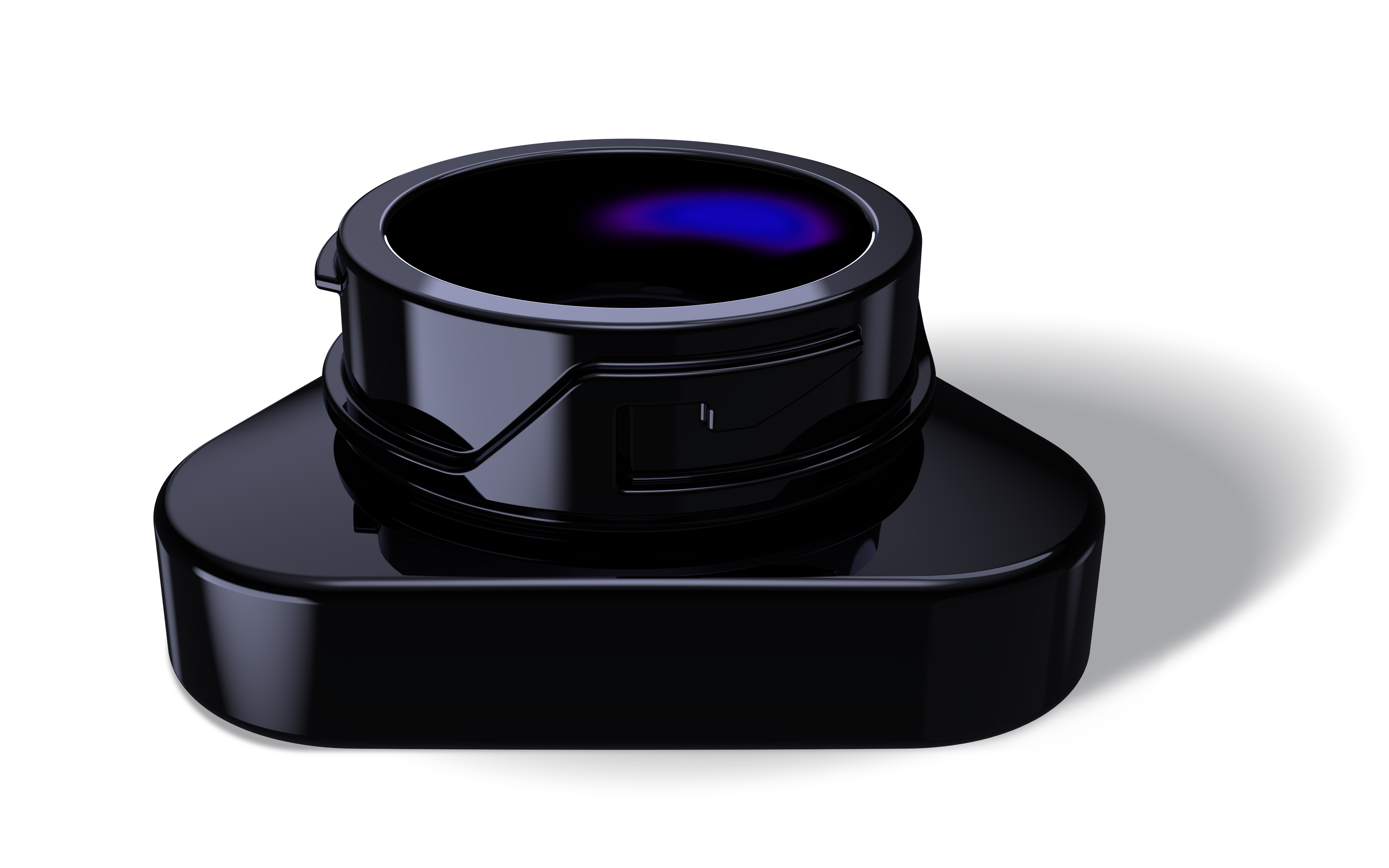
H19 black concentrate jar, triangle shape — light-limiting option at 5 ml and 9 ml.
Use Cases
Pharmaceutical and medical packaging. A German branding business ordered 10,000 units for pharmaceutical packaging and has been running the specification for three years. The reported result is that products stayed fresh through the period, with reusability and UV protection cited as the highlights. That combination — a reclosable child-resistant glass jar with light protection — is the configuration H21 in violet glass and the H19 range are built for.
Sample and trial-dose packaging. The H19 series at 5 ml and 9 ml is the appropriate scale for sample doses, clinic trials, and small-format concentrates. The four shapes (square, round, triangle, hexagon) let a brand differentiate visually without changing the closure category.
Supplement and nutraceutical packaging. The H21 series is documented for supplements alongside food, cosmetics, and medical applications, which makes the 30 ml, 70 ml, 100 ml, and 130 ml codes the working range for capsule and powder fills.
Cannabis concentrate packaging. Both H21 clear square jars and H19 concentrate jars are documented for cannabis applications. The child-resistant closure is supplied as standard rather than as an add-on.
H21 vs H19 at a Glance
| Specification | H21 Clear Square Jar | H19 Child-Resistant Concentrate Jar | H19 Vacuum Click Jar |
|---|---|---|---|
| Capacity | 15 / 30 / 70 / 100 / 130 / 200 ml | 5 ml, 9 ml | 5 ml |
| Shape | Square | Square / Round / Triangle / Hexagon | Square |
| Material | Glass / Plastic / PE | Glass | Glass |
| Closure | Child-resistant cap | Child-resistant cap | Vacuum seal |
| Diameter | 58 mm | Not stated in source data | Not stated in source data |
| Height | 24 mm – 115 mm | Not stated in source data | Not stated in source data |
| Weight | 75 g – 280 g | 27 g – 38 g (27 g – 36 g white) | Not stated in source data |
| Glass thickness | 0.38 mm | Not stated in source data | Not stated in source data |
| Pcs / ctn | Not stated in source data | 250 pcs | 250 pcs |
| Surface treatment | Sticker, silk-screen printing, hot stamping, heat transfer printing, frosted finish | Not stated in source data | Not stated in source data |
| Documented industries | Food, cosmetic, medical; pharma; cannabis; supplements | Food, cosmetic, medical | Food, cosmetic, medical |
FAQ: Pharmaceutical Child-Resistant Packaging
Which child-resistant packaging standards apply to pharmaceutical products?
In the United States, regulations issued under the Poison Prevention Packaging Act (PPPA) and FIFRA require special packaging for many regulated products, and the requirement applies to the primary or immediate packaging. The performance benchmark under 16 CFR 1700.20 is that a child-resistant package must prevent 85% of children under 5 from opening it within 5 minutes. ASTM D3475 classifies special packaging by closure type and the action needed to open it. Internationally, ISO 8317:2015 covers reclosable child-resistant packages and ISO 14375:2018 covers non-reclosable child-resistant packages. Buyers should confirm which of these applies to their specific product and market before locking a jar specification.
What capacities and materials do the H21 and H19 jars cover?
The H21 clear square jar series runs from 15 ml to 200 ml across six item codes (H21-0003C through H21-0008C, at 15 ml, 30 ml, 70 ml, 100 ml, 130 ml, and 200 ml), with a 58 mm diameter, a 24–115 mm height range, 75–280 g weight, and 0.38 mm glass thickness. Its documented material composition is glass, plastic, and PE. The H19 child-resistant concentrate jars cover 5 ml and 9 ml across clear, white, and black versions, in square, round, triangle, and hexagon shapes, at 27–38 g, packed 250 pieces per carton. H19 jars are documented as glass. A 5 ml square vacuum click jar is also available in the same H19 family.
What order quantities and capacity should a buyer plan around?
Honor Packaging states a minimum order quantity of 10,000 units and a monthly capacity of 100,000 units, which sets the practical floor for a custom run. Because both the H21 and H19 families are built on stock item codes rather than unique one-off molds, specification work concentrates on capacity selection and decoration instead of new tooling for every order. Buyers planning a first pharmaceutical run should size the MOQ against the fill volume per unit and the number of SKUs in the range.
How does sampling and pre-production validation work?
Before mass production, Honor Packaging states that it is involved in product structural development, tooling strategy definition, and critical manufacturing risk assessment and validation. Its customization scope covers printing the client's artwork, developing a new design, and frosted finishing. For a pharmaceutical specification, this is the stage where the jar, the closure, and the decoration are confirmed together, so a sample request should name the item code, capacity, and surface treatment rather than a jar size alone.
What are the lead times and quality controls?
Honor Packaging states a lead time of 30 to 45 days, backed by 100% pre-shipment testing and third-party inspection (SGS), with production running through long-term joint-venture glass and plastic packaging bases. After-sales support accepts reissue where needed. Buyers can request a sample or a quote by emailing info@honorpkg.com or visiting the Honor Packaging website to confirm the right H21 or H19 configuration for their product.
Conclusion
Child-resistant packaging standards for pharmaceuticals are decided by the closure, the capacity, and the material — in that order. H21 clear square jars cover 15 ml to 200 ml on a 58 mm square footprint with 0.38 mm glass and child-resistant caps, and the same footprint is available in violet glass for light-sensitive fills. H19 child-resistant concentrate jars cover 5 ml and 9 ml in four shapes and three color versions, with a vacuum click jar available where airtight preservation is the primary requirement.
For buyers in the research and evaluation stages, the sequence is straightforward: confirm the regulatory scope, fix the fill volume, decide on light protection, match the closure to a classification, specify the surface treatment, validate before production, and plan around a 10,000-unit MOQ and a 30–45 day lead time.
Next Step: Request a Sample or Quote
Send the item code, capacity, and surface treatment you are evaluating, and Honor Packaging can confirm the matching H21 or H19 configuration before tooling or production is committed.
Contact: Victor | Email: info@honorpkg.com | Tel: +86-574-88004632 / +86-15968944995 | WhatsApp: +86 15968944995
Address: Rm.305, No.1 Building, No.568 SiMing East Road, YinZhou District, NingBo City, China | Website: www.honorcrpkg.com
Have Questions or Need More Details?
Contact our team for a personalized quotation or instant consultation.
Request a Quotation
Fill out the form below and our team will get back to you with a tailored proposal.
WhatsApp Direct Chat
Prefer to chat in real-time? Message us on WhatsApp for instant assistance & quick answers.
- Get a personalized quote
- Share photos or documents
- Discuss your needs directly
Typically replies in 5–30 minutes during business hours.