
Supplement Packaging Long-Term Supply: A Repeat-Order FAQ
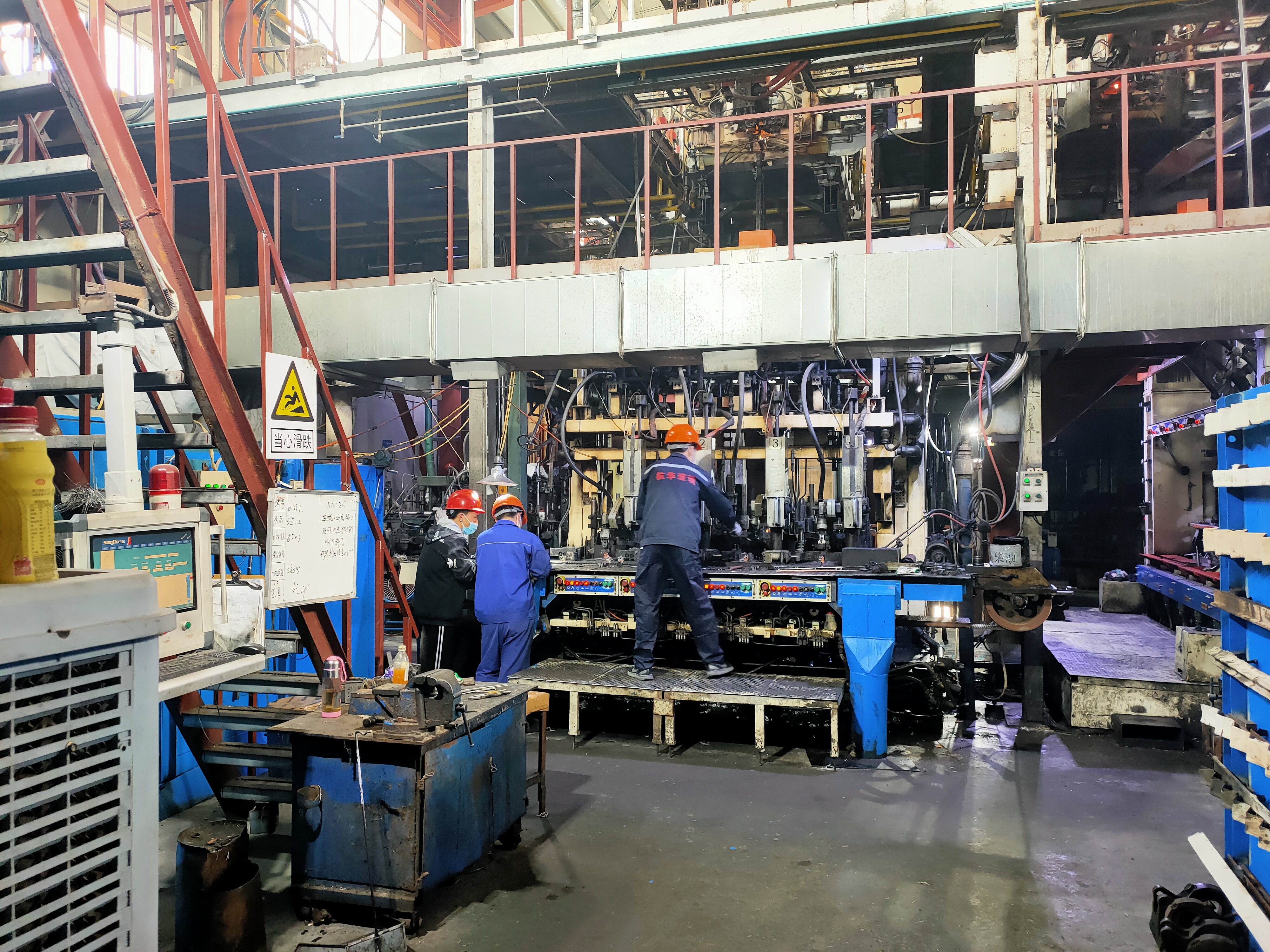
Approving a supplement jar is a discrete decision. Buying it for the next three years is a process. Between those two points sit the questions that rarely appear in a first quotation: which acceptance test applies to lot four rather than lot one, whether the minimum order quantity applies per format or per purchase order, whether the same gold stamping and the same dropper can be repeated twelve months later, and how glass is packed for a sea freight route.
This FAQ answers those questions for supplement brands moving from first approval into repeat supply. The formats referenced throughout are Honor Packaging's H19 5 ml vacuum jar, the H21 clear square child-resistant jar in 15 ml, 30 ml and 20–60 dr, the HDV2 violet jar from 3–200 ml, and the HDV3 violet bottle from 5–100 ml. Honor Packaging (Ningbo Honor Packaging Co., Ltd.) is a Ningbo, China-based packaging manufacturer founded in 2015 that specialises in child-resistant, violet glass and vacuum packaging and exports to the EU, US, Middle East and Southeast Asia.
Commercial and production statements below are drawn from Honor Packaging's published product and manufacturing information. Market and regulatory statements are attributed to their publishers and should be verified for your own market before they enter a specification.
What does long-term supply mean in supplement packaging?
Long-term supply is a repeatable production arrangement rather than a single purchase. In practice, four variables have to stay fixed while orders repeat: the format and capacity, the closure, the decoration, and the commercial and acceptance terms attached to the order.
A first order proves that a supplier can make a sample. A repeat order proves that the same supplier can reproduce it under a documented process, at an agreed volume, against a defined acceptance test, with a packing method that survives export. Those are different capabilities, controlled by different documents: a specification sheet, a purchase agreement, a pre-shipment inspection record and a packing standard.
The exposure is asymmetric for a brand. Packaging that fails on a first order delays a launch. Packaging that drifts on a fifth order can take a listed product out of stock, force a re-label, or push a retail listing past its replenishment window. That is why the questions in this guide are procedural rather than aesthetic.
Why approval leaves gaps that reappear at reorder
Most brand–supplier relationships begin with a sample. The brand approves a jar, a cap and a print, usually against one unit or a small set, and usually on visual and tactile grounds. That approval does not by itself define what “acceptable” means for a 10,000-unit production lot.
Three gaps typically surface at the first reorder. First, the approved sample captured a decoration effect but not the tolerance around it — a silk-screen print has an ink deposit and a registration, a gold stamp has an edge definition, a label has a placement window. Second, the closure was approved as a type rather than as a supply item: a dropper and a lotion pump on the same bottle are different components with different filling-line implications. Third, acceptance was discussed as an intention rather than written as a test.
None of these is a capability failure. They are specification gaps on the buyer's side, and they are cheapest to close between the first and second purchase order.
What is changing around supplement packaging that affects repeat orders
Three external signals are worth carrying into a repeat-order conversation, because each changes something a buyer might otherwise treat as settled.
Category scale. Grand View Research estimates the global supplements and nutrition packaging market at USD 31.3 billion in 2025, with plastic holding approximately 41.67% of the material segment share in that year. These are commercial research estimates rather than statistical or regulatory authority; they are useful for framing the category, not for pricing a specific jar.
Material compliance in the EU. Regulation (EU) 2024/3190 restricts bisphenol A in food contact materials, with the restriction applying to single-use food contact items from 20 July 2026. For a supplement brand, the practical consequence is that closure liners, coatings and any plastic component in contact with the product need a material statement that is still valid at the time of each production run. A declaration collected before the rule took effect is not automatically evidence for a later order.
Tamper evidence in the US. Published guidance summarised by Colorcon notes that tamper-evident packaging is not generally mandated at federal level for dietary supplements in the same way as for many over-the-counter drugs. That does not make tamper evidence unnecessary; it means the requirement more often comes from the brand, the retailer or the destination market than from a single federal rule. Buyers should confirm the applicable requirement per market instead of assuming a default.
Category demand in small formats. The same commercial research source estimates the global Shilajit market at USD 221.4 million in 2026, with liquid resin accounting for 40.5% of the category. Resin and liquid formats put more weight on small-capacity containers and on closure performance — which is why a 5 ml vacuum jar or a 5–100 ml violet bottle can sit in the same supply conversation as a 200 ml jar.
The four formats this FAQ refers to
Each of the four formats below raises a different reorder question. The pattern is consistent: what was approved as an appearance must become a written specification before volume repeats.
H19 5 ml vacuum jar
The H19 is a 5 ml vacuum jar, the smallest capacity in this set. Its supply risk concentrates in the closure assembly rather than the body: a vacuum format depends on the closure system working as one specified unit. At reorder, buyers should be able to point to a line item for the jar, a line item for the closure, and a line item for the packing configuration, because a substitution in any one of the three changes the approved product even when the jar looks identical.
H21 clear square child-resistant jars, 15 ml / 30 ml / 20–60 dr
The H21 is a clear square child-resistant jar supplied in 15 ml and 30 ml and in 20–60 dr capacities. Two properties drive repeat-order questions here. Clear glass makes decoration and content visibility part of the specification, and the child-resistant closure is a functional component rather than a finishing touch, so the closure model, closure colour and the opening and closing behaviour the brand approved all need to be named in the agreement.
Capacity designation is the other issue. Dram (dr) is a traditional small-volume designation used for pharmacy-style containers rather than a metric equivalent, and a 20 dr jar and a 60 dr jar are not interchangeable on a filling line. A purchase order should carry both the dram size and the millilitre capacity wherever the brand's artwork references capacity, so the filling line and the label agree.
HDV2 violet jars, 3–200 ml
The HDV2 is a violet glass jar range spanning 3 ml to 200 ml. Its distinguishing property is light transmittance. Honor Packaging's comparison of violet and amber glass identifies light transmittance as the main difference, describes violet glass as offering better protection against ultraviolet rays, and notes a cost difference of about 15% relative to amber. That is the supplier's own comparison; it is a starting point for a specification discussion, not a substitute for testing a formulation under the brand's own storage conditions.
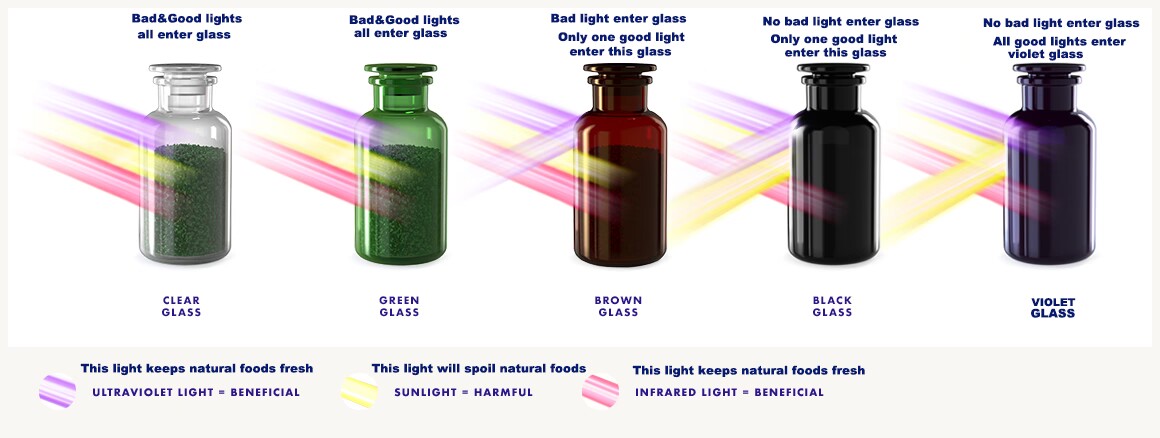
At reorder, the questions for violet glass are consistency questions: whether the violet tone is pinned to a retained reference sample, whether one tone must hold across the 3 ml and 200 ml ends of the range, and whether the artwork assumes a particular background colour behind the glass.
HDV3 violet bottles, 5–100 ml
The HDV3 is a violet glass bottle range from 5 ml to 100 ml, and it is defined as much by its closure and surface programme as by the bottle itself. Documented surface treatment options are label, silk-screen printing and gold stamping. Documented closures are plastic cap, dropper, mist sprayer and lotion pump.
That combination is where repeat-order drift is most likely, because a bottle can be identical while the closure and the decoration are not. A dropper and a lotion pump on the same bottle are different products for the filling line, the artwork and the acceptance test. A silk-screen print and a label are different decoration processes with different approval steps and different reorder timing. The supply agreement should therefore specify “HDV3, 5–100 ml, violet, silk-screen, dropper” rather than “HDV3, violet”.
Format comparison for repeat-order planning
The table below compares only documented characteristics. The final column lists the items a buyer should lock before the next purchase order; it is a planning checklist, not a product claim.
| Format | Documented capacity | Documented characteristics | Lock before the next PO |
|---|---|---|---|
| H19 | 5 ml | Vacuum jar format | Closure assembly, glass, packing configuration |
| H21 | 15 ml, 30 ml, 20–60 dr | Clear square jar with child-resistant closure | Closure model and colour, dram and ml notation on artwork, decoration |
| HDV2 | 3–200 ml | Violet glass jar; supplier comparison cites UV protection versus amber | Reference violet tone across sizes, artwork background, cost basis |
| HDV3 | 5–100 ml | Violet glass bottle; label, silk-screen or gold stamping; plastic cap, dropper, mist sprayer or lotion pump | Decoration process, closure type, capacity |
Source: Honor Packaging product information. Capacities and options as documented; no performance outcome is implied.
What purchasing terms belong in a long-term supply agreement?
For the formats above, Honor Packaging publishes the following commercial terms: a minimum order quantity of 10,000 units; FOB delivery terms; production arranged on receipt of a 30% down payment with the remaining 70% payable before shipment; a typical production lead time of 30–45 days; and a monthly production capacity of 100,000 units. The company also provides OEM and ODM production services and exports to the EU, US, Middle East and Southeast Asia.

Read as a set, those figures answer the question a brand asks after approval: how much must be committed, when payment falls due, and how long the cycle takes. They also define what the agreement still has to clarify:
- Whether the 10,000-unit minimum applies per format, per decoration or per combined order, since a brand running four SKUs needs to know how the threshold is counted.
- How the 100,000-unit monthly capacity is allocated across SKUs, and how far ahead a repeat run should be scheduled when several formats share the line.
- Which port the FOB term names. Honor Packaging is headquartered in Ningbo, close to the Ningbo and Shanghai seaports, so the loading port should be stated rather than assumed.
- What happens to a scheduled run and the down payment if the brand postpones or reduces a confirmed quantity.
None of these points requires new production capability. They require a written answer before the second order, when both sides still have room to negotiate without a shipment waiting at the port.
What should acceptance criteria cover on a repeat order?
Honor Packaging states pre-shipment test as its acceptance criterion, and describes quality control as 100% pre-shipment testing plus third-party inspection (SGS). Those statements define the supplier side of acceptance. The buyer side is the specification the test is measured against, and that specification has to exist in writing for the test to mean anything on a repeat order.
A workable acceptance annex for these formats covers:
- Product identity: format and capacity — for example H21 30 ml rather than “30 ml jar”, or HDV3 50 ml violet with a mist sprayer rather than “violet bottle”.
- Closure: the specific closure named on the approved sample, with colour where colour is part of the approval.
- Decoration: the process (label, silk-screen printing or gold stamping on HDV3) plus the retained reference sample the process is checked against.
- Packing configuration: foam wrap, pallet type and carton count per pallet, so that a packing change is a documented change rather than a surprise on arrival.
- Inspection basis: what is checked pre-shipment, who signs off, and what disposition applies to a lot that fails the check.
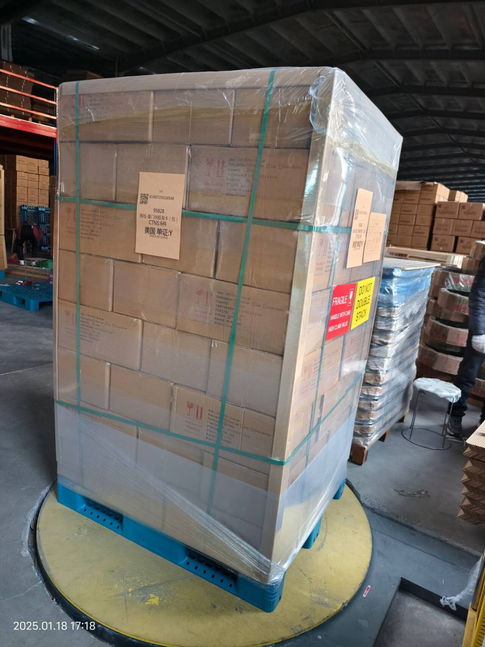
Transit is where glass packaging is most exposed once it leaves the line. Honor Packaging's stated control for fragile products is protective foam wrapping combined with careful palletised loading. For a repeat programme, the packing standard deserves the same attention as the jar specification, because a breakage rate that appears after arrival is usually a packing conversation rather than a glass conversation.
Step by step: from approval to a repeatable order cycle
The sequence below converts a first approval into a supply programme using only the documented terms above. Each step produces a document or a decision, which is what makes the next order repeatable.
- Fix the format and capacity per SKU. Write “H19 5 ml”, “H21 15 ml”, “H21 20 dr”, “HDV2 100 ml” or “HDV3 30 ml” rather than a generic jar description. Ambiguity at this step propagates into artwork, filling and acceptance.
- Fix the closure as a separate line item. For HDV3 that means naming plastic cap, dropper, mist sprayer or lotion pump. For H21 it means recording the child-resistant closure model and colour. A closure substitution is a product change even when the bottle is unchanged.
- Fix the decoration process. Label, silk-screen printing and gold stamping are three different processes with three different approval routes. Retain the approved decorated unit as the reference for every later lot.
- Confirm the commercial terms in writing. Minimum order quantity of 10,000 units, FOB delivery, 30% down payment with 70% before shipment, and a typical 30–45 day lead time. Record how the minimum is counted across multiple SKUs.
- Attach the acceptance annex. Pre-shipment test as the criterion, 100% pre-shipment testing and third-party inspection (SGS) as the stated quality control, and the buyer-side specification list in the previous section.
- Plan volume against monthly capacity. With 100,000 units per month stated as available capacity, a brand forecasting several formats should map its annual volume into monthly slots and identify the peak month before it arrives.
- Agree the packing and shipping route. Foam wrap and palletised loading for fragile glass; FOB port named; destination markets — EU, US, Middle East or Southeast Asia — stated so that any market-specific documentation requirement is raised at order stage rather than at the port.
- Review each lot against the reference sample. A short written review per shipment is what keeps a repeat programme stable; without it, drift is only discovered when a customer notices.
Use cases: where repeat-order questions concentrate
The right container depends on fill, viscosity, closure and market requirements, and this article does not recommend one format over another. What follows are the points that most often need resolution in each application pattern.
Resin and liquid extracts
Liquid resin formats put pressure on small capacities and on closure performance. In this range, the relevant options are the H19 5 ml vacuum jar and the HDV3 violet bottle from 5 ml upward, with dropper, plastic cap, mist sprayer or lotion pump as documented closures. The reorder questions are whether the same closure is quoted again, whether the fill line's torque setting is still valid for that closure, and whether the packing standard protects a heavier small bottle as well as it protects a jar.
Powder and capsule fills
Powder and capsule formats generally sit with the H21 clear square child-resistant jars at 15 ml, 30 ml and 20–60 dr, or the HDV2 violet jars up to 200 ml where light protection is part of the brief. The recurring questions are capacity designation (dram versus millilitre on artwork), closure consistency across sizes, and whether the same violet reference tone is expected across a 3 ml and a 200 ml jar in one range.
Cosmetic-adjacent oils and serums
Where a supplement brand also sells an oil or serum, the HDV3 range carries the widest closure programme: dropper, mist sprayer and lotion pump alongside a plastic cap, with label, silk-screen or gold stamping on the surface. The recurring question is decoration-plus-closure combination control, because that is where the highest number of variables sits in a single SKU.
Sample and trial sizes inside a commercial range
Small capacities — the 5 ml vacuum jar and the lower end of the HDV3 and HDV2 ranges — are often produced alongside full-size SKUs. The commercial question is how the 10,000-unit minimum applies when a small-size SKU sits in the same programme as a larger one, and whether small-format runs are scheduled inside the same 30–45 day cycle.
Frequently asked questions
Which compliance points should be re-confirmed before each repeat order?
Three. First, material statements for any component in contact with the product, because EU Regulation (EU) 2024/3190 restricts bisphenol A in food contact materials and applies to single-use food contact items from 20 July 2026 — a declaration collected earlier should be re-issued with a current validity date. Second, the tamper-evidence requirement for each destination market; published guidance summarised by Colorcon notes that tamper-evident packaging is not generally mandated at federal level in the US for dietary supplements in the same way as for many over-the-counter drugs, so the obligation usually comes from the brand, the retailer or the market itself. Third, any labelling requirement tied to the specific capacity on the artwork, particularly where a jar carries a dram designation.
Can the same format, decoration and closure be repeated on later orders?
The repeatable elements are the documented ones. HDV3 supports label, silk-screen printing and gold stamping, with plastic cap, dropper, mist sprayer or lotion pump as closures. H21 is supplied as a clear square child-resistant jar in 15 ml, 30 ml and 20–60 dr. HDV2 runs from 3–200 ml and HDV3 from 5–100 ml in violet glass, and the H19 is a 5 ml vacuum jar. Repetition depends on the purchase order naming the format, capacity, closure and decoration process explicitly, and on a retained reference sample that both sides accept as the standard.
What are the purchasing terms and acceptance criteria?
Honor Packaging states a minimum order quantity of 10,000 units and FOB delivery terms. Payment is arranged as a 30% down payment at production scheduling, with the remaining 70% payable before shipment. The stated acceptance criterion is a pre-shipment test, supported by quality control that includes 100% pre-shipment testing and third-party inspection (SGS). Typical production lead time is 30–45 days, with monthly production capacity of 100,000 units.
What should a reorder sample prove before a full run is scheduled?
A reorder sample should prove three things that a first-approval sample often does not: that the decoration process produces the approved effect on the current lot, that the named closure fits and functions as approved, and that the packing configuration protects the unit in transit. Ask for the sample to be produced with the same decoration process and the same closure that the purchase order names, and keep it as the reference for the following lot. Honor Packaging provides OEM and ODM production services, so where a design change is involved, the sample should also confirm that the change is manufacturable before volume is committed.
What lead time and monthly capacity should a brand plan against?
Plan against a typical production lead time of 30–45 days and a stated monthly production capacity of 100,000 units. Two adjustments make those figures usable. Add transit time for the destination market — the company exports to the EU, US, Middle East and Southeast Asia — and map multi-SKU programmes onto the monthly capacity so that peak months are scheduled rather than discovered. Where a launch date is fixed, the order should be placed against the lead time plus the pre-shipment inspection step, not against the lead time alone.
How is breakage controlled in export packing?
Honor Packaging's stated control for fragile products is protective foam wrapping combined with careful palletised loading. For a long-term programme, the practical step is to write the packing configuration into the supply agreement — foam wrap, pallet type and carton count per pallet — so that the packing standard is reviewed alongside the product specification at each order.
What is the next step if a brand wants to move from approval to a supply programme?
Convert the approved sample into a written specification covering format, capacity, closure, decoration and packing, then confirm the commercial terms — 10,000-unit minimum, FOB delivery, 30% down payment with 70% before shipment — and the acceptance annex before the second purchase order is issued. Brands that want to review the range first can download Honor Packaging's product brochure or request a sample and a quotation for the specific formats under consideration.
Conclusion
Long-term supply in supplement packaging is decided by the documents a brand writes between approval and the second order, not by the quality of a single sample. The formats in this guide — H19 5 ml vacuum jars, H21 clear square child-resistant jars in 15 ml, 30 ml and 20–60 dr, HDV2 violet jars from 3–200 ml and HDV3 violet bottles from 5–100 ml — are stable product families. What varies on a repeat order is the closure, the decoration, the packing and the acceptance basis.
The commercially useful discipline is therefore narrow and practical: name the format and capacity exactly, name the closure and the decoration process, write the pre-shipment test into the agreement with a specification behind it, and plan volume against the 30–45 day lead time and 100,000-unit monthly capacity with the FOB port stated. A brand that does those four things turns a packaging approval into a supply arrangement it can audit — and keeps the conversation on the next design change instead of the last delivery.
Have Questions or Need More Details?
Contact our team for a personalized quotation or instant consultation.
Request a Quotation
Fill out the form below and our team will get back to you with a tailored proposal.
WhatsApp Direct Chat
Prefer to chat in real-time? Message us on WhatsApp for instant assistance & quick answers.
- Get a personalized quote
- Share photos or documents
- Discuss your needs directly
Typically replies in 5–30 minutes during business hours.