
Solving the Child-Resistant Packaging Puzzle: Which Glass Jar Fits Your Product?
Solving the Child-Resistant Packaging Puzzle: Which Glass Jar Fits Your Product?
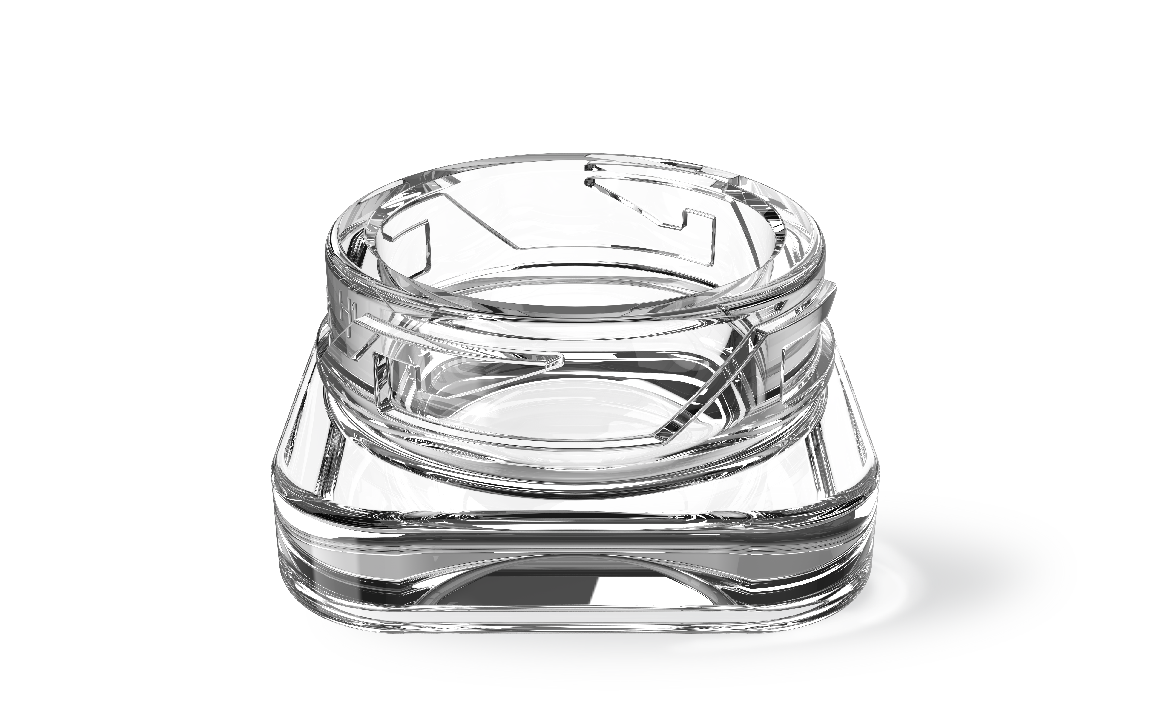
Child-resistant packaging decisions rarely fail because someone ignored the problem. They fail because the decisions are made in the wrong order. Fill volume, shape, closure, barrier and decoration all lock each other in place, and most teams discover this only after they have already picked a jar from a catalog photo.
This guide untangles that puzzle with specifications rather than opinions. It compares the two glass jar families most protective packaging projects end up choosing between: the compact H19 child-resistant series in 5 ml and 9 ml, offered in square, round, triangle and hexagon shapes, and the larger H21 clear square jar, which spans 15 ml to 60 dr from a single 58 mm diameter. Both are produced by Honor Packaging (NINGBO HONOR PACKAGING CO.,LTD), a Ningbo-based packaging manufacturer founded in 2015 that supplies export markets including the EU and the USA.
Quick answer: For fills of 5 ml and 9 ml, the H19 child-resistant glass series — available in square, round, triangle and hexagon shapes across black (B), white (W) and clear (C) item codes — is the practical starting point. For fills from 15 ml up to 60 dr, the H21 clear square jar covers the whole range at one 58 mm diameter, with a 0.38 mm glass wall and a child resistant cap.
The Packaging Puzzle: Three Decisions That Lock Each Other
Child-resistant packaging has to satisfy two requirements that pull in opposite directions. The closure must be difficult enough to keep a child under five out, and predictable enough for an adult — or a filling line — to close it reliably, order after order. Neither property lives in the glass. Both come from the jar-plus-closure system, which is why H19 and H21 jars are specified together with a child resistant cap rather than as glass bodies alone.
Within that system, three decisions lock each other in place. Changing one after the fact usually forces the other two to move:
- Fill volume. A 5 ml or 9 ml fill points to a compact jar; a 15 ml to 60 dr fill needs a wider body. Over-speccing leaves excess headspace and a product that shifts in transit; under-speccing means re-tooling after the sample stage.
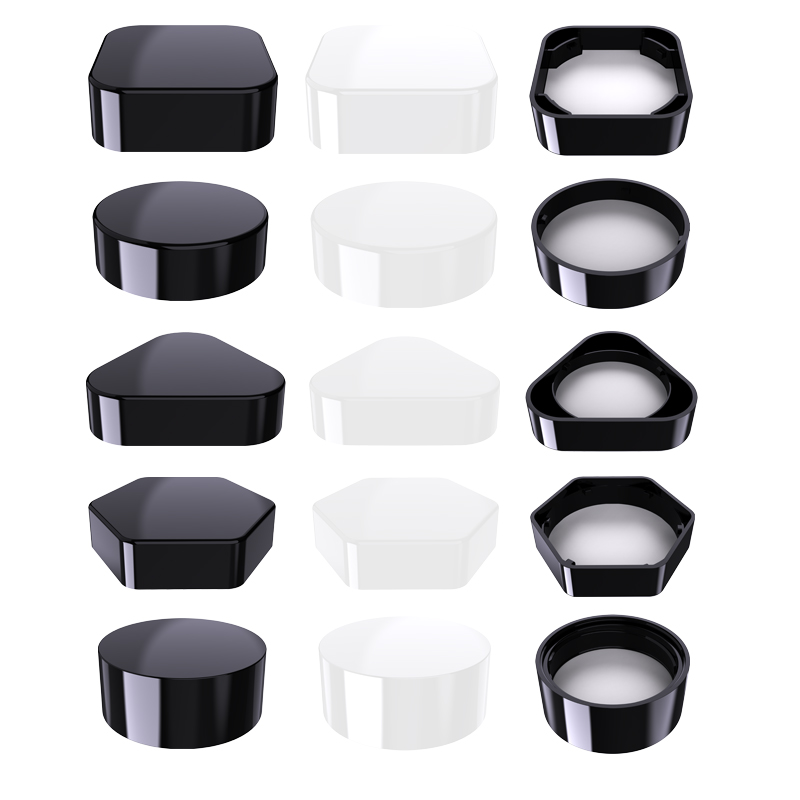
- Shape and label plan. The H19 series offers square, round, triangle and hexagon bodies at the same capacity band. Each geometry presents a different silhouette on shelf and a different amount of flat surface for decoration, so shape should follow the label plan rather than precede it.
- Barrier requirement. Airtightness, odour containment and light blocking are structural choices, not add-ons. A clear jar cannot be made light-blocking after the fact, and a standard screw closure cannot be turned into a vacuum seal by tightening it more.
The cost of solving this puzzle late is concrete: a second sample round, a delayed launch, or a jar that passes quality control but never sits well on a retail shelf. Working in the order above removes most of that risk before any tooling is committed.
Industry Background: A Growing Market With Tighter Specifications
Protective packaging continues to expand. Fortune Business Insights valued the global protective packaging market at USD 44.02 billion in 2025 and projects USD 80.25 billion by 2034, while Grand View Research estimated the same market at USD 40.4 billion for 2025. The gap between the two figures reflects how each research firm draws the category boundary rather than a disagreement about direction.
Within that spend, flexible formats dominate: Grand View Research attributes a 66.4% revenue share to the flexible segment, and paper and paperboard alone held 45.7% of protective packaging revenue in 2025. Fortune Business Insights expects the secondary packaging segment to hold 48.54% of the broader packaging market by 2026. The suppliers named most often in these reports — Sealed Air Corporation, Smurfit Westrock, Mondi Group and Amcor plc — work largely in films, cushioning and paper-based protection. Rigid glass containers with child-resistant closures sit in a much narrower niche, but it is a niche where specification discipline decides whether a launch ships on time, which is why a partner focused on structural development and process control matters more here than scale alone.
Regulation pushes in the same direction. In the European Union, child-resistant packaging is evaluated against ISO/EN 8317; in the United States, the reference is 16 CFR 1700.20 from the CPSC. Both standards exist to prevent access by children under five, and both test the closure together with the container — not the glass by itself.
Light protection is the other moving part. Violet, or biophotonic, glass is described by Miron Violetglass as a natural filter that blocks visible light while allowing 25%–45% UVA and 60% infrared light to penetrate. That figure is published by a glass producer rather than an independent laboratory, so it is best treated as a category reference: buyers with light-sensitive fills should validate their own product inside the exact jar they intend to ship.
The Solution: H19 Compact Jars and the H21 Clear Square Jar
The selection rule is short. If the fill is 5 ml or 9 ml, start with the H19 series. If it is 15 ml or larger — up to 60 dr — the H21 clear square jar covers the range without changing diameter, which keeps caps, cartons and filling tools consistent as a product line grows from a sample size to a bulk size.
H19: A 5 ml and 9 ml Family in Four Shapes
H19 is a compact glass jar series built for concentrate-scale fills. Capacity is 5 ml or 9 ml, and each finish runs through the same item-code sequence, H19-0001 to H19-0011, where the suffix identifies the finish: B for black, W for white, C for clear. Every finish is available in four shapes — square, round, triangle and hexagon — and every jar ships with a child resistant cap.
Shape is encoded in the item code, which makes reordering precise once a specification is locked. In the clear finish, H19-0001C is the square body, H19-0004C is round, H19-0007C is hexagon and H19-0008C is triangle. Jar weight is 27 g to 38 g in the black and clear finishes and 27 g to 36 g in white, and the series is packed 250 pieces per carton. The material is glass, and the listed application industries are food, cosmetic and medical packaging.
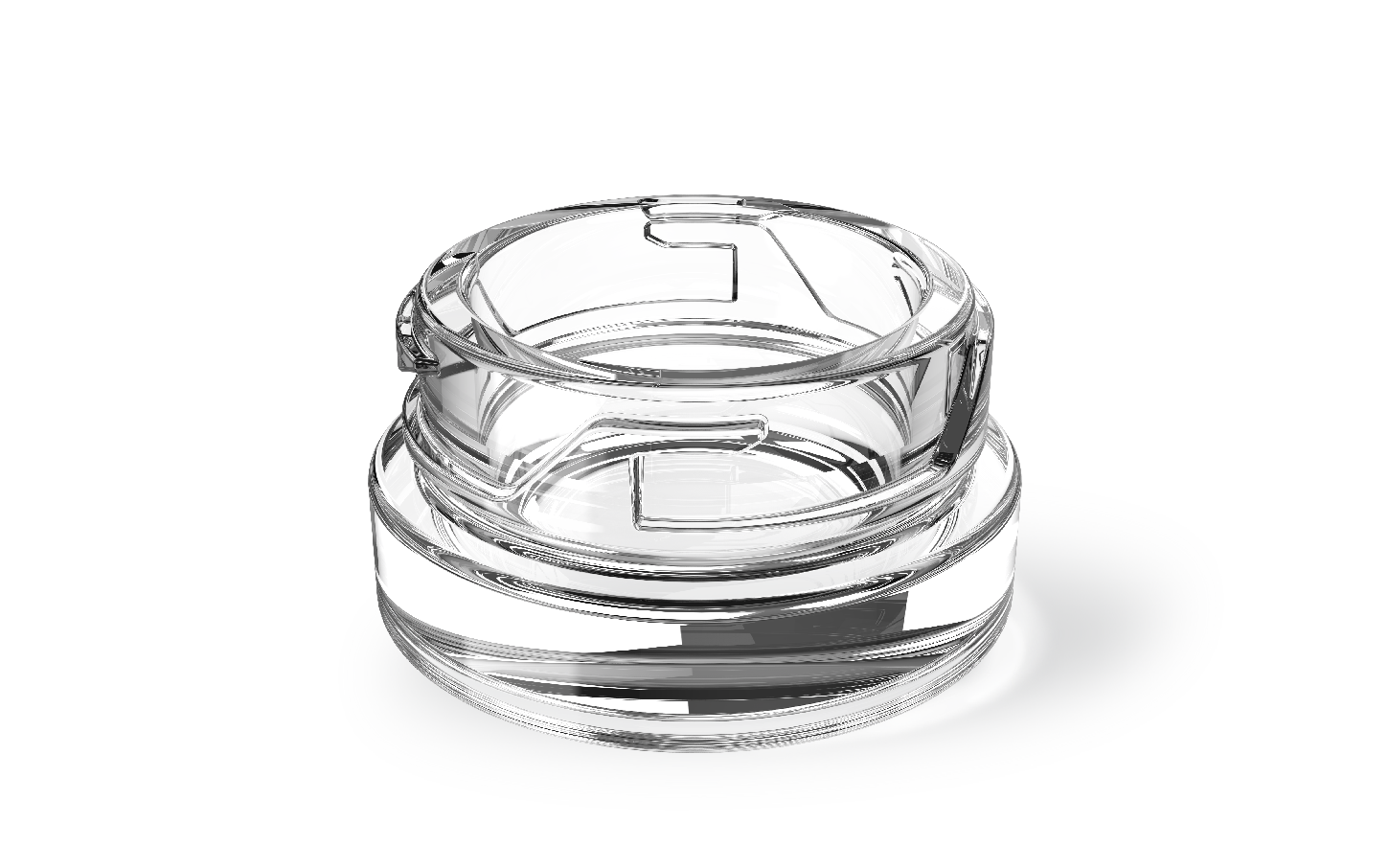
Shape choice is rarely cosmetic in this range. A square or hexagon body gives a brand more flat, uninterrupted surface for silk-screen printing or labels, while a triangle body creates a distinct grip and a recognisable silhouette on a crowded shelf. Round bodies remain the default when the fill needs a smooth interior and simple handling on a filling line.
H21 Clear Square: 15 ml to 60 dr at One 58 mm Diameter
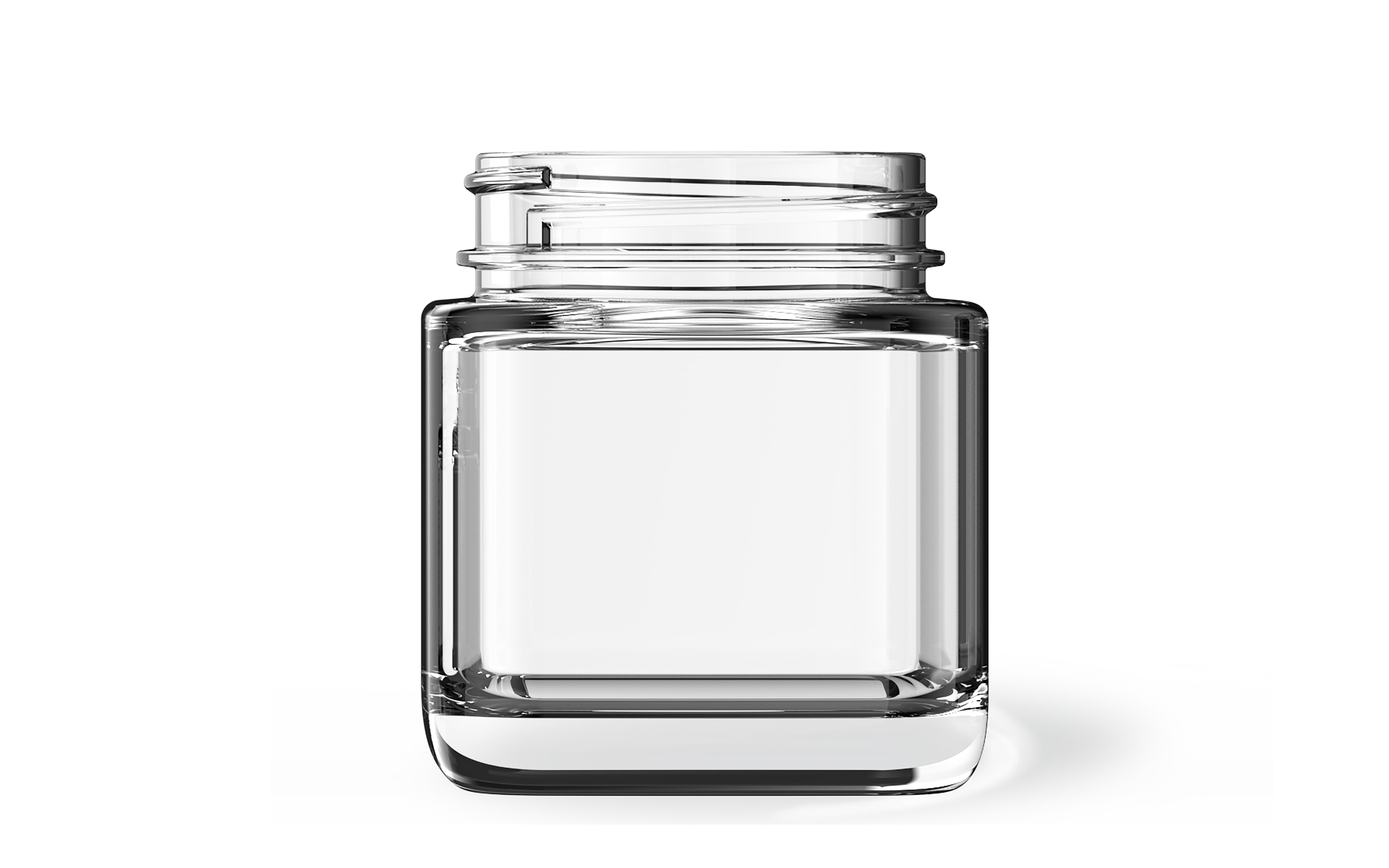
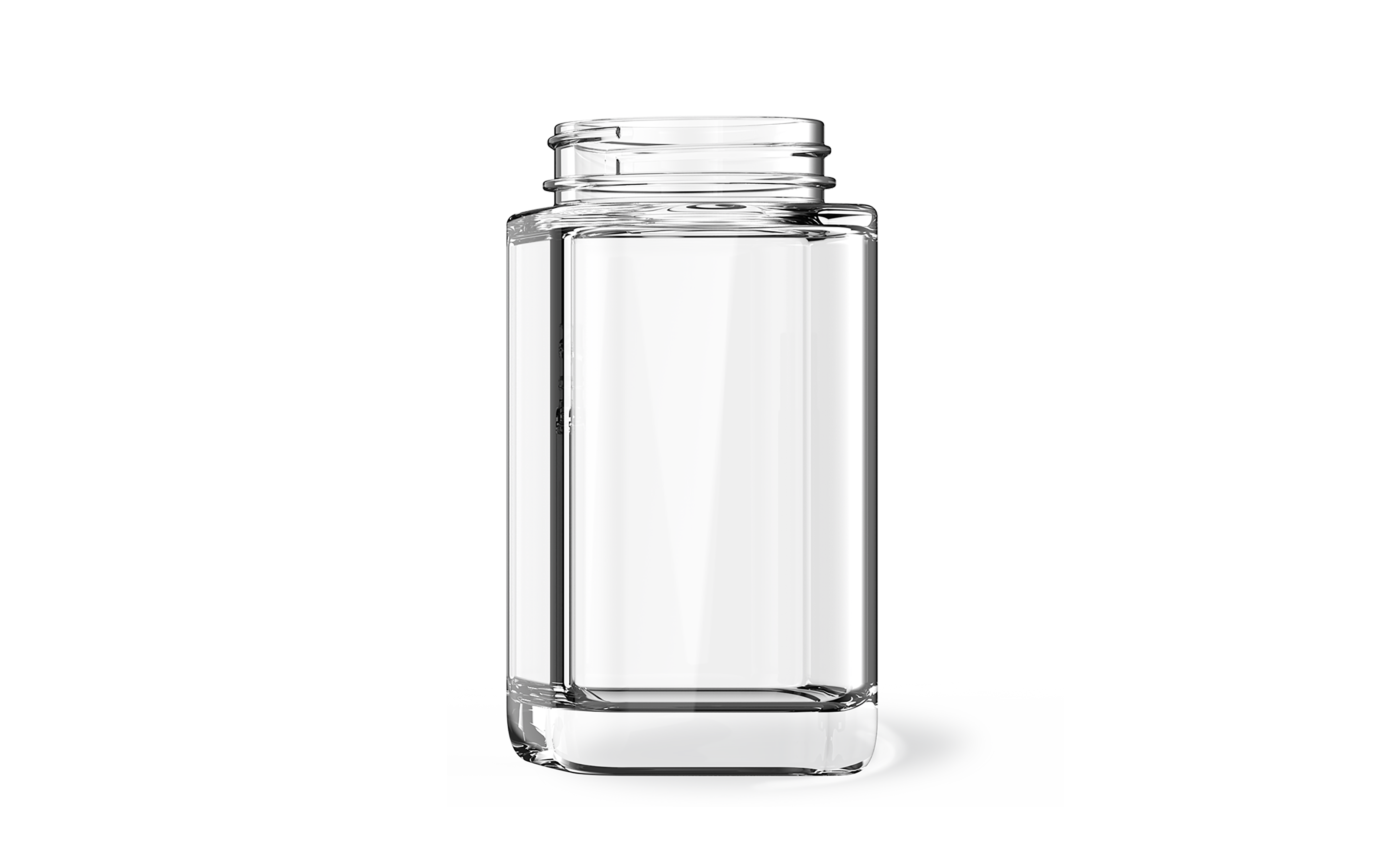
H21 is the step up in scale. The clear square version covers 15 ml, 30 ml, 20 dr, 30 dr, 40 dr and 60 dr through item codes H21-0003C to H21-0008C, all sharing a 58 mm diameter. Heights run from 24 mm to 115 mm and weights from 75 g to 280 g, so the same cap and the same footprint serve everything from a 15 ml sample jar to a 60 dr bulk format.
Glass thickness is 0.38 mm across the range. That number belongs in your own specification document, because wall consistency is what keeps capping torque, fill-line behaviour and drop performance repeatable from order to order. The jar is supplied with a child resistant cap, and the material specification is glass with plastic and PE components. Listed industries include food, cosmetics and daily chemicals, pharmaceutical and medical products, cannabis, supplements, packaging design and packaging wholesale.
When the Fill Needs More Than Child Resistance
Two variants extend the same logic. The H19 vacuum jar — the 5 ml Vacuum Click Jar — replaces the standard screw closure with a vacuum seal in the same square 5 ml format, packed 250 pieces per carton. It is the option for airtight and smell-proof requirements, where oxygen and odour control matter as much as child resistance.
The H21 violet version uses the same dimensions and the same 0.38 mm wall as the clear square jar, but in violet glass with PP and PE components; item codes run H21-0003V to H21-0008V across 15 ml to 60 dr, and a round violet variant covers 30 ml to 6 oz at a 60 mm diameter. Violet glass is the choice when light exposure — not visibility — is the dominant risk to the fill.
Above 60 dr, the range moves to wide-mouth formats. The HDV1 wide mouth violet series spans 100 ml to 1 L (diameter 48 mm to 95 mm, height 84.7 mm to 193 mm, weight 117 g to 610 g, 0.38 mm wall). The HDV2 cosmetic violet jars cover 3 ml to 200 ml, and the HDV3 round violet bottles run 5 ml to 100 ml with a plastic cap, dropper, mist sprayer or lotion pump as the closure.
Closures, Materials and Surface Treatment
Across the H19 and H21 ranges the closure is a child resistant cap, and material combinations are listed as glass with plastic, PP or PE components depending on the model. Decoration options are consistent across the larger formats: sticker, silk-screen printing, hot stamping, heat transfer printing and frosted finish. Honor Packaging operates in both OEM and ODM modes — printing client artwork, developing new designs and applying finishes such as frosted glass — so a jar can reach the filling line already carrying the brand's identity.
Step-by-Step: Matching a Jar to Your Product
Working in this order prevents the rewrite that costs an extra sample round:
- Fix the fill volume, including headspace. 5 ml and 9 ml fills point to H19; 15 ml and above point to the H21 clear square. Settle this number before looking at shapes, because it eliminates an entire product family in one decision.
- Choose the shape and lock the item code. Square, round, triangle and hexagon bodies at the same capacity serve different shelf and handling strategies. The purchase order should carry the code — H19-0004C for the round clear 5 ml body, for example — rather than a description such as "small round jar".
- Confirm the closure and the compliance route. Child resistance belongs to the jar-plus-closure system. For an EU launch, ISO/EN 8317 is the reference; for the US, 16 CFR 1700.20. Decide early which protocol applies to your market and who documents the result.
- Match the barrier requirement. Clear glass where the product is stable and visible; violet glass where light exposure is the risk; the vacuum click jar where air and odour are the risk. The 0.38 mm wall on H21 formats keeps physical performance consistent across every capacity you order.
- Finish with decoration and commercial terms, then validate. Surface treatment, the 10,000-unit minimum order, the 30–45 day lead time and monthly capacity of 100,000 units all shape the launch plan. A pre-production validation run confirms closure performance and fill fit before mass production starts.
Use Cases: Which Jar Fits Which Product
Pharmaceutical and medical packaging. This is one of the listed application industries for both the H21 clear square and the violet H21 formats. A Germany-based branding business has packed pharmaceutical products in Honor's violet glass packaging for three years, ordering in 10,000-unit quantities; the reported outcome is that contents have remained fresh, with reusability and UV protection named as the main benefits of the format.
Cannabis and concentrate products. The 5 ml and 9 ml H19 jars are built for concentrate-scale fills, and the three finishes carry different functions: black and white bodies limit light exposure, while clear bodies keep the product visible. Triangle and hexagon shapes give the pack a recognisable silhouette in a category where shelf differentiation is unusually hard.
Food, supplements and cosmetics. The H21 clear square jar usually wins here, because 15 ml to 60 dr covers sample pots, full retail sizes and larger bulk formats with one cap and one diameter. Where the fill is light-sensitive — oils, botanicals, active powders — the H21 violet version keeps the same footprint and the same 0.38 mm wall. HDV2 violet jars from 3 ml to 200 ml cover creams and cosmetic fills.
Aromatherapy and essential oil products. HDV3 round violet bottles from 5 ml to 100 ml accept a plastic cap, dropper, mist sprayer or lotion pump, so the same glass body supports a dropper oil, a serum or a room spray depending on the closure selected.
Comparison Table: Child-Resistant and Protective Glass Jars at a Glance
| Jar family | Model | Capacity | Shape | Diameter | Height | Weight | Glass thickness | Closure |
|---|---|---|---|---|---|---|---|---|
| Clear concentrate jars | H19 | 5 ml, 9 ml | Square, round, triangle, hexagon | — | — | 27 g–38 g | — | Child resistant cap |
| Black concentrate jars | H19 | 5 ml, 9 ml | Square, round, triangle, hexagon | — | — | 27 g–38 g | — | Child resistant cap |
| White concentrate jars | H19 | 5 ml, 9 ml | Square, round, triangle, hexagon | — | — | 27 g, 36 g | — | Child resistant cap |
| Vacuum Click Jar | H19 | 5 ml | Square | — | — | — | — | Vacuum seal |
| Clear square jars | H21 | 15 ml, 30 ml, 20 dr, 30 dr, 40 dr, 60 dr | Square | 58 mm | 24 mm–115 mm | 75 g–280 g | 0.38 mm | Child resistant cap |
| Clear round jars | H21 | 30 ml, 2 oz, 20 dr, 30 dr, 40 dr, 60 dr, 6 oz | Round | 60 mm | 36.5 mm–125 mm | 84 g–268 g | 0.38 mm | Child resistant cap |
| Square violet glass jars | H21 | 15 ml, 30 ml, 20 dr, 30 dr, 40 dr, 60 dr | Square | 58 mm | 24 mm–115 mm | 75 g–280 g | 0.38 mm | Child resistant cap |
| Wide mouth violet jars | HDV1 | 100 ml–1 L | Round | 48 mm–95 mm | 84.7 mm–193 mm | 117 g–610 g | 0.38 mm | Thread 41/400–89/400 |
Some cells are intentionally left blank: the H19 datasheet does not publish diameter, height or wall thickness, and no figure should be assumed for them. Where a dimension matters to your specification, confirm it against the current datasheet for the exact item code rather than against a similar-looking jar.
FAQ: Child-Resistant Glass Jar Selection
Does a child-resistant glass jar have to pass a specific standard?
In the European Union, child-resistant packaging is evaluated against ISO/EN 8317; in the United States, the reference is 16 CFR 1700.20, administered by the CPSC. Both standards exist to prevent access by children under five, and both test the closure together with the container rather than the glass alone. Honor Packaging supplies its H19 and H21 glass jar ranges with child resistant caps, but because child resistance depends on the closure and the specific fill, the final test result should be confirmed for the destination market before a launch date is fixed. Buyers should decide early which protocol applies and who will document it.
Can the jars be customized — printing, colours, new designs?
Yes. Honor Packaging works in OEM and ODM modes: printing client artwork, developing new designs, and applying finishes such as frosted glass. Surface treatments available on the larger jar formats include sticker, silk-screen printing, hot stamping, heat transfer printing and frosted finish. The H19 5 ml and 9 ml series is already offered in three finishes — black (B), white (W) and clear (C) item codes — across square, round, triangle and hexagon shapes, so colour selection usually happens before any tooling discussion.
What is the minimum order quantity, and what drives the cost?
The minimum order quantity is 10,000 units, and monthly capacity is 100,000 units. Cost is driven by capacity and shape, by material (clear glass versus violet glass, plus PP and PE components), by the closure selected, by surface treatment, and by carton configuration — H19 jars are packed 250 pieces per carton. Quality control covers a 100% pre-shipment test plus third-party inspection by SGS. Honor Packaging's export markets are the EU, the US, the Middle East and Southeast Asia.
How can a buyer validate a jar before mass production?
Honor Packaging's model is manufacturing responsibility: before mass production the company takes part in product structural development, tooling strategy definition and critical manufacturing risk assessment and validation; during production it controls the manufacturing process and order fulfilment. For a buyer, that means sample and specification questions should be raised while the design is still open — fill volume, closure choice and barrier requirement — rather than after tooling is committed. Sample, specification or quotation requests can be sent to info@honorpkg.com or via WhatsApp on +86 15968944995.
How long does production take, and where should a new project start?
Standard lead time is 30 to 45 days from a confirmed order, against a monthly capacity of 100,000 units. The fastest route to a decision is to send the fill volume, the destination market and the decoration requirement, then ask for the matching item code: H19 for 5 ml and 9 ml fills, the H21 clear square jar for 15 ml to 60 dr. The full product brochure can be downloaded here: Honor Packaging product brochure (PDF).
Conclusion: Decide the Fill, Then the Jar
The child-resistant packaging puzzle has a stable answer once the variables are ordered correctly. Fill volume eliminates a family: 5 ml and 9 ml belong to the H19 series, 15 ml to 60 dr belong to the H21 clear square jar. Shape then narrows the item code — square, round, triangle or hexagon in H19, square or round in H21. The closure requirement sets the compliance route, and the barrier requirement decides whether clear glass, violet glass or the vacuum click jar is the right body. Decoration and commercial terms come last, because they are the only variables that can be changed without restarting the specification.
For buyers evaluating a first order, the practical next step is a single question answered in writing: which item code matches this fill, this market and this label? Everything else — samples, tooling, mass production — follows from that answer.
Next step: Send your fill volume, target market and decoration requirement to Honor Packaging and receive the matching item code, specification sheet and quotation. Samples and the full catalog are available on request.
Email: info@honorpkg.com | Tel: +86-574-88004632 / +86-15968944995 | WhatsApp: +86 15968944995 | Website: www.honorcrpkg.com
Honor Packaging (NINGBO HONOR PACKAGING CO.,LTD) — founded 2015, Ningbo, China. 310 employees, 15-person R&D team, 100% export focus across the EU, US, Middle East and Southeast Asia.
Have Questions or Need More Details?
Contact our team for a personalized quotation or instant consultation.
Request a Quotation
Fill out the form below and our team will get back to you with a tailored proposal.
WhatsApp Direct Chat
Prefer to chat in real-time? Message us on WhatsApp for instant assistance & quick answers.
- Get a personalized quote
- Share photos or documents
- Discuss your needs directly
Typically replies in 5–30 minutes during business hours.