
How to Select Child-Resistant Supplement Packaging: Glass Thickness, Capacity, Thread Specs
How to Select Child-Resistant Supplement Packaging: Glass Thickness, Capacity, Thread Specs
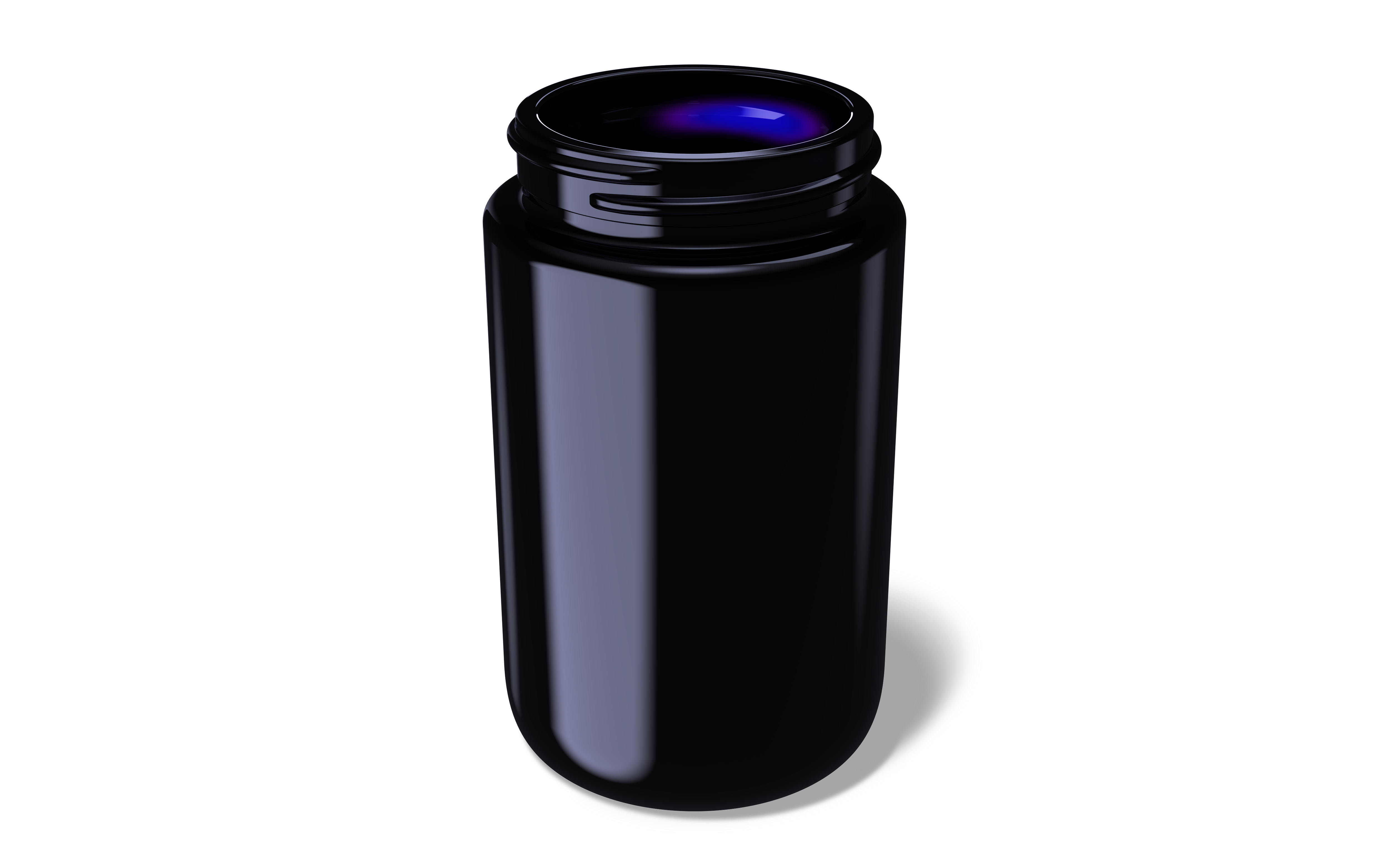
H21-0018V, 6 oz (180 ml) — one item in the H21 round child-resistant jar range that runs from 30 ml to 6 oz.
Child-resistant supplement packaging is selected on four measurable specifications: glass wall thickness, usable capacity, the neck-and-thread finish that the closure engages, and where decoration is applied on the finished jar. Colour, label panel and gift-box presentation are decided after those four are locked. On the H21 square jar line, for example, a single 0.38 mm glass wall thickness carries fills from 15 ml to 60 dr across item codes H21-0003V to H21-0008V, at a fixed 58 mm diameter with a child-resistant cap. The capacity you choose, not the material, is usually what forces the closure decision.
This guide is written for brand owners, procurement managers and packaging engineers who are comparing child-resistant glass formats at the evaluation stage. It uses the H21 child-resistant jar range, the H19 vacuum click jar and the HDV1–HDV3 violet glass lines from Ningbo Honor Packaging Co., Ltd. as reference specifications, because those lines publish the parameters that actually decide fill-line performance: glass thickness, diameter, height, net weight, thread range and closure type.
Why child-resistant packaging fails at the specification stage
Most child-resistant packaging problems that reach a brand are not design problems. They are specification mismatches that a sample cannot reveal, because a sample is produced and inspected in isolation while a production order runs against a drawing, a fill line and a shipping budget. Four mismatch types account for most of them.
- Closure-and-thread mismatch. A closure matched to a 41/400 finish will not seat correctly on a 32/400 finish, even when the two necks look interchangeable on a bench. The HDV1 wide-mouth jar range is specified from 41/400 to 89/400; the HDV2 range runs from 32/400 to 89/400. Treating those as equivalent is the most common cause of a cap that releases too easily, or one that an adult cannot release at all.
- Capacity versus declared fill. A listed capacity of 15 ml or 60 dr describes the jar, not the dose. A jar filled to the shoulder behaves differently under torque and drop testing than the same jar filled to nominal volume, and the declared net weight printed on the label has to match what the fill line can deliver consistently.
- Decoration crossing a functional zone. Silk-screen printing, hot stamping and heat transfer printing are safe on the body and shoulder. Printed or frosted material that reaches the thread, or the cap engagement surface, alters the friction that the child-resistant mechanism depends on.
- Regulatory mismatch. In the United States, tamper-evident packaging is a mandatory requirement for dietary supplements under the Poison Prevention Packaging Act for certain ingredients, including iron above 30 mg. A jar selected purely on capacity will not satisfy that requirement on its own.
Industry background: where child-resistant supplement packaging sits in 2026
Precedence Research values the global dietary supplement packaging market at approximately USD 12.7 billion in 2024 and projects growth at a CAGR of 6.1% through 2034. Grand View Research, analysing the adjacent nutraceutical packaging category, reports plastic holding a 58.3% revenue share in 2024 on the strength of cost-effectiveness and barrier properties, with North America the largest regional market at 34.4% of global revenue. The two sources scope the market differently and their absolute figures should not be added together; the direction they describe is consistent, and it matters for one reason: plastic remains the volume default, so glass child-resistant formats have to justify themselves on protection, compliance and brand value rather than on price alone.
Regulation shapes that justification more than material trends do. In the US, dietary supplement packaging must comply with the Dietary Supplement Health and Education Act (DSHEA) of 1994 and FDA Current Good Manufacturing Practice under 21 CFR Part 111. In the EU, Regulation (EU) No. 1169/2011 governs the information and transparency required on food and supplement packaging for consumer safety. Underneath both sits food-contact compliance: the EU certificate held by Ningbo Honor Packaging Co., Ltd. is issued by SGS under EC No 1935/2004, certificate number NGBHL24007770101, dated 27 December 2025, covering the European market. The corresponding US certificate is issued by SGS under FDA CPG, number NGBHL23005693401, dated 30 November 2023, covering a Food, Cosmetic and Medical scope.
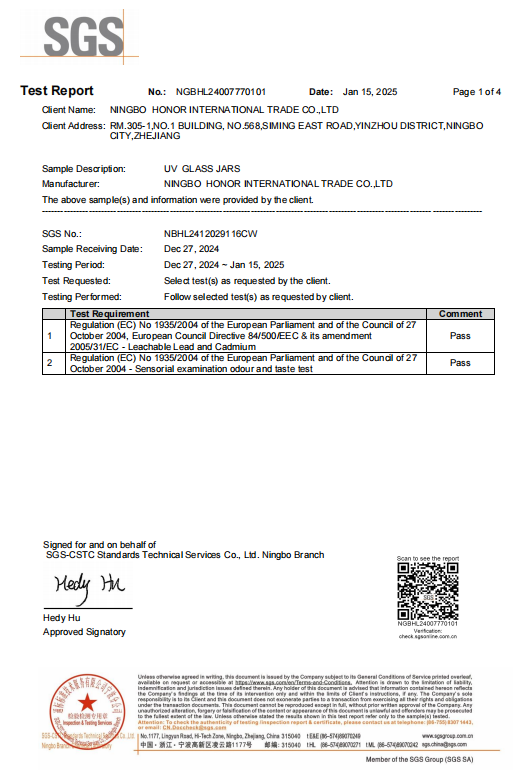
EU food-contact certificate issued by SGS under EC No 1935/2004 (NGBHL24007770101).
The specification levers that decide child-resistant performance
Five parameters do most of the work when a brand moves from a concept jar to a production order. They are listed below in the order they should be fixed, because each one constrains the next.
Lever 1 — Glass wall thickness: the 0.38 mm reference
Glass thickness is stated as 0.38 mm across the HDV1 wide-mouth jars, the HDV2 cosmetic jars and both H21 lines, square and round. This is useful for buyers in two ways. First, it means that when you compare item codes across these ranges, you are comparing like-for-like on wall thickness, and the real differentiators become neck geometry, net weight and closure. Second, it gives you a fixed reference point when a quotation arrives with an unstated or substituted glass specification: ask for the stated thickness in writing and compare it against 0.38 mm rather than against the sample in your hand, because a sample can be drawn from a different cavity than the production run. Where a specification sheet does not state a thickness, as with the H19 vacuum click jar and the HDV3 essential-oil bottle, treat the thickness as unconfirmed and request it before tooling.
Lever 2 — Capacity and fill volume
Capacity ranges determine which jar can physically carry your dose, and the ranges differ sharply by line. The H21 square child-resistant jars are specified at 15 ml, 30 ml, 20 dr, 30 dr, 40 dr and 60 dr. The H21 round child-resistant jars start higher, at 30 ml, 2 oz, 20 dr, 30 dr, 40 dr, 60 dr and 6 oz. The HDV1 wide-mouth jars run from 100 ml up to 1 L; the HDV2 cosmetic jars cover 3 ml to 200 ml; the HDV3 round bottle covers 5 ml to 100 ml; and the H19 vacuum click jar is listed at 5 ml. Note that the H21 lines publish the same fills in both millilitre and dram designations. That is a specification convenience, not a conversion guarantee — confirm which unit your fill line, artwork and declared net weight are built around before you approve a drawing.
Lever 3 — Thread specification and closure matching
Thread designation is the parameter most often left vague in a first enquiry and most expensive to correct later. In the designations used across these lines, the leading figure is the nominal neck diameter in millimetres and the trailing figure identifies the finish type that the closure must match. That is why a 41/400 finish and an 89/400 finish are not interchangeable, and why the HDV1 range (41/400 to 89/400) and the HDV2 range (32/400 to 89/400) overlap only in the upper sizes. The H21 child-resistant jars are published by diameter rather than by thread code — 58 mm for the square line and 60 mm for the round line, both with a child-resistant cap. For those items, the thread designation should be confirmed item-code by item-code against the current drawing, and the closure should be confirmed as a matched pair, not as a jar and a cap bought separately.
Lever 4 — Shape, diameter and net weight
Shape and weight are commercial decisions as much as technical ones. The H21 square jar is 58 mm in diameter, 24 mm to 115 mm in height and 75 g to 280 g in net weight; the H21 round jar is 60 mm in diameter, 36.5 mm to 125 mm in height and 84 g to 268 g. Square geometry buys shelf density and label area per millimetre; round geometry buys a familiar silhouette and, at 60 mm, an opening that suits capsule fills. The weight spread matters at both ends of the order: heavier jars raise freight cost per unit and lower the number of units per carton, while very light jars in the same range are usually the smaller fills, so a mixed order can carry very different shipping economics per SKU even when the jar family is identical. The verified shape options in these specifications are round and square; where an enquiry requires a geometry outside them, treat it as a new tooling question rather than an available variant.
Lever 5 — Decoration that preserves child-resistant integrity
Decoration is where branding and function collide, and the H21 and HDV1–HDV3 lines support the full commercial set: sticker, silk-screen printing, hot stamping, heat transfer printing and frosted finish, with the HDV3 adding label and gold stamping, and HDV1 also listing a sticker option. Used on the body and shoulder, all of these are compatible with a child-resistant cap, which is why logo-printed supplement packaging in this format is routine rather than exceptional. The design rule is simple and non-negotiable: keep print, foil and frost off the thread and off the cap engagement surface. Frosted finishes are the highest-risk option in this respect because the treatment is applied to the whole body, so the drawing should specify where the frost stops. Applied correctly, matte and frosted finishes deliver the matte look associated with premium supplement and luxury supplement gift packaging without touching the mechanism.
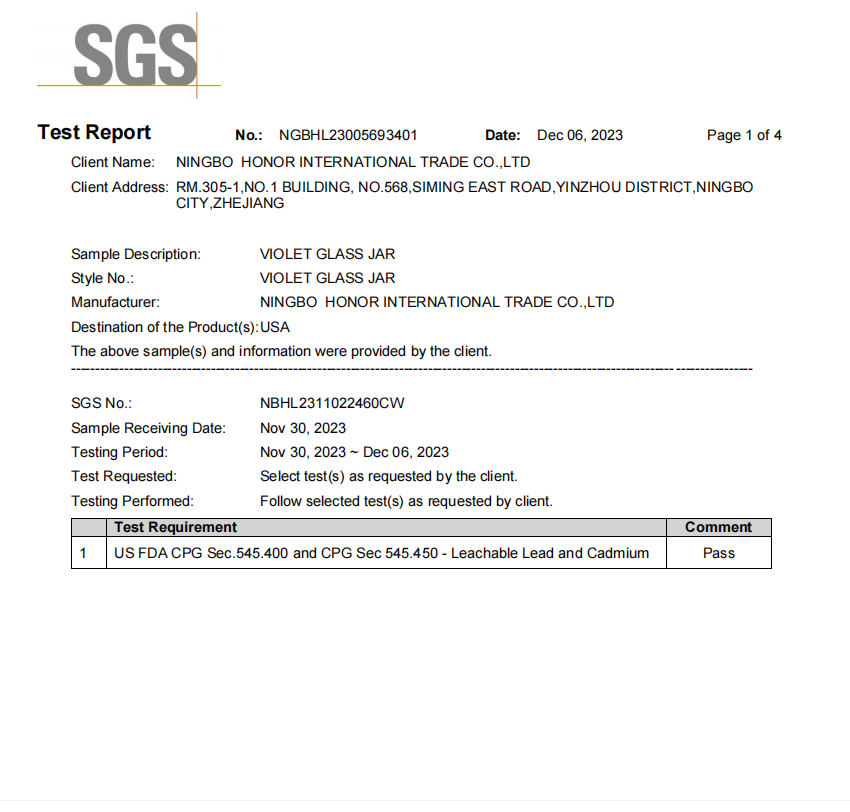
US certificate issued by SGS under FDA CPG (NGBHL23005693401), covering a Food, Cosmetic and Medical scope.
Step-by-step: selecting a child-resistant jar in seven steps
- Define the dose and the fill volume. Convert your dose into a usable fill volume with headspace, then map it onto a capacity range: 15 ml to 60 dr for the H21 square line, 30 ml to 6 oz for the H21 round line, 100 ml to 1 L for HDV1, 3 ml to 200 ml for HDV2, 5 ml to 100 ml for HDV3, 5 ml for the H19 vacuum click jar.
- Fix the glass specification. Confirm 0.38 mm wall thickness in writing for HDV1, HDV2 and both H21 lines, and request the thickness figure for any item that does not state one.
- Match the neck and closure as a pair. Select thread from the published ranges (41/400 to 89/400 on HDV1; 32/400 to 89/400 on HDV2), or confirm the thread code for a 58 mm square or 60 mm round H21 jar, and require the closure to be validated against that exact finish.
- Check footprint and weight against freight. Compare 58 mm square against 60 mm round, and check net weight (75–280 g square; 84–268 g round) against carton configuration and landed cost.
- Draw the decoration boundary. Choose from silk-screen printing, hot stamping, heat transfer printing, sticker or frosted finish, and mark the point on the jar where decoration stops relative to the thread.
- Validate before mass production. Test fill, torque, drop and light exposure on the exact item code and closure combination, then confirm quality control terms: 100% pre-shipment test plus third-party inspection by SGS.
- Lock commercial terms. Confirm minimum order quantity of 10,000 units, production capacity of 100,000 units per month, and a lead time of 30–45 days, with the after-sales position on reissue agreed in advance.
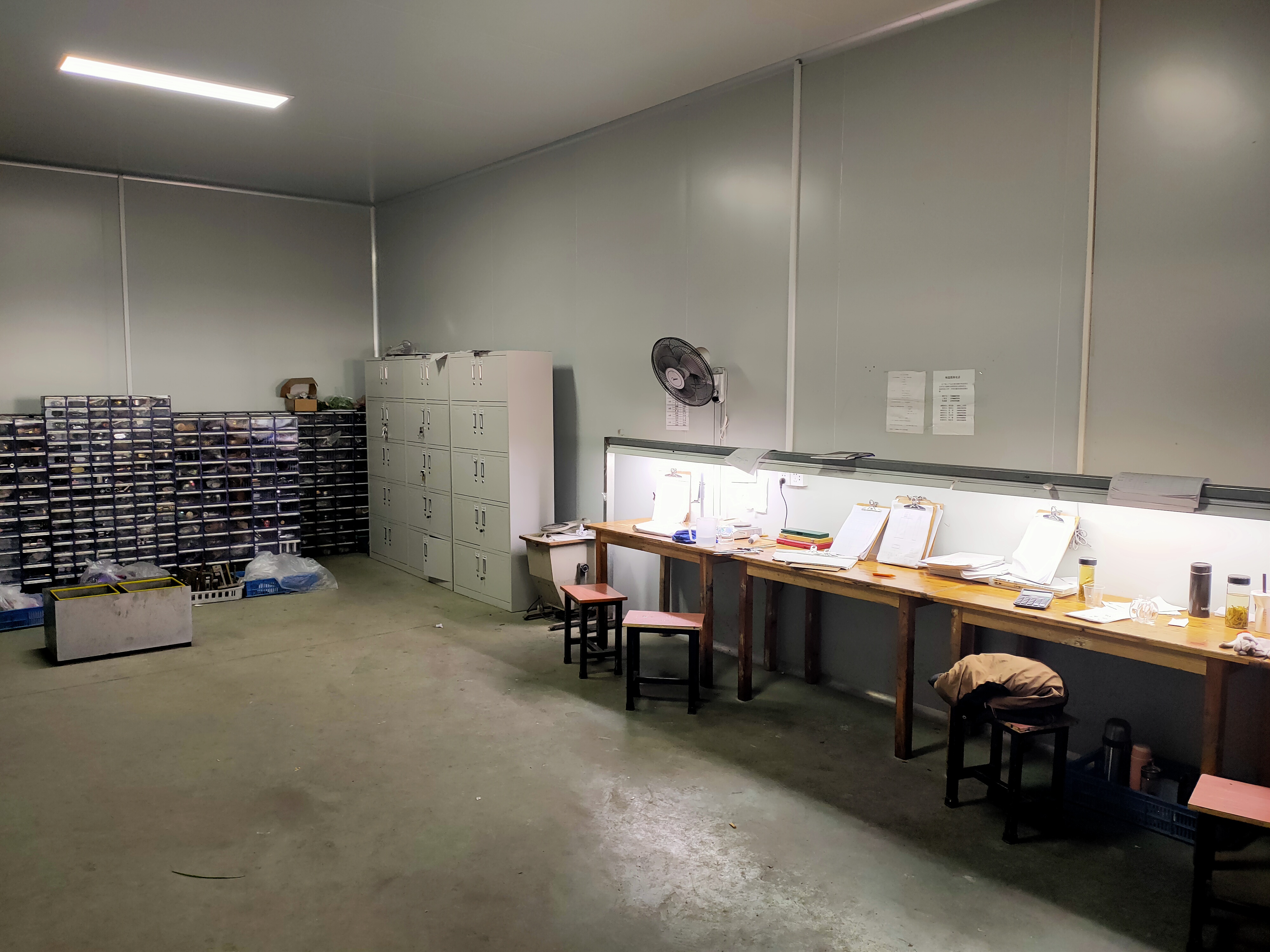
Workshop and inspection environment for child-resistant glass jar production.
Use cases: matching the specification to the product
Powder supplement packaging. Larger fills favour the HDV1 wide-mouth range at 100 ml to 1 L, where the 41/400 to 89/400 thread band and 117 g to 610 g net weight suit scoop access and bulk powder. The trade-off is freight: at the top of that range the jar is a shipping decision as much as a packaging one.
Capsule packaging. Capsule counts usually land in the H21 round jars — 60 dr or 6 oz — where the 60 mm diameter opening supports fast filling and easy dispensing, and the 84 g to 268 g weight band stays manageable per unit.
Shilajit, herbs and resin-based fills. Small, dense fills are where the 0.38 mm wall and the 15 ml to 30 dr square H21 formats do the most work, and where moisture-proof closure matching matters more than capacity headline. For concentrate and trial formats, the H19 vacuum click jar is specified at 5 ml, 250 pcs per carton.
Cosmetic and crossover SKUs. The HDV2 range (3 ml to 200 ml) and the HDV3 round bottle (5 ml to 100 ml, with plastic cap, dropper, mist sprayer or lotion pump) let a supplement brand run adjacent cosmetic packaging formats on the same glass specification.
Proven in production. A German branding business ordered 10,000 units of violet glass packaging for pharmaceutical packaging and has been running the format for three years; the reported outcome is that the products remained fresh across that period, with reusable jars and UV protection cited as the highlights. That is a longevity signal for buyers comparing glass against flexible formats, not a claim about every product category.
Specification comparison across child-resistant and violet glass lines
| Line | Type | Capacity | Shape | Diameter | Height | Net weight | Glass thickness | Closure / decoration |
|---|---|---|---|---|---|---|---|---|
| H21 (square) | Violet glass jar | 15 ml / 30 ml / 20 dr / 30 dr / 40 dr / 60 dr | Square | 58 mm | 24–115 mm | 75–280 g | 0.38 mm | Child-resistant cap; sticker, silk-screen, hot stamping, heat transfer, frosted finish |
| H21 (round) | Violet glass jar | 30 ml / 2 oz / 20 dr / 30 dr / 40 dr / 60 dr / 6 oz | Round | 60 mm | 36.5–125 mm | 84–268 g | 0.38 mm | Child-resistant cap; sticker, silk-screen, hot stamping, heat transfer, frosted finish |
| HDV1 | Wide-mouth violet jar | 100 / 150 / 200 / 250 / 300 / 500 ml / 1 L | Wide mouth | 48–95 mm | 84.7–193 mm | 117–610 g | 0.38 mm | Thread 41/400–89/400; sticker, silk-screen, heat transfer, hot stamping, frosted finish |
| HDV2 | Cosmetic violet jar | 3–200 ml | Jar | 36–93.2 mm | 25.6–55 mm | 36–205 g | 0.38 mm | Thread 32/400–89/400; sticker, silk-screen, heat transfer, hot stamping, frosted finish |
| HDV3 | Round violet glass bottle | 5–100 ml | Round | Not stated | 54.5–125 mm | 22.5–120 g | Not stated | Plastic cap / dropper / mist sprayer / lotion pump; label, silk-screen, gold stamping |
| H19 | Vacuum click jar | 5 ml | Square | Not stated | Not stated | Not stated | Not stated | Vacuum click jar; 250 pcs per carton |
All figures above are the published specifications for these lines. H21 jars are published by diameter (58 mm square, 60 mm round) with a child-resistant cap — confirm the thread code for each item before tooling.
Frequently asked questions
In the US, dietary supplement packaging must comply with DSHEA (1994) and FDA CGMP under 21 CFR Part 111; in the EU, Regulation (EU) No. 1169/2011 governs required product information. Beneath those sits food-contact compliance: the EU certificate for these glass lines is issued by SGS under EC No 1935/2004, certificate NGBHL24007770101, dated 27 December 2025, and the US certificate is issued by SGS under FDA CPG, number NGBHL23005693401, dated 30 November 2023, with a Food, Cosmetic and Medical scope. Buyers should also verify tamper-evidence obligations under the Poison Prevention Packaging Act, which applies to certain ingredients such as iron above 30 mg.
Yes, provided the decoration stays off the thread and the cap engagement surface. Ningbo Honor Packaging Co., Ltd. offers OEM and ODM work covering printing of client artwork, new design development and frosted finishes, and the H21, HDV1 and HDV2 lines support sticker, silk-screen printing, hot stamping, heat transfer printing and frosted finish. Silk-screen and foil decoration on the body or shoulder does not interfere with a child-resistant cap; frosted finishes applied across the whole body are the highest-risk option and should be specified with a defined stopping point below the neck.
Four variables dominate. The first is glass mass and capacity, because a 60 dr H21 jar (up to 280 g net weight) and a 1 L HDV1 jar (up to 610 g) carry very different material and freight costs per unit. The second is geometry and tooling, since a new shape is a tooling project while an existing item code is not. The third is decoration steps: each additional printing or finishing pass adds process cost. The fourth is order structure — the published minimum order quantity is 10,000 units against a monthly production capacity of 100,000 units, so smaller or mixed orders should be planned against that floor rather than assumed to scale down freely.
Validate the exact item code and the matched closure together, not a visually similar alternative. The checks that matter are fill-volume accuracy against the declared net weight, adult release and child-resistance behaviour after repeated opening, drop and torque performance at the intended fill level, and light exposure where the product is photosensitive. Production quality control on these lines is a 100% pre-shipment test supported by third-party inspection through SGS, so a validation protocol agreed at sample stage can be carried through to the shipped batch.
The published figures are a minimum order quantity of 10,000 units, a monthly production capacity of 100,000 units, and a lead time of 30–45 days. Orders are produced under OEM and ODM arrangements with an after-sales policy that accepts reissue where a quality issue is confirmed. Because lead time runs from approved artwork and confirmed tooling rather than from enquiry, brands launching a new SKU should agree the decoration boundary and the thread confirmation before the 30–45 day clock starts. Ningbo Honor Packaging Co., Ltd. supplies a sample, specification confirmation and quotation request through www.honorcrpkg.com, and the full product and capability set is summarised in the downloadable catalogue.
Conclusion: fix the specification, then design around it
Child-resistant supplement packaging is a specification problem before it is a design problem. Glass thickness (0.38 mm across the HDV1, HDV2 and H21 lines), capacity (15 ml to 60 dr on the H21 square jar, 30 ml to 6 oz on the H21 round jar, up to 1 L on HDV1), thread and closure matching (41/400 to 89/400 on HDV1, 32/400 to 89/400 on HDV2, with the thread code confirmed per H21 item code), geometry and net weight, and a decoration boundary that stops below the thread — those five decisions determine whether a jar releases correctly on the shelf and holds up in transit. Brands that fix them in that order spend their design budget on branding; brands that leave them open spend it on rework.
Honor Packaging (Ningbo Honor Packaging Co., Ltd.) was founded in 2015 and is headquartered in Ningbo, China, close to both Ningbo and Shanghai seaports. The company employs 310 people, including a 15-person R&D team, with a stated annual output of 1,000,000 units, 100% export orientation, and main markets in the EU and the USA. Its product focus is child-resistant packaging, violet glass packaging and vacuum packaging, supported by OEM and ODM customisation, third-party inspection and a reissue-based after-sales policy.
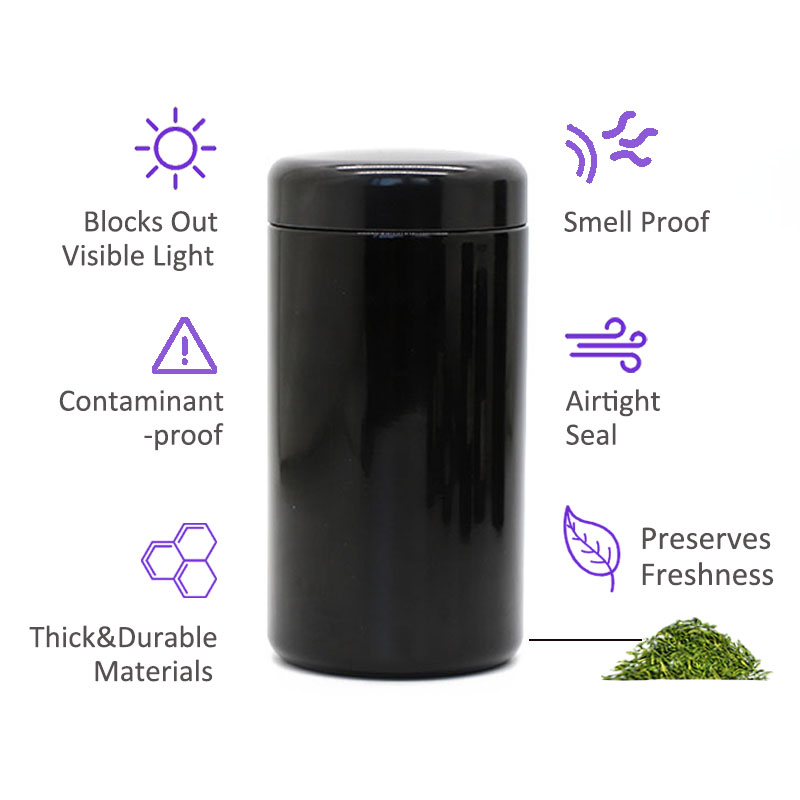
UV protection and product-freshness function reference for violet glass packaging.
Next step: confirm your specification before tooling
Send your dose, target fill volume and closure preference, and request a sample plus a specification sheet stating glass thickness, diameter, height, net weight and thread code for the exact item. Quotations, samples and the full downloadable catalogue are available on request.
Website: www.honorcrpkg.com | Email: info@honorpkg.com | Tel / WhatsApp: +86 15968944995
Brochure download: Honor Packaging product catalogue (PDF)
Have Questions or Need More Details?
Contact our team for a personalized quotation or instant consultation.
Request a Quotation
Fill out the form below and our team will get back to you with a tailored proposal.
WhatsApp Direct Chat
Prefer to chat in real-time? Message us on WhatsApp for instant assistance & quick answers.
- Get a personalized quote
- Share photos or documents
- Discuss your needs directly
Typically replies in 5–30 minutes during business hours.