
Amber vs. Clear vs. Violet Glass Jars for Supplement Packaging: A Practical Comparison
Amber vs. Clear vs. Violet Glass Jars for Supplement Packaging: A Practical Comparison
Choosing a glass jar for a supplement line is not just a purchasing decision. The jar needs to protect a formula, present the brand on a shelf, and still work with the product's dosing format, label, cap, and filling line. For many supplement brands, the question is even more specific: should the jar be amber, clear, or violet? This article compares those three glass options from a buyer's perspective, with emphasis on light protection, perceived premium quality, and product visibility. Where specifications are needed, the guide uses verified product data from NINGBO HONOR PACKAGING CO.,LTD. (Honor Glass Packaging), including the 0.38 mm glass thickness that appears across Honor's H21 and HDV glass jar series.
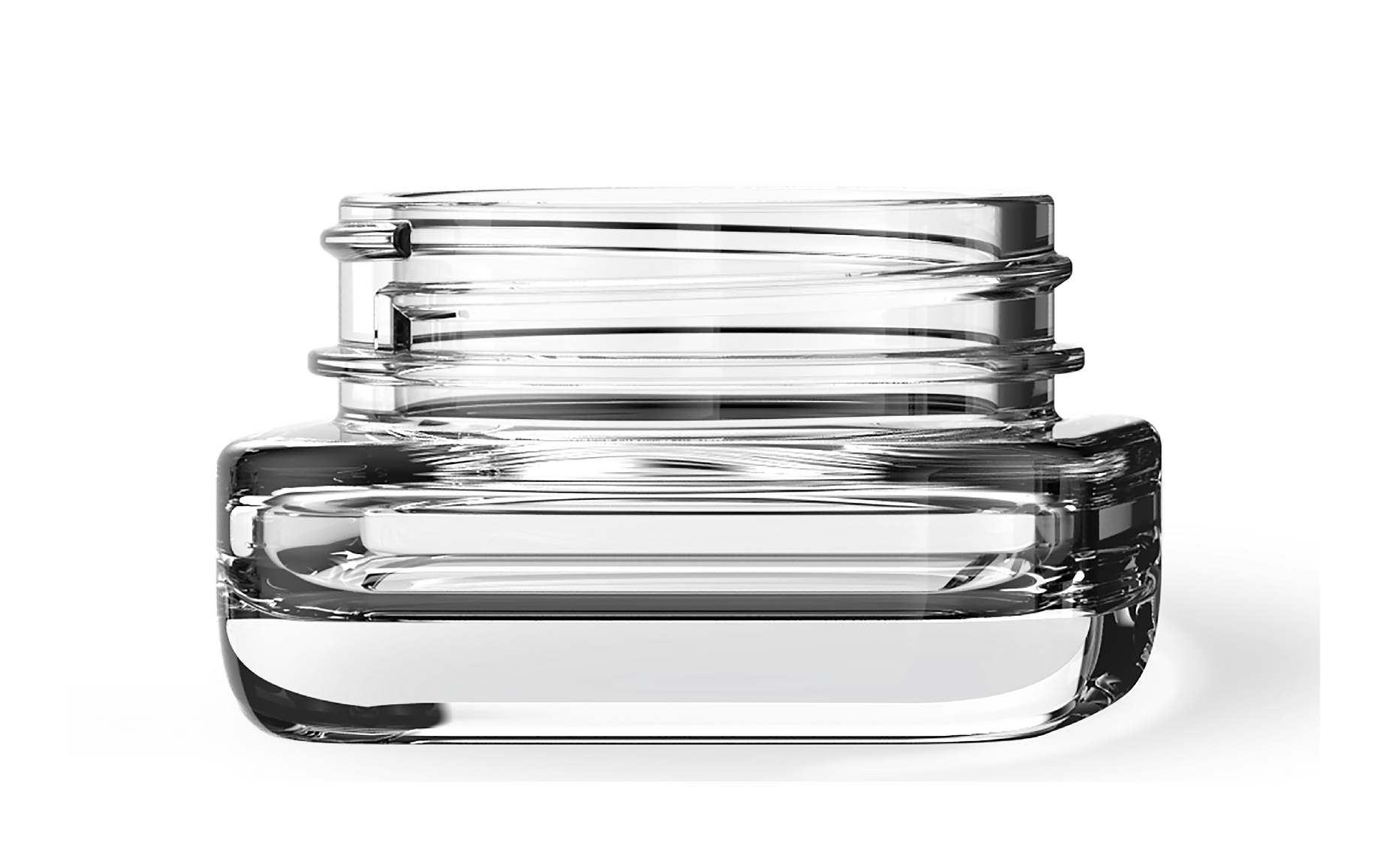
Clear square glass jar from Honor Packaging. A clear jar allows the product to be seen, but it does not replace a light-protection strategy.
Why the Color of a Supplement Jar Is a Packaging Decision
When supplement brands compare amber, clear, and violet glass jars, they are really comparing three different relationships between the product and the consumer. The first is product visibility. Some supplements benefit from being visible: colorful capsules, elegant softgels, or plant material with a distinct texture can communicate quality before the label is read. Clear glass provides that visual access. The second is light protection. Traditional amber glass, and to a lesser extent tinted violet glass, reduces the amount of light that reaches the product. This matters because many supplement ingredients are formulated with the assumption that they will be stored away from direct sunlight or packaged in a light-protective container. The third factor is perceived quality. Glass itself tends to feel more premium than plastic, but color changes the impression: amber suggests apothecary heritage, clear suggests freshness and simplicity, and violet suggests a niche botanical or cosmetic identity.
These three goals are not always compatible. A dark amber jar may be excellent for a light-sensitive formula, but it hides the product. A clear jar may show off the formulation, but it provides little inherent light blockage. A violet jar can create a distinctive premium look, but its optical behavior is not identical across all glass suppliers. A practical packaging decision therefore depends on formula sensitivity, brand positioning, retail environment, and the technical range available from the supplier.
Industry Context: Market Growth and Compliance
The supplement packaging industry is large and expanding. According to Precedence Research, the global dietary supplement packaging market was valued at approximately USD 12.7 billion in 2024 and is expected to grow at a CAGR of 6.1% through 2034. Grand View Research reports that North America remains the largest regional market with an estimated 34.4% global revenue share in 2024. The same dataset notes that plastic still holds the largest material share at 58.3%, which means glass purchases need a distinct justification: product compatibility, perceived quality, environmental messaging, or a high-end packaging format.
Regulatory context also shapes the discussion. In the United States, dietary supplement packaging and labeling must be assessed under the Dietary Supplement Health and Education Act (DSHEA) framework and FDA Current Good Manufacturing Practice rules, specifically 21 CFR Part 111. In the European Union, Regulation (EU) No. 1169/2011 sets the consumer information and transparency requirements for food and supplement labeling. Certain products may require child-resistant or tamper-evident packaging, for example under the Poison Prevention Packaging Act in the US when ingredients such as iron exceed 30 mg per unit. Jar color does not by itself determine compliance, but it becomes part of a completed package that must be documented and presented to a responsible buyer.
Practical Comparison: Amber, Clear, and Violet Glass Jars
The most reliable way to compare these three options is to separate what is true about general glass usage from what is verified about a specific supplier. One sourcing reality should be stated early: the verified product data used in this article focuses on Honor's clear and violet glass jar series. The amber row in the comparison table therefore describes how amber glass is commonly used in the supplement packaging industry, not an Honor product claim that is not present in the provided data.
Amber glass: the protective classic
Amber glass has long been associated with protection from light. Its brown color reduces the amount of visible light entering the jar, which is why amber is often regarded as a default for formulations known to be light-sensitive. For supplement brands, amber sends a pharmaceutical or apothecary message: protective, traditional, and serious about stability. This can be valuable for herbal extracts, botanical powders, and products purchased by consumers who look for old-fashioned quality cues.
The trade-off is that amber glass makes the contents difficult to see through the container. A supplement brand cannot rely on the visual appeal of the product itself; it must instead use label design, embossing, and color contrast to carry the shelf story. Amber continues to be relevant for light-sensitive product lines, especially when the formula does not need to be shown to the buyer.
Clear glass: maximum product visibility
Clear glass jars do the opposite of amber: they make the product the hero of the package. This works especially well for colorful capsules, distinctive powders, and natural products whose appearance reinforces their perceived quality. A clear jar can feel clean, modern, and honest, because the consumer can check the texture, shape, or color before purchase.
The practical weakness of clear glass is lower inherent light protection. Transparent glass does not filter light the way tinted or colored glass does, so clear jars are generally selected when the formulation is stable enough for retail lighting, or when secondary packaging such as a carton or opaque sleeve provides the light barrier. For formulators who know their product is light-sensitive, clear glass should be validated with a photostability test before committing to a new package.
Honor's verified H21 clear jar range illustrates how visible an offer can be. The H21 clear square jars, item codes H21-0003C to H21-0008C, are listed with a child-resistant cap, glass thickness of 0.38 mm, overall diameter of 58 mm, height from 24 mm to 115 mm, and net weight from 75 g to 280 g. Their published capacities include 15 ml, 30 ml, 20 dr, 30 dr, 40 dr, and 60 dr. The H21 clear round jars, item codes H21-0012C to H21-0018C, are listed with a diameter of 60 mm, glass thickness of 0.38 mm, height from 36.5 mm to 125 mm, net weight from 84 g to 268 g, and capacities including 30 ml, 2 oz, 20 dr, 30 dr, 40 dr, 60 dr, and 6 oz.
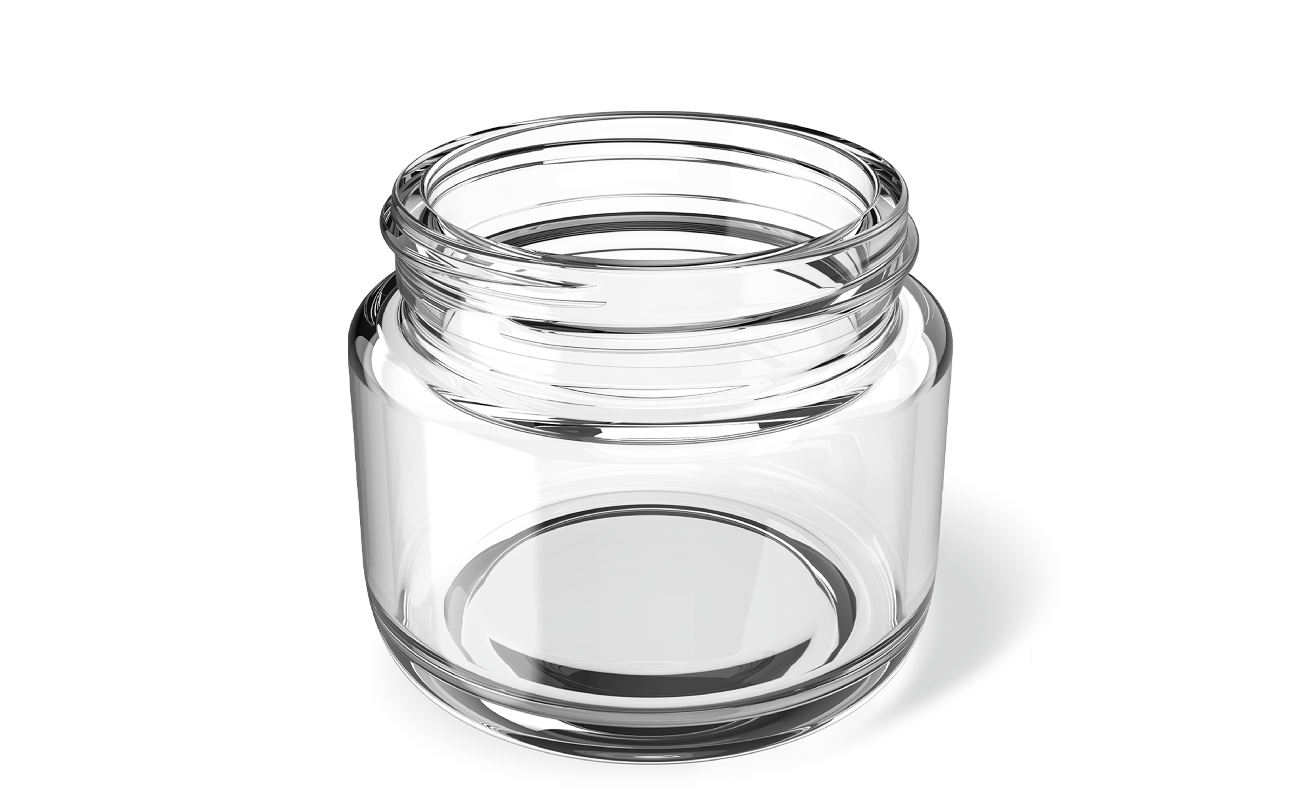
H21 clear round jars are among the visible glass formats used for supplement packaging projects.
Violet glass: a differentiated tinted option
Violet glass packaging has grown beyond its original association with essential oil dropper bottles. For supplement brands, violet glass offers a way to be different without committing to conventional amber. A violet jar tends to hide or obscure the contents while giving the pack a botanical, premium, or cosmetic character. Consumers often perceive violet glass as more distinctive than standard flint glass and less pharmacy-like than amber, which is why it appears in natural skincare, botanical supplements, and premium herbal lines.
In terms of light behavior, violet glass is not a single universal standard. Its protection depends on the color recipe, wall thickness, and manufacturing process. What can be said without overclaiming is that violet glass is visually darker than clear glass and will normally block a meaningful portion of transmission, but brands should ask the vendor for optical or light-transmission data when the formula is sensitive to light.
Honor's violet glass line includes several relevant formats. The H21 square violet glass jars, item codes H21-0003V to H21-0008V, are made of violet glass, PP, and PE, and are offered with a child-resistant cap. They share the same 0.38 mm glass thickness and the same broad dimensional frame as the H21 clear square jars. The H21 round violet glass jars, item codes H21-0012V to H21-0018V, are explicitly described as being intended for supplement packaging scenarios. For larger family or bulk formats, the HDV1 wide-mouth violet jar range extends capacity from 100 ml to 1 L and also carries a 0.38 mm glass thickness in the published specification. For smaller cosmetic-style supplement formats, HDV2 cosmetic violet jars are offered in capacities from 3 ml to 200 ml, again with a 0.38 mm glass thickness, and HDV3 round violet essential oil bottles are available in capacities from 5 ml to 100 ml.
Verified Capability Data: Honor H21 and HDV Glass Jar Series
For a supplement brand at the Awareness or Research stage, specifications matter because they convert visual preference into a feasible project. The most useful points from Honor's published product data are simple and tangible. First, the glass thickness of 0.38 mm appears on the H21 clear square jars, H21 clear round jars, H21 square violet jars, H21 round violet jars, HDV1 wide-mouth violet jars, and HDV2 cosmetic violet jars. This provides a consistent physical baseline when comparing clear and violet jars of similar format. Second, child-resistant closure is a documented part of the H21 clear and violet jar families; it is not left as an open custom request. Third, the published capacity range is broad enough to support small concentrates, daily capsules, powders, and larger refill or bulk containers.
Decoration options are also documented. The H21 and HDV series list surface treatments such as sticker, silk-screen printing, hot stamping, heat transfer printing, and frosted finish. The HDV3 line adds label and gold stamping. For a supplement brand, this matters because jar color should not be purchased separately from decoration feasibility. A frosted violet jar, a hot-stamped amber label, or a silk-screened clear jar can completely change the premium impression.
Step-by-Step Selection Framework
The following progression can help a brand move from a beautiful glass sample to a justified packaging choice.
- Define the formula's light sensitivity. Speak with formulation or quality personnel before visual selection. If the product requires light protection, a clear jar alone may be insufficient.
- Set the visibility requirement. Decide whether the consumer should see the product in its primary pack or whether a carton can perform that communication task instead.
- Choose a color direction. Use amber when the brand wants a protective classic tone, clear when the formula is stable and visible, and violet when the project needs a distinctive premium identity with a tinted glass look.
- Confirm the format and cap. For powders, capsules, resins, or cream-type supplements, verify that the mouth size supports filling and dosing. Confirm whether the cap is child-resistant or can be converted to a CR version.
- Check the capacity range. Compare the desired weight or dose count against the supplier's listed capacities rather than assuming a one-size-fits-all jar.
- Align decoration with jar color. Evaluate labels, silk-screening, hot stamping, or frosting on an actual sample. Decoration contrast behaves differently on amber, clear, and violet glass.
- Validate with a sample batch. The final step is not a color swatch but a filled, capped, labeled sample. This confirms fit, finish, weight, decoration, and ease of handling before mass production begins.
Scenario-Fit Examples
These scenarios show how the three jar types fit realistic supplement projects.
Light-sensitive herbal powders or shilajit-style resins. A dark jar reduces light exposure and signals protection. Amber is the classic choice, while violet can provide a more contemporary premium look. If the product is not meant to be seen through the pack, both formats do the job.
Colorful capsules or gummies that are stable under retail light. Clear glass allows the product to be the star. This gives consumers direct visual confirmation of color, size, and consistency. In these cases, the brand can use a clear jar and rely on a carton or label if extra light protection is needed.
Botanical, cosmetic, or skincare-adjacent supplement lines. Violet glass is often selected when the brand wants a natural and premium identity rather than a conventional medicine look. It pairs well with frosted decoration, gold stamping, or minimalist labels.
Large-volume powder or household supplement formats. For family-sized containers, the HDV1 wide-mouth violet jar range from 100 ml to 1 L offers an option for brands that want a tinted jar with a wide opening. The same series is listed with a 0.38 mm glass thickness and several thread options.
Small-dose concentrates. The H19 child-resistant glass concentrate jars, available in 5 ml and 9 ml capacities, show that glass packaging is not limited to large supplement jars. This small format can serve concentrated tinctures, resin dropper sets, or sample kits.
Amber vs Clear vs Violet at a Glance
| Comparison point | Amber glass | Clear glass | Violet glass |
|---|---|---|---|
| Typical light-protection impression | High in conventional industry use | Low; transparent glass does not filter light like tinted glass | Higher than clear in usual market perception; check supplier data |
| Product visibility | Low; contents not usually visible | High; contents are exposed | Low to partial depending on color intensity |
| Premium shelf perception | Traditional, protective, apothecary | Clean, modern, transparent | Botanical, niche, premium cosmetic |
| Verified Honor example | No Honor amber specification in the provided dataset | H21 clear square and round jars | H21 violet square and round jars, HDV1, HDV2, HDV3 |
| Glass thickness in verified data | Not assessed from supplier data | 0.38 mm on H21 clear square and round | 0.38 mm on H21 violet square/round, HDV1, HDV2 |
| Child-resistant cap availability | Not assessed from supplier data | Available on H21 clear square and round jars | Available on H21 violet square and round jars; CR variants exist in HDV1 program |
| Decoration options | Not assessed from supplier data | Sticker, silk-screen, hot stamping, heat transfer, frosted finish | Sticker, silk-screen, hot stamping, heat transfer, frosted finish; HDV3 adds label/gold stamping |
Table note: The amber column reflects widely understood industry practice rather than a verified Honor amber specification. Brands should request precise optical and technical data from the jar manufacturer before finalizing.
Frequently Asked Questions
Do amber, clear, and violet glass jars have different compliance requirements for supplement packaging?
Compliance depends on the finished package, its food-contact materials, closures, and labeling, not simply on glass color. In the US, supplement packaging must be evaluated within the DSHEA and FDA CGMP 21 CFR Part 111 framework. In the EU, Regulation (EU) No. 1169/2011 defines the consumer information requirements for food and supplement labels. Ask the packaging supplier to confirm materials, closure options, and production documentation for the destination market.
What capacities are available in Honor H21 clear and violet glass jars?
For square jars, H21 clear and violet capacities include 15 ml, 30 ml, 20 dr, 30 dr, 40 dr, and 60 dr. For round jars, H21 clear and violet capacities include 30 ml, 2 oz, 20 dr, 30 dr, 40 dr, 60 dr, and 6 oz. The HDV1 wide-mouth violet jar line extends capacity from 100 ml to 1 L, while HDV2 cosmetic violet jars cover 3 ml to 200 ml and HDV3 round violet bottles cover 5 ml to 100 ml.
Can Honor clear and violet glass jars be fitted with child-resistant caps?
Yes. The published H21 clear square and round jar data lists child-resistant caps, and the H21 violet square and round jar data also lists child-resistant caps. Honor also publishes H19 child-resistant concentrate jars in 5 ml and 9 ml formats. The HDV1 wide-mouth violet jar program includes a CR variant in item code HDV1100M-1-CR.
What surface treatments can be used for custom branding on these jars?
Documented options across H21 and HDV glass jar series include sticker, silk-screen printing, hot stamping, heat transfer printing, and frosted finish. The HDV3 violet essential oil bottle line also lists label and gold stamping. Actual logo execution should be checked against the jar shape and artwork requirements before production.
How can a brand move from this comparison to a sample or specification check?
After defining target capacity, closure type, and decoration direction, contact NINGBO HONOR PACKAGING CO.,LTD. directly. The company's email is info@honorpkg.com, and its public website is www.honorcrpkg.com. A downloadable company brochure is available for packaging capabilities and project references.
For a more complete view of Honor's glass jar series and manufacturing approach, download the company brochure: Honor Packaging Company Brochure (PDF).
For specification confirmation, sample requests, or quotations, contact:
NINGBO HONOR PACKAGING CO.,LTD.
Email: info@honorpkg.com
Tel: +86-574-88004632 / +86-15968944995
Address: Rm.305, No.1 Building, No.568 SiMing East Road, YinZhou District, Ningbo City, China
Conclusion: Choose the Glass Type That Matches Formula and Brand Position
Amber glass brings the trust of a protective classic. Clear glass offers the honesty of product visibility. Violet glass creates a distinctive premium route between the two. For supplement brands in the research phase, the best next step is not to buy a jar color but to define the product's light sensitivity, visibility requirements, and shelf identity. Then compare the verified technical range: the H21 clear and violet jar families offer child-resistant caps and a documented 0.38 mm glass thickness, while HDV1 and HDV2 add larger and smaller violet formats. A practical comparison should always lead to a physical sample that can be filled, capped, labeled, and judged under real retail lighting.
Have Questions or Need More Details?
Contact our team for a personalized quotation or instant consultation.
Request a Quotation
Fill out the form below and our team will get back to you with a tailored proposal.
WhatsApp Direct Chat
Prefer to chat in real-time? Message us on WhatsApp for instant assistance & quick answers.
- Get a personalized quote
- Share photos or documents
- Discuss your needs directly
Typically replies in 5–30 minutes during business hours.