
Supplement Packaging Made Simple: Materials, Formats & Buying Criteria for 2026
Supplement Packaging: A Plain-Language Guide to Materials, Formats & Supplier Selection
Supplement packaging is the first physical interaction a customer has with your formula—and it is also a compliance surface, a stability tool, and a brand asset. This guide explains the common material options, packaging formats, regulatory considerations, and the supplier capabilities that matter when you are choosing packaging for supplements, herbs, Shilajit, cosmetics, or powders.
The Problem: Why Supplement Packaging Is Harder Than It Looks
Supplements are not a single product category. A brand may sell capsules, powders, oils, tinctures, herbs, or gummies—and each form places different demands on the package. Moisture, oxygen, UV light, contamination, children, shipping stress, and label readability all have to be considered before a single unit is produced.
At the same time, packaging is regulated. In the United States, dietary supplements must meet FDA Current Good Manufacturing Practice (CGMP) requirements under 21 CFR Part 111. In the European Union, Regulation (EU) No. 1169/2011 governs the information that must appear on food and supplement packaging. Packaging is therefore not only a marketing decision; it is part of the product's compliance and safety system.
This is why brands move beyond “just picking a bottle.” They need a packaging partner that can supply the right material, format, closure, decoration method, and quality control—consistently, at scale.
Industry Background: The Supplement Packaging Market in 2026
Industry data provides useful context for buying decisions. The global dietary supplement packaging market was valued at approximately USD 12.7 billion in 2024 and is projected to grow at a CAGR of 6.1% through 2034. Plastics remain the dominant material in nutraceutical packaging, with a 58.3% revenue share in 2024, due to cost-effectiveness and barrier performance. North America is the largest regional market, accounting for 34.4% of global revenue.
The flexible packaging segment—often used for powders and herbs—is also expanding. The Mylar bags market was valued at USD 2.4 billion in 2023 and is projected to reach USD 4.1 billion by 2030. For a buyer, these numbers point to a mature but still-growing supply base with broad options across rigid and flexible formats.
Core Packaging Options for Supplements
Most supplement packaging decisions come down to a few material families: glass, plastic, and flexible film (often called Mylar). Each has strengths and trade-offs that matter at different product life stages.
Glass Packaging
Glass is widely used when brands want premium presentation, chemical neutrality, and strong barrier properties. Glass jars and bottles are especially common for Shilajit, herbal extracts, oils, and high-value cosmetics. However, glass is heavier and more fragile than plastic, which affects shipping cost and handling.
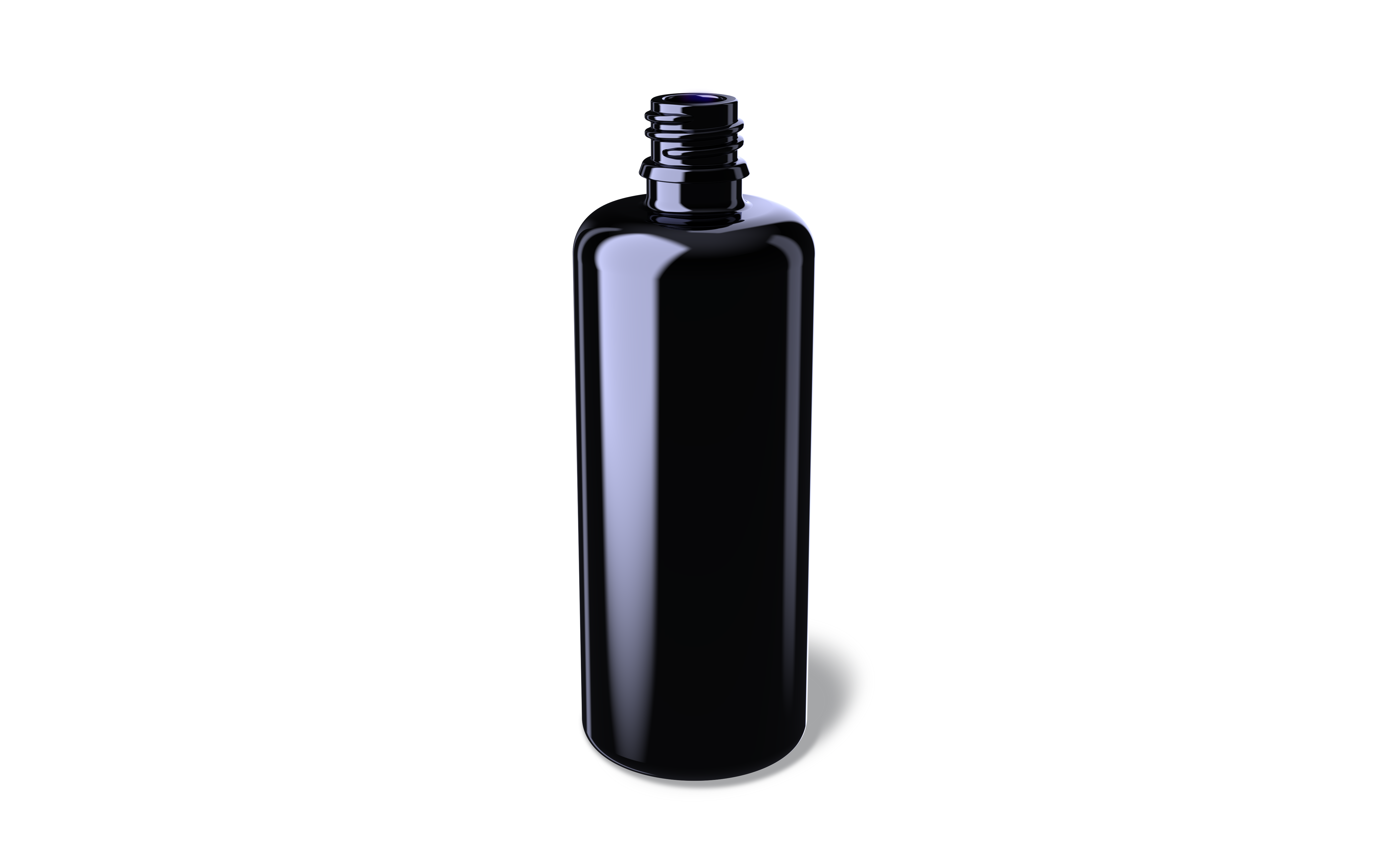
One specialized glass option is violet glass, which is designed to filter specific light wavelengths. Honor Packaging produces violet glass jars in several formats, including wide-mouth jars, cosmetic jars, and essential oil bottles, with a glass thickness of 0.38 mm.
- Wide-mouth violet jars (HDV1 series): capacities from 100 ml to 1 L, glass thickness 0.38 mm, diameters from 48 mm to 95 mm, heights from 84.7 mm to 193 mm, net weights from 117 g to 610 g.
- Cosmetic violet jars (HDV2 series): capacities from 3 ml to 200 ml, diameters from 36 mm to 93.2 mm, heights from 25.6 mm to 55 mm, net weights from 36 g to 205 g.
- Round violet essential oil bottles (HDV3 series): capacities from 5 ml to 100 ml, heights from 54.5 mm to 125 mm, net weights from 22.5 g to 120 g, with closure options including plastic cap, dropper, mist sprayer, and lotion pump.
Plastic Packaging
Plastic remains dominant because it is cost-effective, lightweight, and versatile. Many child-resistant supplement jars use polypropylene (PP) or polyethylene (PE) components. Plastic also allows a wider range of cap designs, including child-resistant closures that combine safety with convenience.
Honor Packaging combines glass bodies with PP or PE caps across several lines, which gives brands the premium feel of glass plus the functional advantages of engineered closures.
Flexible Packaging: Mylar Bags
For powders, herb blends, and single-serve supplements, flexible packaging in the form of Mylar bags is a common choice. These bags are lightweight, moisture-resistant, and space-efficient. They are not part of Honor Packaging's core manufacturing lines, but they are relevant context for brands comparing formats for different SKUs.
Tamper-Evident and Child-Resistant Features
Safety features are not optional extras for every product. In the United States, the Poison Prevention Packaging Act (PPPA) requires child-resistant packaging for certain ingredients, such as iron in quantities over 30 mg. Tamper-evident features help show consumers that the product has not been opened before purchase.
Honor Packaging integrates child-resistant caps across multiple glass jar series, including clear, white, black, and violet glass models.
Detailed Solution: What a Complete Supplement Packaging System Looks Like
A reliable supplement package is more than a container. It is a system of four layers:
- Primary container: the jar, bottle, or bag that holds the product.
- Closure: the cap or dispensing system that controls access, freshness, and safety.
- Decoration: labels, silk-screen printing, hot stamping, heat transfer printing, or frosted finish that carries brand and regulatory information.
- Packaging for shipment: carton configuration and packing density that protect units in transit.
For glass packaging, the closure and decoration choices are often as important as the container itself. A 5 ml vacuum jar and a 1 L wide-mouth jar are both “glass packaging,” but they serve completely different product scenarios.
Step-by-Step: How to Choose Supplement Packaging for Your Product
Step 1: Define the Product Form and Volume
Powders need wide openings for scooping; liquids need leak-proof closures; concentrates and tinctures often use droppers; creams and balms need jars that are easy to open. Capacities are usually measured in milliliters (ml), ounces (oz), or drams (dr). Honor Packaging's H21 clear round jars, for example, are available in 30 ml, 2 oz, 20 dr, 30 dr, 40 dr, 60 dr, and 6 oz sizes.
Step 2: Identify Protection Requirements
Light-sensitive products may benefit from violet glass or other light-protective packaging. Moisture-sensitive powders may require desiccants or packaging with strong barrier properties. Products containing iron above 30 mg may require child-resistant closures under US rules.
Step 3: Choose the Format and Materials
Decide between jars, bottles, or flexible bags. Then select the material: glass, plastic, or a hybrid. Hybrid options such as glass jars with PP or PE caps offer both premium presentation and functional closures.
Step 4: Evaluate Decoration and Branding Options
Common decoration methods include stickers/labels, silk-screen printing, hot stamping, heat transfer printing, and frosted finish. These affect shelf presence, durability, and cost. A frosted finish changes the perceived quality of the same glass jar; silk-screen printing is often more durable than a label for simple designs.
Step 5: Verify Supplier Manufacturing Capability
Ask whether the supplier can handle structural development, tooling strategy, and process control before mass production. Honor Packaging, for example, describes itself as a manufacturing-responsibility-focused partner that works from finalized designs into reliable mass production, with involvement in product structural development, tooling strategy, and manufacturing risk assessment.
Step 6: Confirm Compliance and Documentation
Depending on your market, you may need documentation supporting FDA CGMP 21 CFR Part 111 compliance or EU Regulation (EC) No. 1169/2011. Your packaging supplier does not always provide these documents, but their materials, processes, and quality control should support your own compliance file.
Use Cases: Packaging Formats in Real Scenarios
Shilajit and Herbal Extracts
Shilajit and herbal extracts are often sold in small, concentrated formats. Small glass jars—such as 5 ml or 9 ml concentrate jars—or violet glass dropper bottles are suitable. The H19 child-resistant concentrate jars come in clear, white, and black glass, with square, round, triangle, and hexagon shapes. Capacities are 5 ml and 9 ml, with net weights from 27 g to 38 g.
Powder Supplements
Powders benefit from wide-mouth jars that allow scoops, or flexible Mylar bags for larger volumes. Wide-mouth violet jars in the HDV1 series reach up to 1 L, making them suitable for larger quantities.
Cosmetics and Premium Brands
Cosmetic jars require a balance between visual appeal and function. The HDV2 cosmetic violet jars range from 3 ml to 200 ml, with thread options of 32/400 and 89/400. Closure options can include droppers, sprayers, and pumps depending on the viscosity of the product.
Capsules and Tablets
Capsules and tablets are typically packaged in round or square glass jars with child-resistant caps. Honor Packaging's H21 clear round jars and square jars offer capacities from 15 ml to 6 oz, with child-resistant caps and multiple surface treatment options.
Oils and Tinctures
Essential oil-style bottles fit oils and tinctures. The HDV3 round violet glass essential oil bottle supports closures such as plastic cap, dropper, mist sprayer, and lotion pump, with capacities from 5 ml to 100 ml.
Comparison: Key Supplement Packaging Formats
| Format | Common Uses | Typical Capacities | Key Features | Examples from Honor Packaging |
|---|---|---|---|---|
| Clear round jar | Capsules, tablets, powders | 30 ml to 6 oz | Child-resistant cap, glass/plastic/PE, 60 mm diameter | H21 clear round jars (H21-0012C to H21-0018C) |
| Clear square jar | Supplements, cosmetics, cannabis | 15 ml to 60 dr | Square shape, child-resistant cap, 58 mm diameter | H21 clear square jars (H21-0003C to H21-0008C) |
| Round violet glass jar | Light-sensitive supplements | 30 ml to 6 oz | Violet glass, PP/PE cap, child-resistant | H21 round violet jars (H21-0012V to H21-0018V) |
| Square violet glass jar | Light-sensitive supplements, cosmetics | 15 ml to 60 dr | Violet glass, square, child-resistant cap | H21 square violet jars (H21-0003V to H21-0008V) |
| Wide-mouth violet jar | Powders, larger quantities, food | 100 ml to 1 L | Wide opening, multiple materials, 0.38 mm glass | HDV1 series |
| Cosmetic violet jar | Creams, balms, cosmetics | 3 ml to 200 ml | Varied diameters, thread options, decorating options | HDV2 series |
| Round violet essential oil bottle | Oils, tinctures, dropper products | 5 ml to 100 ml | Dropper/sprayer/pump closures, gold stamping option | HDV3 series |
| Concentrate jar | Shilajit, concentrates, small doses | 5 ml and 9 ml | Child-resistant, square/round/triangle/hexagon | H19 clear/white/black jars |
| Vacuum jar | Short-term freshness, samples | 5 ml | Square glass, vacuum click design | H19 vacuum jar |
What to Check When Evaluating a Supplement Packaging Supplier
Supplier quality is not only about the final sample. It is about the systems that produce the same result at scale. When evaluating a supplier, consider these checks:
- Manufacturing responsibility: Does the supplier take responsibility for process control, cost control, and on-time delivery during mass production?
- Tooling and structural development: Can the supplier participate in tooling strategy and validate manufacturing risks before mass production?
- Scale: Does the supplier have the production capacity to support your order sizes? Honor Packaging reports a 45,000-square-meter facility, approximately 310 employees, an R&D team of 15, and annual production capacity of 1,000,000 units.
- Export experience: Is the supplier experienced in your target markets? Honor Packaging exports to EU and USA markets, with 100% export ratio.
- Product range: Can the supplier cover different materials and formats, or only a single type?
- Custom capability: Can the supplier handle custom surface treatments such as silk-screen printing, hot stamping, heat transfer printing, and frosted finish?
For a checklist-style treatment of supplier quality verification, see our earlier guide on supplement packaging supplier quality.
Supplier Landscape: Types of Supplement Packaging Manufacturers
The supplement packaging supply market is broad, from global packaging groups to specialized manufacturers. According to Grand View Research, Amcor, Berry Global, and Gerresheimer are identified as top-tier global manufacturers in the nutraceutical and dietary supplement packaging sector. These companies operate at very large scale across multiple packaging categories.
Specialized manufacturers such as Honor Packaging focus on narrower but technically demanding segments: child-resistant glass packaging, violet glass packaging, and vacuum packaging. For a brand that needs a specific format with custom decoration and child-resistant closures, a specialized manufacturer can offer more direct engineering involvement than a generalist giant.
There is no single “best” supplier type. Your choice depends on order volume, customization complexity, target market compliance, and the level of engineering support you need.
Custom Supplement Packaging: What Is Actually Customizable?
Customization is often misunderstood as “changing the label.” In practice, packaging customization can include:
- Shape and structure: square, round, triangle, hexagon, or custom tooling.
- Material: glass, plastic, PE, PP, urea, SAN, ABS, or violet glass.
- Color: clear, white, black, violet, or other colors.
- Closure: child-resistant cap, dropper, mist sprayer, lotion pump, vacuum click closure.
- Surface treatment: sticker, silk-screen printing, hot stamping, heat transfer printing, frosted finish.
- Pack configuration: pieces per carton, carton dimensions, inner packaging.
When a supplier offers OEM/ODM work, they take responsibility for turning your design or concept into a manufacturable product. For example, Honor Packaging states that before mass production, it is involved in product structural development, tooling strategy definition, and critical manufacturing risk assessment and validation.
Cost Considerations and Trade-offs
Packaging cost is not only unit price. It includes logistics, breakage, line efficiency, and consumer perception. Glass offers premium positioning but adds weight and fragility. Plastic is lighter and often cheaper but can feel less premium. Flexible packaging saves space but may not fit all product forms.
Moisture-proof and tamper-proof features add cost but reduce risk. A child-resistant cap is more complex than a standard cap, but for certain regulated ingredients it is mandatory.
A common trade-off in supplement packaging is between glass and plastic. Glass communicates quality; plastic communicates convenience and value. Violet glass adds a specialty angle for brands that want light protection and a distinctive look.
Regulatory and Compliance Considerations
Supplement brands are responsible for their own regulatory compliance, but packaging choices affect that compliance. In the US, dietary supplements are regulated under the Dietary Supplement Health and Education Act (DSHEA) of 1994 and FDA CGMP 21 CFR Part 111. In the EU, Regulation (EU) No. 1169/2011 sets requirements for consumer information on food and supplement labels.
Child-resistant packaging is required in defined cases, such as iron-containing products above a certain level under the Poison Prevention Packaging Act (PPPA). Even when not mandatory, child-resistant caps reduce accidental ingestion risk and can support consumer trust.
Brands should ask suppliers whether materials and processes are suitable for food-contact applications. Suppliers like Honor Packaging state that their jars are intended for food, cosmetic, medical, and in some cases supplement and cannabis industries.
FAQ
What materials are commonly used for supplement packaging?
Common materials include glass, plastic (PP, PE), and flexible films such as Mylar. Glass is used for premium and light-sensitive products; plastic is cost-effective and lightweight; Mylar bags are common for powders and herbs. Honor Packaging also produces violet glass packaging, which is used for light-sensitive supplements and cosmetics.
Does supplement packaging need to be tamper-proof or child-resistant?
Child-resistant packaging is mandatory for certain products in the US, such as iron supplements over 30 mg under the Poison Prevention Packaging Act (PPPA). Tamper-evident features are widely expected in the supplement market. Many supplement jars from Honor Packaging are available with child-resistant caps across clear, white, black, and violet glass formats.
Can supplement packaging be fully customized with logos and printing?
Yes. Common decoration options include stickers, silk-screen printing, hot stamping, heat transfer printing, and frosted finish. Honor Packaging offers these surface treatments on its glass jar series. Customization can also include shape, material, capacity, closure type, and carton configuration.
How much does custom supplement packaging cost?
Pricing depends on container material, capacity, closure mechanism, decoration method, carton quantity, and tooling requirements. Glass is generally heavier and more expensive to ship than plastic; child-resistant closures and specialty treatments such as violet glass or frosted finish add cost. For specific pricing, request a quote with your target capacity, quantity, and decoration specification.
What lead time should I expect for custom supplement packaging?
Lead time varies with product complexity and order size. Standard items with existing tooling ship faster than fully custom designs requiring new molds. To get a reliable timeline, confirm the supplier's tooling status, decoration requirements, and production capacity before ordering. Honor Packaging's annual production capacity is 1,000,000 units, supported by long-term joint-venture production bases for plastic and glass packaging.
Can I request samples before placing a bulk order?
Sample requests are a normal step in packaging procurement. Reviewing a physical sample lets you check glass thickness, cap mechanism, decoration quality, and overall feel. To request samples or a quote, contact Honor Packaging at info@honorpkg.com or WhatsApp +86 15968944995.
Conclusion
Supplement packaging is a multi-layer decision that touches product stability, compliance, brand perception, logistics, and cost. Start by defining the product form and protection needs, then compare materials and formats before engaging a supplier.
For brands that need glass packaging with safety and customization, Honor Packaging offers child-resistant glass jars, violet glass jars, vacuum jars, and closure options across multiple capacities. Their manufacturing model emphasizes structural development, tooling strategy, and process control before and during mass production—exactly the disciplines that protect a supplement brand at scale.
Want to evaluate packaging options for your supplement line?
Download the Honor Packaging brochure or request a sample to check the fit for your product.
Have Questions or Need More Details?
Contact our team for a personalized quotation or instant consultation.
Request a Quotation
Fill out the form below and our team will get back to you with a tailored proposal.
WhatsApp Direct Chat
Prefer to chat in real-time? Message us on WhatsApp for instant assistance & quick answers.
- Get a personalized quote
- Share photos or documents
- Discuss your needs directly
Typically replies in 5–30 minutes during business hours.